AD-JUPITER-EBZ
Software-Defined Radio Module.
Overview
AD-JUPITER-EBZ is a versatile software-defined platform based on Analog Devices ADRV9002 and AMD Xilinx Zynq UltraScale+ MPSoC. ADRV9002 is a new generation RF transceiver that has dual-channel transmitters, dual-channel receivers covering 30 MHz to 6 GHz frequency range with very good RF linearity performance and a set of advanced features like fast profiles switching, flexible power vs performance configuration, fast frequency hopping, multi-chip synchronization and DPD for narrow and wide band waveform. The evaluation platform includes XCZU3EG processing device that has a wide range of interfaces making the system capable of local processing or streaming to a remote host. It comes integrated in a self-contained ruggedised aluminum case which gives flexibility in evaluating and prototyping across different environments.
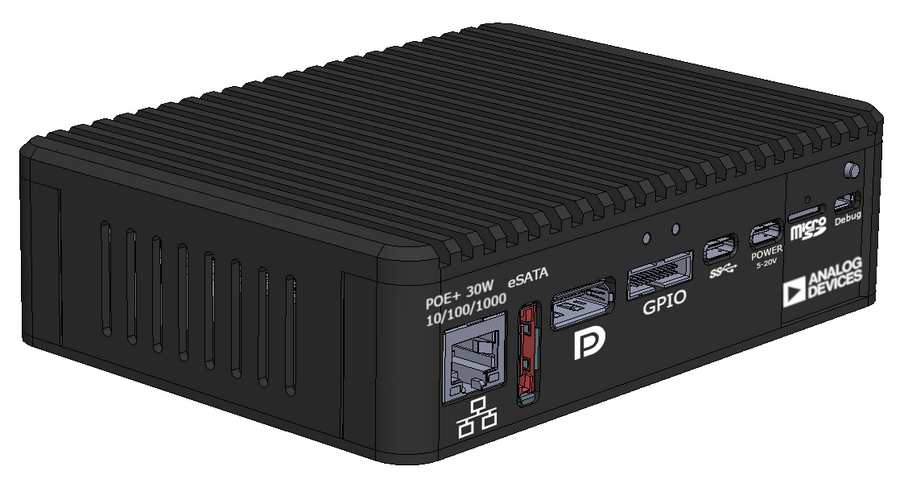
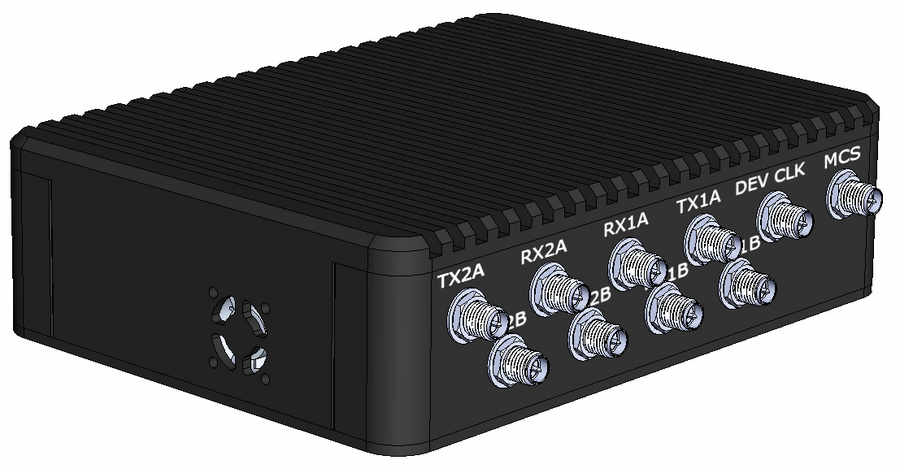
The platform comes with open-source software that includes:
Linux and no-OS
HDL reference design
IIO
MATLAB
GNU Radio
Python
Key Features
- RF/SDR
- ADRV9002 transceiver
2 x RX, 2 x TX
LO Frequency range 30 MHz to 6 GHz
12 KHz to 40 MHz frequency bandwidth
Sampling rate 12 KS/s to 61.44 MS/s
External device clock input
External MCS input
RF Front-end
- Processing system
- AMD Xilinx Zynq UltraScale+ MPSoC XCZU3EG
ARM CORTEX-A53 1.5GHz
ARM CORTEX-R5 500 MHz
Mali-400 MP2 graphic processor
Programmable logic 154k
DDR4 – 2 GB (x32)
- Boot source
SD CARD 3.0
FLASH memory 128MB
- User Interfaces
- USB 3.1 Gen 1 – Type C
Upstream Facing Port (UFP)
Downstream Facing Port (DFP)
USB 2.0 compatible
Ethernet 1000BASE-T RGMII
Display Port v1.2 (2 lanes 5.4Gb/s)
SATA 3
USB (micro) debug interface
16 GPIOs (3V3 LVCMOS)
- Power Sources
- USB Type-C (power only)
Power Sink 5V, 9V/3A
- USB Type-C (data)
Power Sink 5V/3A
Power Source 5V/0.9A
802.3at POE compliant, 25.5W Type2 (POE+)
Applications
Software-defined radio (SDR)
Electronic warfare
Radar
Communications
Spectrum monitoring
Test and measurement
Recommendations
People who follow the flow that is outlined, have a much better experience with things. However, like many things, documentation is never as complete as it should be. If you have any questions, check the Help and Support section at the bottom of the page.
To better understand the ADRV9002, we recommend to use the AD-JUPITER-EBZ evaluation board.
Table of contents
Using the evaluation board/full stack reference design that we offer:
Configure an SD Card with Using Kuiper Images
Linux Applications
Design with the ADRV9002
Hardware in the Loop / How to design your own custom baseband
Resources for designing a custom ADRV9002-based platform software
For Linux software:
About the device driver:
About the device tree:
For no-OS software:
Jupiter SDR HDL Reference Design which you must use in your FPGA.
Jupiter SDR Hardware Overview (see Jupiter SDR Hardware Overview)
Multi-chip synchronization support (see Jupiter_SDR MCS Setup)
Additional Documentation about SDR Signal Chains - The math behind the RF
Reference Material
Software Defined Radio using the Linux IIO Framework
ADI Articles
Four Quick Steps to Production: Using Model-Based Design for Software-Defined Radio
MathWorks Webinars
Help and support
Known issues (see Jupiter SDR - known issues)
For Hardware technical support go to:
For questions regarding the HDL reference design please use the
FPGA Reference Designs sub-community.
For questions regarding the ADI Linux distribution, the Linux drivers, or the device trees for the ADRV9001/2 based platforms, please use the
Linux Software Drivers sub-community.
For questions regarding the no-OS drivers for ADRV9001/2, please use the
Microcontroller and No-OS Driver sub-community.
All the products described on this page include ESD (electrostatic discharge) sensitive devices. Electrostatic charges as high as 4000V readily accumulate on the human body or test equipment and can discharge without detection. Although the boards feature ESD protection circuitry, permanent damage may occur on devices subjected to high-energy electrostatic discharges. Therefore, proper ESD precautions are recommended to avoid performance degradation or loss of functionality. This includes removing static charge on external equipment, cables, or antennas before connecting to the device.