AD719X-ASDZ HDL project
The AD719X-ASDZ HDL project supports the EVAL-AD719XASDZ family, comprised of EVAL-AD7190ASDZ, EVAL-AD7193ASDZ, EVAL-AD7195ASDZ, as well as the EVAL-AD4131-8, EVAL-AD4130-8 and EVAL-AD4129-8.
Each evaluation kit features its own chip, the AD7190, AD7193, AD7195, AD4131-4, AD4131-8, AD4130-4, AD4129-4 and AD4129-8 respectively - 4.8 kHz ultralow noise sigma-delta ADC, each with its own particularities.
The on-chip low noise gain stage means that signals of small amplitude can interface directly to the ADC. The internal clock option provides a compact solution for low BW requirements.
Supported boards
Supported devices
Supported carriers
Evaluation board |
Carrier |
Connector |
|---|---|---|
PMOD JA/Arduino shield |
||
Arduino shield |
||
PMOD JA/Arduino shield |
||
Arduino shield |
||
PMOD JA/Arduino shield |
||
Arduino shield |
||
PMOD JA/Arduino shield |
||
Arduino shield |
||
PMOD JA/Arduino shield |
||
Arduino shield |
||
PMOD JA/Arduino shield |
||
PMOD JA/Arduino shield |
||
PMOD JA/Arduino shield |
Block design
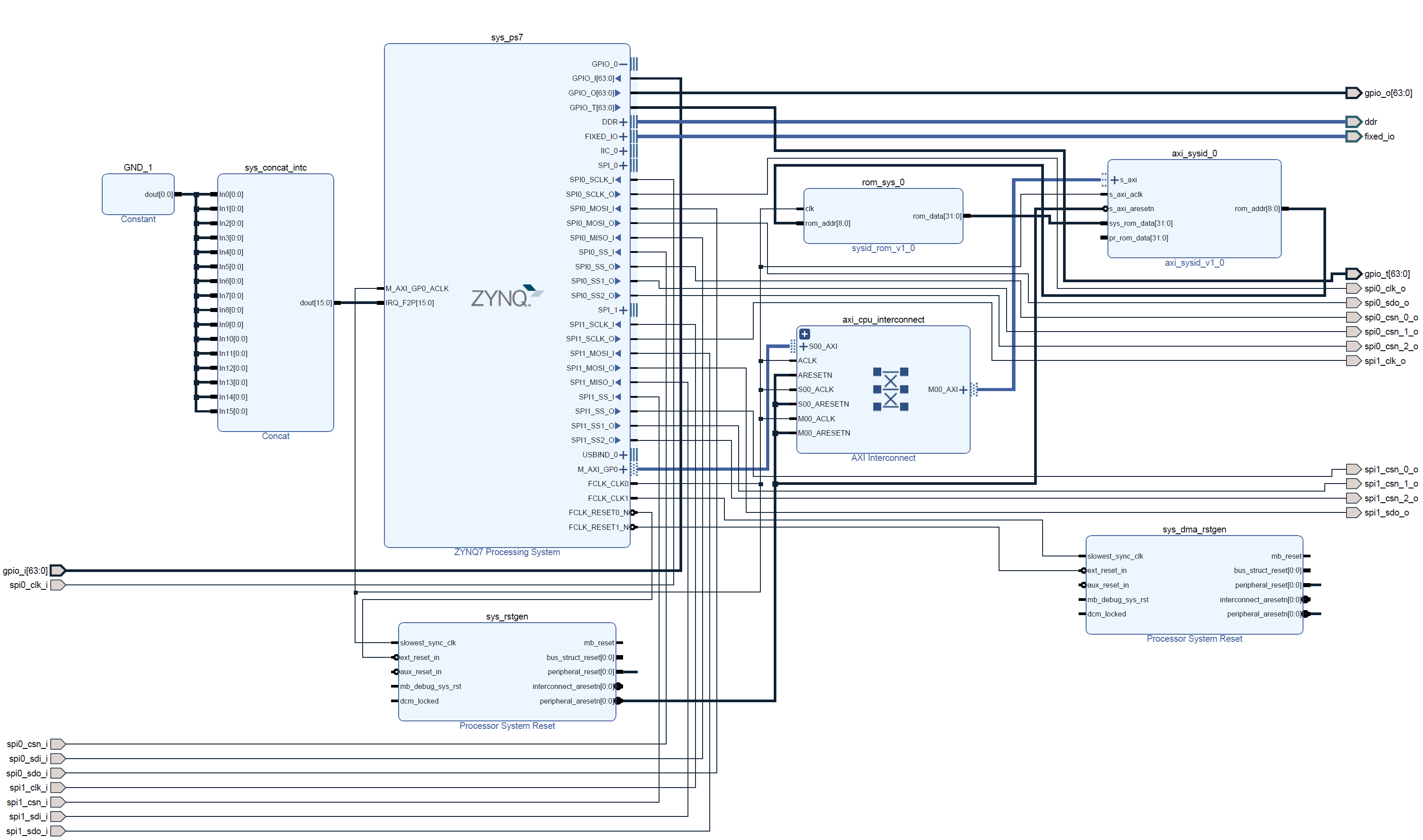
Block diagram
The data path and clock domains are depicted in the below diagram:
SPI connections
SPI type |
SPI manager instance |
SPI subordinate |
CS |
|---|---|---|---|
PS |
SPI 0 |
AD719X |
0 |
GPIOs
To know how the Software GPIO numbers are calculated, check out GPIOs - HDL Architecture page.
GPIO signal |
Direction |
HDL no. |
Zynq-7000 |
DE10-Nano |
|---|---|---|---|---|
ad719x_sync_n * |
OUT |
33 |
– |
1 |
ad719x_spi_miso * |
IN |
32 |
– |
0 |
adc_spi_miso_rdyn |
IN |
32 |
86 |
– |
adc_syncn ** |
INOUT |
33 |
87 |
– |
adc_int ** |
IN |
31 |
85 |
– |
Legend
GPIO signal = name of the GPIO in the HDL project
Direction = from the FPGA point of view
HDL no. = HDL GPIO EMIO
Zynq-7000, DE10-Nano are Software GPIOs, to be used in device trees
*- signals present only in the DE10-Nano project**- signals present only in the Cora Z7S project when built withARDZ_PMOD_N=1(eval. board connected through the Arduino header)adc_spi_miso_rdynis present in all Cora Z7S variants
Building the HDL project
The design is built upon ADI’s generic HDL reference design framework. ADI distributes the bit/elf files of these projects as part of the ADI Kuiper Linux. If you want to build the sources, ADI makes them available on the HDL repository. To get the source you must clone the HDL repository.
Cora Z7S
Linux/Cygwin/WSL
The default build configuration (ARDZ_PMOD_N=0) features the eval. boards
connected to Cora Z7S through PMOD JA:
~$
cd hdl/projects/ad719x_asdz/coraz7s
~/hdl/projects/ad719x_asdz/coraz7s$
make
The other possible way to connect the supported boards to CoraZ7S, is through
the Arduino header, for which the project needs to be built with the parameter
ARDZ_PMOD_N=1.
The built project will be located at hdl/projects/ad719x_asdz/coraz7s/ARDZPMODN1.
~$
cd hdl/projects/ad719x_asdz/coraz7s
~/hdl/projects/ad719x_asdz/coraz7s$
make ARDZ_PMOD_N=1
DE10-Nano
Linux/Cygwin/WSL
The only configuration available is through the Arduino header, so this project is not parameterizable:
~$
cd hdl/projects/ad719x_asdz/de10nano
~/hdl/projects/ad719x_asdz/de10nano$
make
A more comprehensive build guide can be found in the Build an HDL project user guide.
Software considerations
The reference design when using the Arduino header, has an extra GPIO, compared to the other one — the SYNCN, which is used for synchronizing multiple devices.
Resources
More information
Support
Analog Devices, Inc. will provide limited online support for anyone using the reference design with ADI components via the EngineerZone FPGA reference designs forum.
For questions regarding the ADI Linux device drivers, device trees, etc. from our Linux GitHub repository, the team will offer support on the EngineerZone Linux software drivers forum.
For questions concerning the ADI No-OS drivers, from our No-OS GitHub repository, the team will offer support on the EngineerZone microcontroller No-OS drivers forum.
It should be noted, that the older the tools’ versions and release branches are, the lower the chances to receive support from ADI engineers.