EVAL-AD6676
Wideband IF Receiver Subsystem
Overview
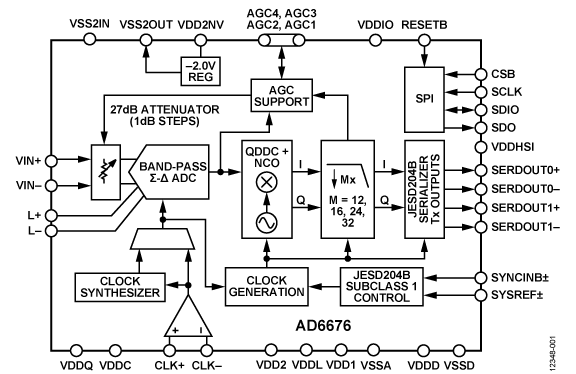
The AD6676 is a highly integrated IF subsystem that can digitize radio frequency (RF) bands up to 160 MHz in width centered on an intermediate frequency (IF) of 70 MHz to 450 MHz. Unlike traditional Nyquist IF sampling ADCs, the AD6676 relies on a tunable band-pass Σ-Δ ADC with a high oversampling ratio to eliminate the need for band specific IF SAW filters and gain stages, resulting in significant simplification of the wideband radio receiver architecture. On-chip quadrature digital downconversion followed by selectable decimation filters reduces the complex data rate to a manageable rate between 62.5 MSPS to 266.7 MSPS. The 16-bit complex output data is transferred to the host via a single or dual lane JESD204B interface supporting line rates of up to 5.333 Gbps.
Features:
High instantaneous dynamic range
Noise figure (NF) as low as 13 dB
Noise spectral density (NSD) as low as −159 dBFS/Hz
IIP3 up to 36.9 dBm with spurious tones <−99 dBFS
Tunable band-pass Σ-Δ analog-to-digital converter (ADC)
20 MHz to 160 MHz signal bandwidth
70 MHz to 450 MHz IF center frequency
Configurable input full-scale level of −2 dBm to −14 dBm
Gain flatness of 1 dB with under 0.5 dB out-of-band peaking
2.0 GSPS to 3.2 GSPS ADC clock rate
16-bit I/Q rate up to 266 MSPS
On-chip digital signal processing
NCO and quadrature digital downconverter (QDDC)
Selectable decimation factor of 12, 16, 24, and 32
Automatic gain control (AGC) support
On-chip attenuator with 27 dB span in 1 dB steps
Fast attenuator control via configurable AGC data port
Peak detection flags with programmable thresholds
Single or dual lane, JESD204B capable
Low power consumption: 1.20 W
1.1 V and 2.5 V supply voltage
TDD power saving up to 60%
4.3 mm × 5.0 mm WLCSP
Applications:
Wideband cellular infrastructure equipment and repeaters
Point-to-point microwave equipment
Instrumentation
Spectrum and communication analyzers
Software defined radio
Recommendation
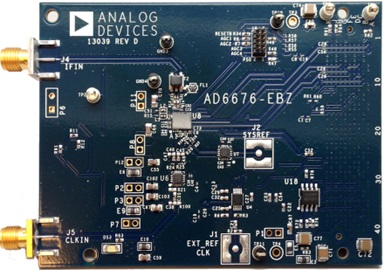
To better understand the AD6676, we recommend to use the EVAL-AD6676 evaluation board.
Table of contents
Using the evaluation board/full stack reference design that we offer:
EVAL-AD6676 Quick Start Guides:
Using the ZC706
Configure an SD Card with Kuiper
Software Solutions
Design with the AD6676
Resources for designing a custom AD6676-based platform software
For Linux software:
About the device driver:
For no-OS software:
FPGA Resources:
HDL reference design which you must use in your FPGA.
Block diagram
Additional information
Application notes
AN-835 Application Note, Understanding ADC Testing and Evaluation
AN-877 Application Note, Interfacing to High Speed ADCs via SPI
Design tools
Help and support
People who follow the flow that is outlined, have a much better experience with things. However, like many things, documentation is never as complete as it should be. If you have any questions, feel free to ask on the EngineerZone technical support community, but before that, please make sure you read our documentation thoroughly.
Warning
All the products described on this page include ESD (electrostatic discharge) sensitive devices. Electrostatic charges as high as 4000V readily accumulate on the human body or test equipment and can discharge without detection. Although the boards feature ESD protection circuitry, permanent damage may occur on devices subjected to high-energy electrostatic discharges. Therefore, proper ESD precautions are recommended to avoid performance degradation or loss of functionality. This includes removing static charge on external equipment, cables, or antennas before connecting to the device.