

QUAD_ADAQ77681 HDL project
Overview
The ADAQ7768-1 is a 24-bit precision data acquisition (DAQ) μModule system that encapsulates signal conditioning, conversion, and processing blocks into one system-in-package (SiP) design for the rapid development of highly compact, high-performance precision DAQ systems.
The ADAQ7768-1 consists of a low-noise, low-bias current, high-bandwidth programmable gain instrumentation amplifier (PGIA) also capable of signal amplification and signal attenuation while maintaining high input impedance, a fourth-order, low-noise, linear phase anti-aliasing filter, a low-noise, low-distortion, high-bandwidth ADC driver plus an optional linearity boost buffer. Also, contains a high-performance medium bandwidth 24-bit Σ-Δ ADC with programmable digital filter,a low-noise, low-dropout linear regulator, reference buffers and critical passive components required for the signal chain.
The ADAQ7768-1 supports fully differential input signal with a maximum range of ±12.6 V. It has an input common-mode voltage range of ±12 V with excellent common-mode rejection ratio (CMRR). The input signal is fully buffered with very low input bias current of 2 pA typical. This allows easy input impedance matching and enables the ADAQ7768-1 to directly interface to sensors with high output impedance.
The analog-to-digital converter (ADC) inside the ADAQ7768-1 is a high-performance, 24-bit precision, single-channel sigma-delta converter with excellent AC performance and DC precision, and the throughput rate of 256 kSPS from a 16.384 MHz MCLK.
The ADAQ7768-1 device has an operating temperature range of −40°C to +85°C and is available in a 12.00 mm × 6.00 mm 84-ball CSP_BGA package with an 0.80 mm ball pitch, which makes it ideal for multiple channel applications.
Supported boards
QUAD_AD77681 EvalPlus Signal Chain Board
Supported devices
Supported carriers
ZedBoard on FMC slot
Block design
Block diagram
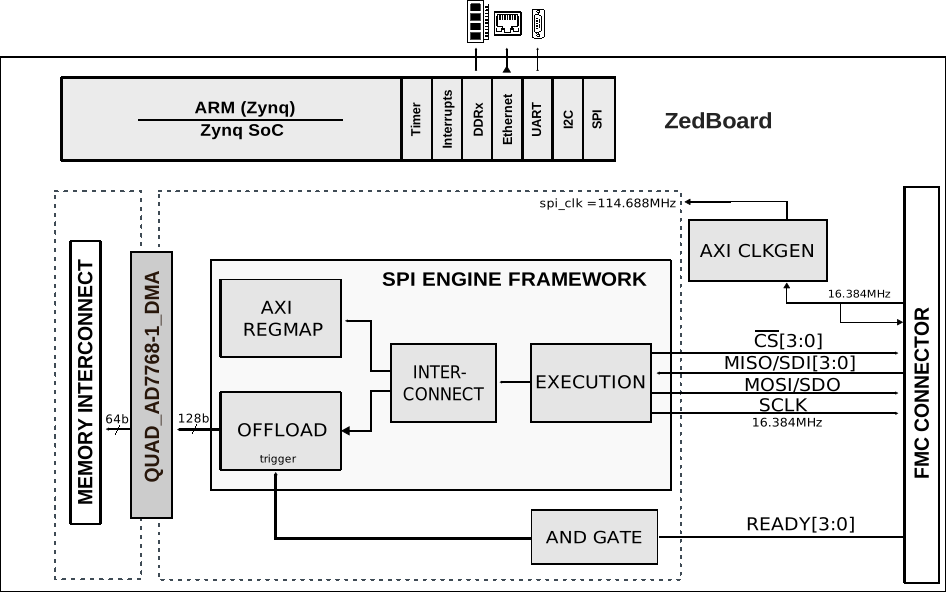
The data path and clock domains are depicted in the below diagram:
QUAD_ADAQ77681
CPU/Memory interconnects addresses
The addresses are dependent on the architecture of the FPGA, having an offset added to the base address from HDL (see more at HDL Architecture).
Instance |
Zynq |
|---|---|
quad_adaq77681_axi_regmap |
0x44A0_0000 |
axi_qadc_dma |
0x44A3_0000 |
mclk_clkgen |
0x44B0_0000 |
I2C connections
I2C type |
I2C manager instance |
Alias |
Address |
I2C subordinate |
|---|---|---|---|---|
PL |
iic_fmc |
axi_iic_fmc |
0x4162_0000 |
— |
PL |
iic_main |
axi_iic_main |
0x4160_0000 |
— |
SPI connections
SPI type |
SPI manager instance |
SPI subordinate |
CS |
|---|---|---|---|
PL |
axi_spi_engine |
quad_adaq77681 |
0 |
GPIOs
The Software GPIO number is calculated as follows:
Zynq-7000: if PS7 is used, then offset is 54
GPIO signal |
Direction |
HDL GPIO EMIO |
Software GPIO |
|---|---|---|---|
(from FPGA view) |
Zynq-7000 |
||
quad_adaq77681_out_drdy |
INOUT |
45 |
99 |
qadc_pgood[3:0] |
INOUT |
44:41 |
98:95 |
qadc_muxa[1:0] |
INOUT |
40:39 |
94:93 |
qadc_muxb[1:0] |
INOUT |
38:37 |
92:91 |
qadc_muxc[1:0] |
INOUT |
36:35 |
90:89 |
qadc_muxd[1:0] |
INOUT |
34:33 |
88:87 |
qadc_sync |
INOUT |
32 |
86 |
Interrupts
Below are the Programmable Logic interrupts used in this project.
Instance name |
HDL |
Linux Zynq |
Actual Zynq |
|---|---|---|---|
axi_qadc_dma |
13 |
57 |
89 |
quad_adaq77681 |
12 |
56 |
88 |
Building the HDL project
The design is built upon ADI’s generic HDL reference design framework. ADI distributes the bit/elf files of these projects as part of the ADI Kuiper Linux. If you want to build the sources, ADI makes them available on the HDL repository. To get the source you must clone the HDL repository, and then build the project as follows:
Linux/Cygwin/WSL
1user@analog:~$ cd hdl/projects/quad_adaq77681/zed
2user@analog:~/hdl/projects/quad_adaq77681/zed$ make
A more comprehensive build guide can be found in the Build an HDL project user guide.
More information
Support
Analog Devices, Inc. will provide limited online support for anyone using the reference design with ADI components via the EngineerZone FPGA reference designs forum.
For questions regarding the ADI Linux device drivers, device trees, etc. from our Linux GitHub repository, the team will offer support on the EngineerZone Linux software drivers forum.
For questions concerning the ADI No-OS drivers, from our No-OS GitHub repository, the team will offer support on the EngineerZone microcontroller No-OS drivers forum.
It should be noted, that the older the tools’ versions and release branches are, the lower the chances to receive support from ADI engineers.