

AXI AD9740
The AXI AD9740 IP core can be used to interface the AD9740, AD9742, AD9744 or AD9748 devices. It is a DAC with 8, 10, 12 or 14 bits resolution and with sample rates up to 210 MSPS (per datasheet). The reference design uses a 250 MHz external clock from the ADF4351, achieving up to 250 MSPS DAC update rate using DDR output. This documentation only covers the IP core and requires that one must be familiar with the device for a complete and better understanding.
More about the generic framework interfacing DACs can be read in Generic AXI DAC.
Features
AXI Lite control/status interface
32-bit DMA data interface (2 x 16-bit samples per transfer)
DDR output via Xilinx ODDR primitives (CLK_RATIO=2)
Configurable DAC resolution (8/10/12/14-bit via DAC_RESOLUTION parameter)
Multiple data source modes:
DDS - Direct Digital Synthesis with dual-tone support
DMA - Data streaming from memory
Ramp - Internal test pattern generator
Sedation - Zero output (mute)
Data format conversion (two’s complement to offset binary via MSB inversion)
MSB-aligned 14-bit data path for all resolutions, with unused lower bits held at zero
Files
Name |
Description |
|---|---|
Verilog source for the AXI AD9740 top module. |
|
Verilog source for the AXI AD9740 core. |
|
Verilog source for the AXI AD9740 channel processing. |
|
Verilog source for the AXI AD9740 DDR output interface. |
|
Verilog source for the DAC Common regmap. |
|
Verilog source for the DAC Channel regmap. |
Functional Description
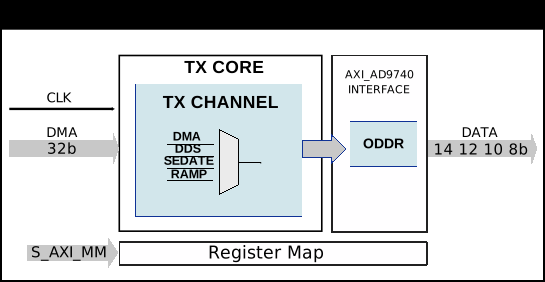
The axi_ad9740 cores architecture contains:
Interface module for Xilinx devices. Uses ODDR primitives to output two 14-bit samples per clock cycle in DDR mode (CLK_RATIO=2). Handles data format conversion (two’s complement to offset binary) by inverting the MSB when enabled. For DAC resolutions below 14 bits, unused lower output bits are driven to zero through dedicated ODDR instances.
Transmit module, which contains:
AXI control and status modules.
Block Diagram
Configuration Parameters
Name |
Description |
Default Value |
Choices/Range |
|---|---|---|---|
ID |
Core ID should be unique for each IP in the system |
0 |
|
FPGA_TECHNOLOGY |
Encoded value describing the technology/generation of the FPGA device (e.g., 1=7series, 2=ultrascale, 3=ultrascale+, 4=versal). Auto-set in project. |
0 |
Unknown (0), 7series (1), ultrascale (2), ultrascale+ (3), versal (4) |
FPGA_FAMILY |
Encoded value describing the family variant of the FPGA device (e.g., 1=artix, 2=kintex, 3=virtex, 4=zynq). Auto-set in project. |
0 |
Unknown (0), artix (1), kintex (2), virtex (3), zynq (4), versalprime (5), versalaicore (6), versalpremium (7) |
SPEED_GRADE |
Encoded value describing the FPGA’s speed-grade. Auto-set in project. |
0 |
Unknown (0), -1 (10), -1L (11), -1H (12), -1HV (13), -1LV (14), -2 (20), -2L (21), -2LV (22), -2MP (23), -2LVC (24), -2LVI (25), -3 (30) |
DEV_PACKAGE |
Encoded value describing the device package. The package might affect high-speed interfaces. Auto-set in project. |
0 |
Unknown (0), rf (1), fl (2), ff (3), fb (4), hc (5), fh (6), cs (7), cp (8), ft (9), fg (10), sb (11), rb (12), rs (13), cl (14), sf (15), ba (16), fa (17), fs (18), fi (19), vs (20), ls (21) |
DAC_RESOLUTION |
Sets the DAC resolution in bits. Valid values are 8, 10, 12, or 14 corresponding to the target device: AD9748 (8-bit), AD9740 (10-bit), AD9742 (12-bit), or AD9744 (14-bit). This parameter controls the DDS output width and the DMA data alignment. Default value is 14. |
14 |
8, 10, 12, 14 |
CLK_RATIO |
Number of samples processed per clock cycle. Fixed at 2 for DDR output (two samples per clock via ODDR primitives). This parameter determines the DMA data bus width (32 bits) and the internal data path width (28 bits). Default value is 2. |
2 |
1, 2 |
DDS_DISABLE |
Disable the DDS logic to save FPGA resources when not needed. Set to 1 to disable. Default value is 0. |
0 |
|
DDS_TYPE |
Selects the DDS phase-to-amplitude converter implementation. Set to 1 for CORDIC (better precision) or 2 for Polynomial (uses more DSPs but fewer LUTs). Default value is 1. |
1 |
|
DDS_CORDIC_DW |
CORDIC DDS data width, range 8-24. Default value is 14. The reference design sets this to 22 for higher precision. |
14 |
|
DDS_CORDIC_PHASE_DW |
Number of CORDIC rotation stages, range 8-24. Higher values provide better precision at the cost of more resources. Default value is 14. The reference design sets this to 22. |
14 |
Interface
Physical Port |
Logical Port |
Direction |
Dependency |
|---|---|---|---|
s_axi_awaddr |
AWADDR |
in [15:0] |
|
s_axi_awprot |
AWPROT |
in [2:0] |
|
s_axi_awvalid |
AWVALID |
in |
|
s_axi_awready |
AWREADY |
out |
|
s_axi_wdata |
WDATA |
in [31:0] |
|
s_axi_wstrb |
WSTRB |
in [3:0] |
|
s_axi_wvalid |
WVALID |
in |
|
s_axi_wready |
WREADY |
out |
|
s_axi_bresp |
BRESP |
out [1:0] |
|
s_axi_bvalid |
BVALID |
out |
|
s_axi_bready |
BREADY |
in |
|
s_axi_araddr |
ARADDR |
in [15:0] |
|
s_axi_arprot |
ARPROT |
in [2:0] |
|
s_axi_arvalid |
ARVALID |
in |
|
s_axi_arready |
ARREADY |
out |
|
s_axi_rdata |
RDATA |
out [31:0] |
|
s_axi_rresp |
RRESP |
out [1:0] |
|
s_axi_rvalid |
RVALID |
out |
|
s_axi_rready |
RREADY |
in |
Physical Port |
Logical Port |
Direction |
Dependency |
|---|---|---|---|
s_axi_aclk |
CLK |
in |
Physical Port |
Logical Port |
Direction |
Dependency |
|---|---|---|---|
s_axi_aresetn |
RST |
in |
Physical Port |
Logical Port |
Direction |
Dependency |
|---|---|---|---|
dac_clk |
CLK |
in |
Physical Port |
Logical Port |
Direction |
Dependency |
|---|---|---|---|
dma_ready |
TREADY |
out |
|
dma_valid |
TVALID |
in |
|
dma_data |
TDATA |
in [31:0] |
Physical Port |
Direction |
Dependency |
Description |
|---|---|---|---|
dac_data |
out [13:0] |
14-bit DDR output to DAC via ODDR primitives. For DAC resolutions below 14 bits, the lower (14 - DAC_RESOLUTION) bits are held at zero. Active data bits are MSB-aligned. |
Register Map
The register map of the core contains instances of several generic register maps like DAC common and DAC channel. The following table presents the base addresses of each instance, after that can be found the detailed description of each generic register map. The absolute address of a register should be calculated by adding the instance base address to the registers relative address.
DWORD |
BYTE |
Name |
Description |
|---|---|---|---|
0x0000 |
0x0000 |
TX COMMON |
See the DAC Common table for more details. |
0x0100 |
0x0400 |
TX CHANNEL |
See the DAC Channel table for more details. |
Address |
Reg Name |
|||||
|---|---|---|---|---|---|---|
HDL |
DWORD |
BITS |
Field Name |
Type |
Default Value |
Description |
0x0 |
0x0 |
VERSION |
Version and Scratch Registers |
|||
[31:0] |
VERSION |
RO |
0x00000000 |
Version number. Unique to all cores. |
||
0x1 |
0x4 |
ID |
Version and Scratch Registers |
|||
[31:0] |
ID |
RO |
0x00000000 |
Instance identifier number. |
||
0x2 |
0x8 |
SCRATCH |
Version and Scratch Registers |
|||
[31:0] |
SCRATCH |
RW |
0x00000000 |
Scratch register. |
||
0x3 |
0xc |
CONFIG |
Version and Scratch Registers |
|||
[0] |
IQCORRECTION_DISABLE |
RO |
0x0 |
If set, indicates that the IQ Correction module was not implemented. (as a result of a configuration of the IP instance) |
||
[1] |
DCFILTER_DISABLE |
RO |
0x0 |
If set, indicates that the DC Filter module was not implemented. (as a result of a configuration of the IP instance) |
||
[2] |
DATAFORMAT_DISABLE |
RO |
0x0 |
If set, indicates that the Data Format module was not implemented. (as a result of a configuration of the IP instance) |
||
[3] |
USERPORTS_DISABLE |
RO |
0x0 |
If set, indicates that the logic related to the User Data Format (e.g. decimation) was not implemented. (as a result of a configuration of the IP instance) |
||
[4] |
MODE_1R1T |
RO |
0x0 |
If set, indicates that the core was implemented in 1 channel mode. (e.g. refer to AD9361 data sheet) |
||
[5] |
DELAY_CONTROL_DISABLE |
RO |
0x0 |
If set, indicates that the delay control is disabled for this IP. (as a result of a configuration of the IP instance) |
||
[6] |
DDS_DISABLE |
RO |
0x0 |
If set, indicates that the DDS is disabled for this IP. (as a result of a configuration of the IP instance) |
||
[7] |
CMOS_OR_LVDS_N |
RO |
0x0 |
CMOS or LVDS mode is used for the interface. (as a result of a configuration of the IP instance) |
||
[8] |
PPS_RECEIVER_ENABLE |
RO |
0x0 |
If set, indicates the PPS receiver is enabled. (as a result of a configuration of the IP instance) |
||
[9] |
SCALECORRECTION_ONLY |
RO |
0x0 |
If set, indicates that the IQ Correction module implements only scale correction. IQ correction must be enabled. (as a result of a configuration of the IP instance) |
||
[12] |
EXT_SYNC |
RO |
0x0 |
If set the transport layer cores (ADC/DAC) have implemented the support for external synchronization signal. |
||
[13] |
RD_RAW_DATA |
RO |
0x0 |
If set, the ADC has the capability to read raw data in register CHAN_RAW_DATA from adc_channel. |
||
0x4 |
0x10 |
PPS_IRQ_MASK |
PPS Interrupt mask |
|||
[0] |
PPS_IRQ_MASK |
RW |
0x1 |
Mask bit for the 1PPS receiver interrupt |
||
0x7 |
0x1c |
FPGA_INFO |
FPGA device information library/scripts/adi_intel_device_info_enc.tcl (Intel encoded values) library/scripts/adi_xilinx_device_info_enc.tcl (Xilinx encoded values) |
|||
[31:24] |
FPGA_TECHNOLOGY |
RO |
0x00 |
Encoded value describing the technology/generation of the FPGA device (arria 10/7series) |
||
[23:16] |
FPGA_FAMILY |
RO |
0x00 |
Encoded value describing the family variant of the FPGA device(e.g., SX, GX, GT or zynq, kintex, virtex) |
||
[15:8] |
SPEED_GRADE |
RO |
0x00 |
Encoded value describing the FPGA’s speed-grade |
||
[7:0] |
DEV_PACKAGE |
RO |
0x00 |
Encoded value describing the device package. The package might affect high-speed interfaces |
||
Address |
Reg Name |
|||||
|---|---|---|---|---|---|---|
HDL |
DWORD |
BITS |
Field Name |
Type |
Default Value |
Description |
0x10 |
0x40 |
RSTN |
DAC Interface Control & Status |
|||
[2] |
CE_N |
RW |
0x0 |
Clock enable, default is enabled(0x0). An inverse version of the signal is exported out of the module to control clock enables |
||
[1] |
MMCM_RSTN |
RW |
0x0 |
MMCM reset only (required for DRP access). Reset, default is IN-RESET (0x0), software must write 0x1 to bring up the core. |
||
[0] |
RSTN |
RW |
0x0 |
Reset, default is IN-RESET (0x0), software must write 0x1 to bring up the core. |
||
0x11 |
0x44 |
CNTRL_1 |
DAC Interface Control & Status |
|||
[0] |
SYNC |
RW |
0x0 |
Setting this bit synchronizes channels within a DAC, and across multiple instances. This bit self clears. |
||
[1] |
EXT_SYNC_ARM |
RW |
0x0 |
Setting this bit will arm the trigger mechanism sensitive to an external sync signal. Once the external sync signal goes high it synchronizes channels within a DAC, and across multiple instances. This bit has an effect only the EXT_SYNC synthesis parameter is set. This bit self clears. |
||
[2] |
EXT_SYNC_DISARM |
RW |
0x0 |
Setting this bit will disarm the trigger mechanism sensitive to an external sync signal. This bit has an effect only the EXT_SYNC synthesis parameter is set. This bit self clears. |
||
[8] |
MANUAL_SYNC_REQUEST |
RW |
0x0 |
Setting this bit will issue an external sync event if it is hooked up inside the fabric. This bit has an effect only the EXT_SYNC synthesis parameter is set. This bit self clears. |
||
0x12 |
0x48 |
CNTRL_2 |
DAC Interface Control & Status |
|||
[16] |
SDR_DDR_N |
RW |
0x0 |
Interface type (1 represents SDR, 0 represents DDR) |
||
[15] |
SYMB_OP |
RW |
0x0 |
Select data symbol format mode (0x1) |
||
[14] |
SYMB_8_16B |
RW |
0x0 |
Select number of bits for symbol format mode (1 represents 8b, 0 represents 16b) |
||
[12:8] |
NUM_LANES |
RW |
0x00 |
Number of active lanes (1 : CSSI 1-lane, LSSI 1-lane, 2 : LSSI 2-lane, 4 : CSSI 4-lane) |
||
[7] |
PAR_TYPE |
RW |
0x0 |
Select parity even (0x0) or odd (0x1). |
||
[6] |
PAR_ENB |
RW |
0x0 |
Select parity (0x1) or frame (0x0) mode. |
||
[5] |
R1_MODE |
RW |
0x0 |
Select number of RF channels 1 (0x1) or 2 (0x0). |
||
[4] |
DATA_FORMAT |
RW |
0x0 |
Select data format 2’s complement (0x0) or offset binary (0x1). NOT-APPLICABLE if DAC_DP_DISABLE is set (0x1). |
||
[3:0] |
RESERVED |
NA |
0x0 |
Reserved |
||
0x13 |
0x4c |
RATECNTRL |
DAC Interface Control & Status |
|||
[7:0] |
RATE |
RW |
0x00 |
The effective dac rate (the maximum possible rate is dependent on the interface clock). The samples are generated at 1/RATE of the interface clock. |
||
0x14 |
0x50 |
FRAME |
DAC Interface Control & Status |
|||
[0] |
FRAME |
RW |
0x0 |
The use of frame is device specific. Usually setting this bit to 1 generates a FRAME (1 DCI clock period) pulse on the interface. This bit self clears. |
||
0x15 |
0x54 |
STATUS1 |
DAC Interface Control & Status |
|||
[31:0] |
CLK_FREQ |
RO |
0x00000000 |
Interface clock frequency. This is relative to the processor clock and in many cases is 100MHz. The number is represented as unsigned 16.16 format. Assuming a 100MHz processor clock the minimum is 1.523kHz and maximum is 6.554THz. The actual interface clock is CLK_FREQ * CLK_RATIO (see below). Note that the actual sampling clock may not be the same as the interface clock- software must consider device specific implementation parameters to calculate the final sampling clock. |
||
0x16 |
0x58 |
STATUS2 |
DAC Interface Control & Status |
|||
[31:0] |
CLK_RATIO |
RO |
0x00000000 |
Interface clock ratio - as a factor actual received clock. This is implementation specific and depends on any serial to parallel conversion and interface type (ddr/sdr/qdr). |
||
0x17 |
0x5c |
STATUS3 |
DAC Interface Control & Status |
|||
[0] |
STATUS |
RO |
0x0 |
Interface status, if set indicates no errors. If not set, there are errors, software may try resetting the cores. |
||
0x18 |
0x60 |
DAC_CLKSEL |
DAC Interface Control & Status |
|||
[0] |
DAC_CLKSEL |
RW |
0x0 |
Allows changing of the clock polarity. Note: its default value is CLK_EDGE_SEL |
||
0x1a |
0x68 |
SYNC_STATUS |
DAC Synchronization Status register |
|||
[0] |
DAC_SYNC_STATUS |
RO |
0x0 |
DAC synchronization status. Will be set to 1 while waiting for the external synchronization signal This bit has an effect only the EXT_SYNC synthesis parameter is set. |
||
0x1c |
0x70 |
DRP_CNTRL |
DRP Control & Status |
|||
[28] |
DRP_RWN |
RW |
0x0 |
DRP read (0x1) or write (0x0) select (does not include GTX lanes). NOT-APPLICABLE if DRP_DISABLE is set (0x1). |
||
[27:16] |
DRP_ADDRESS |
RW |
0x000 |
DRP address, designs that contain more than one DRP accessible primitives have selects based on the most significant bits (does not include GTX lanes). NOT-APPLICABLE if DRP_DISABLE is set (0x1). |
||
[15:0] |
RESERVED |
RO |
0x0000 |
Reserved for backwards compatibility |
||
0x1d |
0x74 |
DRP_STATUS |
DAC Interface Control & Status |
|||
[17] |
DRP_LOCKED |
RO |
0x0 |
If set indicates the MMCM/PLL is locked |
||
[16] |
DRP_STATUS |
RO |
0x0 |
If set indicates busy (access pending). The read data may not be valid if this bit is set (does not include GTX lanes). NOT-APPLICABLE if DRP_DISABLE is set (0x1). |
||
[15:0] |
RESERVED |
RO |
0x0000 |
Reserved for backwards compatibility |
||
0x1e |
0x78 |
DRP_WDATA |
DAC Interface Control & Status |
|||
[15:0] |
DRP_WDATA |
RW |
0x0000 |
DRP write data (does not include GTX lanes). NOT-APPLICABLE if DRP_DISABLE is set (0x1). |
||
0x1f |
0x7c |
DRP_RDATA |
DAC Interface Control & Status |
|||
[15:0] |
DRP_RDATA |
RO |
0x0000 |
DRP read data (does not include GTX lanes). NOT-APPLICABLE if DRP_DISABLE is set (0x1). |
||
0x20 |
0x80 |
DAC_CUSTOM_RD |
DAC Read Configuration Data |
|||
[31:0] |
DAC_CUSTOM_RD |
RO |
0x00000000 |
Custom Read of the available registers. |
||
0x21 |
0x84 |
DAC_CUSTOM_WR |
DAC Write Configuration Data |
|||
[31:0] |
DAC_CUSTOM_WR |
RW |
0x00000000 |
Custom Write of the available registers. |
||
0x22 |
0x88 |
UI_STATUS |
User Interface Status |
|||
[4] |
IF_BUSY |
RO |
0x0 |
Interface busy. If set, indicates that the data interface is busy. |
||
[1] |
UI_OVF |
RW1C |
0x0 |
User Interface overflow. If set, indicates an overflow occurred during data transfer at the user interface (FIFO interface). Software must write a 0x1 to clear this register bit. |
||
[0] |
UI_UNF |
RW1C |
0x0 |
User Interface underflow. If set, indicates an underflow occurred during data transfer at the user interface (FIFO interface). Software must write a 0x1 to clear this register bit. |
||
0x23 |
0x8c |
DAC_CUSTOM_CTRL |
DAC Control Configuration Data |
|||
[31:0] |
DAC_CUSTOM_CTRL |
RW |
0x00000000 |
Custom Control of the available registers. |
||
0x28 |
0xa0 |
USR_CNTRL_1 |
DAC User Control & Status |
|||
[7:0] |
USR_CHANMAX |
RW |
0x00 |
This indicates the maximum number of inputs for the channel data multiplexers. User may add different processing modules as inputs to the dac. NOT-APPLICABLE if USERPORTS_DISABLE is set (0x1). |
||
0x2e |
0xb8 |
DAC_GPIO_IN |
DAC GPIO inputs |
|||
[31:0] |
DAC_GPIO_IN |
RO |
0x00000000 |
This reads auxiliary GPI pins of the DAC core |
||
0x2f |
0xbc |
DAC_GPIO_OUT |
DAC GPIO outputs |
|||
[31:0] |
DAC_GPIO_OUT |
RW |
0x00000000 |
This controls auxiliary GPO pins of the DAC core NOT-APPLICABLE if GPIO_DISABLE is set (0x1). |
||
Address |
Reg Name |
|||||
|---|---|---|---|---|---|---|
HDL |
DWORD |
BITS |
Field Name |
Type |
Default Value |
Description |
0x100 + 0x10*n |
0x400 + 0x40*n |
CHAN_CNTRLn_1 |
DAC Channel Control & Status (channel - 0) Where n is from 0 to 15. |
|||
[21:16] |
DDS_PHASE_DW |
RO |
0x00 |
The DDS phase data width offers the HDL parameter configuration with the same name. This information is used in conjunction with CHAN_CNTRL_9 and CHAN_CNTRL_10. More info at AD Direct Digital Synthesis. |
||
[15:0] |
DDS_SCALE_1 |
RW |
0x0000 |
The DDS scale for tone 1. Sets the amplitude of the tone. The format is 1.1.14 fixed point (signed, integer, fractional). The DDS in general runs on 16-bits, note that if you do use both channels and set both scale to 0x4000, it is over-range. The final output is (tone_1_fullscale * scale_1) + (tone_2_fullscale * scale_2). NOT-APPLICABLE if DDS_DISABLE is set (0x1). |
||
0x101 + 0x10*n |
0x404 + 0x40*n |
CHAN_CNTRLn_2 |
DAC Channel Control & Status (channel - 0) Where n is from 0 to 15. |
|||
[31:16] |
DDS_INIT_1 |
RW |
0x0000 |
The DDS phase initialization for tone 1. Sets the initial phase offset of the tone. NOT-APPLICABLE if DDS_DISABLE is set (0x1). |
||
[15:0] |
DDS_INCR_1 |
RW |
0x0000 |
Sets the frequency of the phase accumulator. Its value can be calculated by \(INCR = (f_{out} * 2^{16}) * clkratio / f_{if}\); where f_out is the generated output frequency, and f_if is the frequency of the digital interface, and clock_ratio is the ratio between the sampling clock and the interface clock. If DDS_PHASE_DW is greater than 16(from CHAN_CNTRL_1), the phase increment for tone 1 is extended in CHAN_CNTRL_9. NOT-APPLICABLE if DDS_DISABLE is set (0x1). |
||
0x102 + 0x10*n |
0x408 + 0x40*n |
CHAN_CNTRLn_3 |
DAC Channel Control & Status (channel - 0) Where n is from 0 to 15. |
|||
[15:0] |
DDS_SCALE_2 |
RW |
0x0000 |
The DDS scale for tone 2. Sets the amplitude of the tone. The format is 1.1.14 fixed point (signed, integer, fractional). The DDS in general runs on 16-bits, note that if you do use both channels and set both scale to 0x4000, it is over-range. The final output is (tone_1_fullscale * scale_1) + (tone_2_fullscale * scale_2). NOT-APPLICABLE if DDS_DISABLE is set (0x1). |
||
0x103 + 0x10*n |
0x40c + 0x40*n |
CHAN_CNTRLn_4 |
DAC Channel Control & Status (channel - 0) Where n is from 0 to 15. |
|||
[31:16] |
DDS_INIT_2 |
RW |
0x0000 |
The DDS phase initialization for tone 2. Sets the initial phase offset of the tone. If DDS_PHASE_DW is greater than 16(from CHAN_CNTRL_1), the phase init for tone 2 is extended in CHAN_CNTRL_10. NOT-APPLICABLE if DDS_DISABLE is set (0x1). |
||
[15:0] |
DDS_INCR_2 |
RW |
0x0000 |
Sets the frequency of the phase accumulator. Its value can be calculated by \(INCR = (f_{out} * 2^{16}) * clkratio / f_{if}\); where f_out is the generated output frequency, and f_if is the frequency of the digital interface, and clock_ratio is the ratio between the sampling clock and the interface clock. If DDS_PHASE_DW is greater than 16(from CHAN_CNTRL_1), the phase increment for tone 2 is extended in CHAN_CNTRL_10. NOT-APPLICABLE if DDS_DISABLE is set (0x1). |
||
0x104 + 0x10*n |
0x410 + 0x40*n |
CHAN_CNTRLn_5 |
DAC Channel Control & Status (channel - 0) Where n is from 0 to 15. |
|||
[31:16] |
DDS_PATT_2 |
RW |
0x0000 |
The DDS data pattern for this channel. |
||
[15:0] |
DDS_PATT_1 |
RW |
0x0000 |
The DDS data pattern for this channel. |
||
0x105 + 0x10*n |
0x414 + 0x40*n |
CHAN_CNTRLn_6 |
DAC Channel Control & Status (channel - 0) Where n is from 0 to 15. |
|||
[2] |
IQCOR_ENB |
RW |
0x0 |
if set, enables IQ correction. NOT-APPLICABLE if DAC_DP_DISABLE is set (0x1). |
||
[1] |
DAC_LB_OWR |
RW |
0x0 |
If set, forces DAC_DDS_SEL to 0x8, loopback If DAC_LB_OWR and DAC_PN_OWR are both set, they are ignored |
||
[0] |
DAC_PN_OWR |
RW |
0x0 |
IF set, forces DAC_DDS_SEL to 0x09, device specific pnX If DAC_LB_OWR and DAC_PN_OWR are both set, they are ignored |
||
0x106 + 0x10*n |
0x418 + 0x40*n |
CHAN_CNTRLn_7 |
DAC Channel Control & Status (channel - 0) Where n is from 0 to 15. |
|||
[3:0] |
DAC_DDS_SEL |
RW |
0x0 |
Select internal data sources (available only if the DAC supports it).
|
||
0x107 + 0x10*n |
0x41c + 0x40*n |
CHAN_CNTRLn_8 |
DAC Channel Control & Status (channel - 0) Where n is from 0 to 15. |
|||
[31:16] |
IQCOR_COEFF_1 |
RW |
0x0000 |
IQ correction (if equipped) coefficient. If scale & offset is implemented, this is the scale value and the format is 1.1.14 (sign, integer and fractional bits). If matrix multiplication is used, this is the channel I coefficient and the format is 1.1.14 (sign, integer and fractional bits). NOT-APPLICABLE if IQCORRECTION_DISABLE is set (0x1). |
||
[15:0] |
IQCOR_COEFF_2 |
RW |
0x0000 |
IQ correction (if equipped) coefficient. If scale & offset is implemented, this is the offset value and the format is 2’s complement. If matrix multiplication is used, this is the channel Q coefficient and the format is 1.1.14 (sign, integer and fractional bits). NOT-APPLICABLE if IQCORRECTION_DISABLE is set (0x1). |
||
0x108 + 0x10*n |
0x420 + 0x40*n |
USR_CNTRLn_3 |
DAC Channel Control & Status (channel - 0) Where n is from 0 to 15. |
|||
[25] |
USR_DATATYPE_BE |
RW |
0x0 |
The user data type format- if set, indicates big endian (default is little endian). NOT-APPLICABLE if USERPORTS_DISABLE is set (0x1). |
||
[24] |
USR_DATATYPE_SIGNED |
RW |
0x0 |
The user data type format- if set, indicates signed (2’s complement) data (default is unsigned). NOT-APPLICABLE if USERPORTS_DISABLE is set (0x1). |
||
[23:16] |
USR_DATATYPE_SHIFT |
RW |
0x00 |
The user data type format- the amount of right shift for actual samples within the total number of bits. NOT-APPLICABLE if USERPORTS_DISABLE is set (0x1). |
||
[15:8] |
USR_DATATYPE_TOTAL_BITS |
RW |
0x00 |
The user data type format- number of total bits used for a sample. The total number of bits must be an integer multiple of 8 (byte aligned). NOT-APPLICABLE if USERPORTS_DISABLE is set (0x1). |
||
[7:0] |
USR_DATATYPE_BITS |
RW |
0x00 |
The user data type format- number of bits in a sample. This indicates the actual sample data bits. NOT-APPLICABLE if USERPORTS_DISABLE is set (0x1). |
||
0x109 + 0x10*n |
0x424 + 0x40*n |
USR_CNTRLn_4 |
DAC Channel Control & Status (channel - 0) Where n is from 0 to 15. |
|||
[31:16] |
USR_INTERPOLATION_M |
RW |
0x0000 |
This holds the user interpolation M value of the channel that is currently being selected on the multiplexer above. The total interpolation factor is of the form M/N. NOT-APPLICABLE if USERPORTS_DISABLE is set (0x1). |
||
[15:0] |
USR_INTERPOLATION_N |
RW |
0x0000 |
This holds the user interpolation N value of the channel that is currently being selected on the multiplexer above. The total interpolation factor is of the form M/N. NOT-APPLICABLE if USERPORTS_DISABLE is set (0x1). |
||
0x10a + 0x10*n |
0x428 + 0x40*n |
USR_CNTRLn_5 |
DAC Channel Control & Status (channel - 0) Where n is from 0 to 15. |
|||
[0] |
DAC_IQ_MODE |
RW |
0x0 |
Enable complex mode. In this mode the driven data to the DAC must be a sequence of I and Q sample pairs. |
||
[1] |
DAC_IQ_SWAP |
RW |
0x0 |
Allows IQ swapping in complex mode. Only takes effect if complex mode is enabled. |
||
0x10b + 0x10*n |
0x42c + 0x40*n |
CHAN_CNTRLn_9 |
DAC Channel Control & Status (channel - 0) Where n is from 0 to 15. |
|||
[31:16] |
DDS_INIT_1_EXTENDED |
RW |
0x0000 |
The extended DDS phase initialization for tone 1. Sets the initial phase offset of the tone. The extended init(phase) value should be calculated according to DDS_PHASE_DW value from CHAN_CNTRL_1 NOT-APPLICABLE if DDS_DISABLE is set (0x1). |
||
[15:0] |
DDS_INCR_1_EXTENDED |
RW |
0x0000 |
Sets the frequency of tone 1’s phase accumulator. Its value can be calculated by \(INCR = (f_{out} * 2^{phaseDW}) * clkratio / f_{if}\); Where f_out is the generated output frequency, DDS_PHASE_DW value can be found in CHAN_CNTRL_1 in case DDS_PHASE_DW is not 16, f_if is the frequency of the digital interface, and clock_ratio is the ratio between the sampling clock and the interface clock. NOT-APPLICABLE if DDS_DISABLE is set (0x1). |
||
0x10c + 0x10*n |
0x430 + 0x40*n |
CHAN_CNTRLn_10 |
DAC Channel Control & Status (channel - 0) Where n is from 0 to 15. |
|||
[31:16] |
DDS_INIT_2_EXTENDED |
RW |
0x0000 |
The extended DDS phase initialization for tone 2. Sets the initial phase offset of the tone. The extended init(phase) value should be calculated according to DDS_PHASE_DW value from CHAN_CNTRL_2 NOT-APPLICABLE if DDS_DISABLE is set (0x1). |
||
[15:0] |
DDS_INCR_2_EXTENDED |
RW |
0x0000 |
Sets the frequency of tone 2’s phase accumulator. Its value can be calculated by \(INCR = (f_{out} * 2^{phaseDW}) * clkratio / f_{if}\); Where f_out is the generated output frequency, DDS_PHASE_DW value can be found in CHAN_CNTRL_2 in case DDS_PHASE_DW is not 16, f_if is the frequency of the digital interface, and clock_ratio is the ratio between the sampling clock and the interface clock. NOT-APPLICABLE if DDS_DISABLE is set (0x1). |
||
Design Guidelines
The control of the AD9740/AD9742/AD9744/AD9748 DAC is done through the AXI AD9740 IP core registers. These devices use a parallel data interface and do not require a separate SPI interface for configuration.
The DAC data output signals must be directly connected to the top-level FPGA
I/O pins. The dac_clk input expects a logic-rate clock (e.g. the external
clock divided by 2 via BUFR), not the raw pad clock. The reference design uses
IBUFGDS followed by a BUFR divide-by-2 to derive the logic clock from the
250 MHz differential input.
The example design uses a DMA to stream data from memory to the DAC. The IP supports multiple data sources selectable via the DAC_DDS_SEL register:
DDS mode (0x0) - Internal dual-tone DDS generator
DMA mode (0x2) - Data streaming from memory
Sedation mode (0x3) - Zero output (mute)
Ramp mode (0xB) - Internal ramp pattern for testing
The data format (signed/unsigned) can be configured via the DAC_DATAFMT register in DAC Common. When set to 1, the IP converts two’s complement data to offset binary format expected by these devices by inverting the MSB of each sample. The lower bits are passed through unchanged.
Software Guidelines
The software for this IP can be found as part of the ZedBoard Reference Design.
Software Support
Warning
The software support for this IP is not yet merged into the main ADI Linux kernel branch. The links below refer to development branches.
Linux device driver at drivers/iio/dac/ad9740.c
Linux device tree at arch/arm/boot/dts/xilinx/zynq-zed-adv7511-ad9740.dts
Linux device tree at arch/arm/boot/dts/xilinx/zynq-zed-adv7511-ad9742.dts
Linux device tree at arch/arm/boot/dts/xilinx/zynq-zed-adv7511-ad9744.dts
Linux device tree at arch/arm/boot/dts/xilinx/zynq-zed-adv7511-ad9748.dts
References
HDL IP core at library/axi_ad9740
HDL project at projects/ad9740_fmc
HDL project documentation at AD9740-FMC HDL project