

ADMX100X-EVB HDL project
The EVAL-ADMX1001 and EVAL-ADMX1002 modules are ultra-low-distortion, low-noise signal generators. They support output frequencies up to 40 kHz when the digital pre-distortion (DPD) algorithm is disabled, and up to 20 kHz with DPD enabled while maintaining a typical total harmonic distortion (THD) of −130 dB at 1 kHz. The ADMX1001 includes a built-in acquisition channel that enables simultaneous generation and capture of differential signals, making it ideal for characterization and closed-loop evaluation of high-performance ADCs, audio converters, and precision sensing systems. The integrated DPD algorithm minimizes distortion typically introduced by DAC and amplifier stages, enabling the generation of extremely clean test signals for precision measurement applications. The ADMX1002 focuses solely on high-fidelity signal generation, providing a streamlined solution for setups where local signal acquisition is not required.
The HDL reference design implements both the TX signal generation path and the RX acquisition path. The RX path uses an ADAQ7768-1 precision ADC, enabling simultaneous signal generation and capture on the ADMX1001.
This project has a SPI Engine instance to control and acquire data from the ADAQ7768-1 24-bit precision ADC. This instance provides support for capturing continuous samples at the maximum sample rate of 256 kSPS.
Supported boards
Supported devices
Supported carriers
Block design
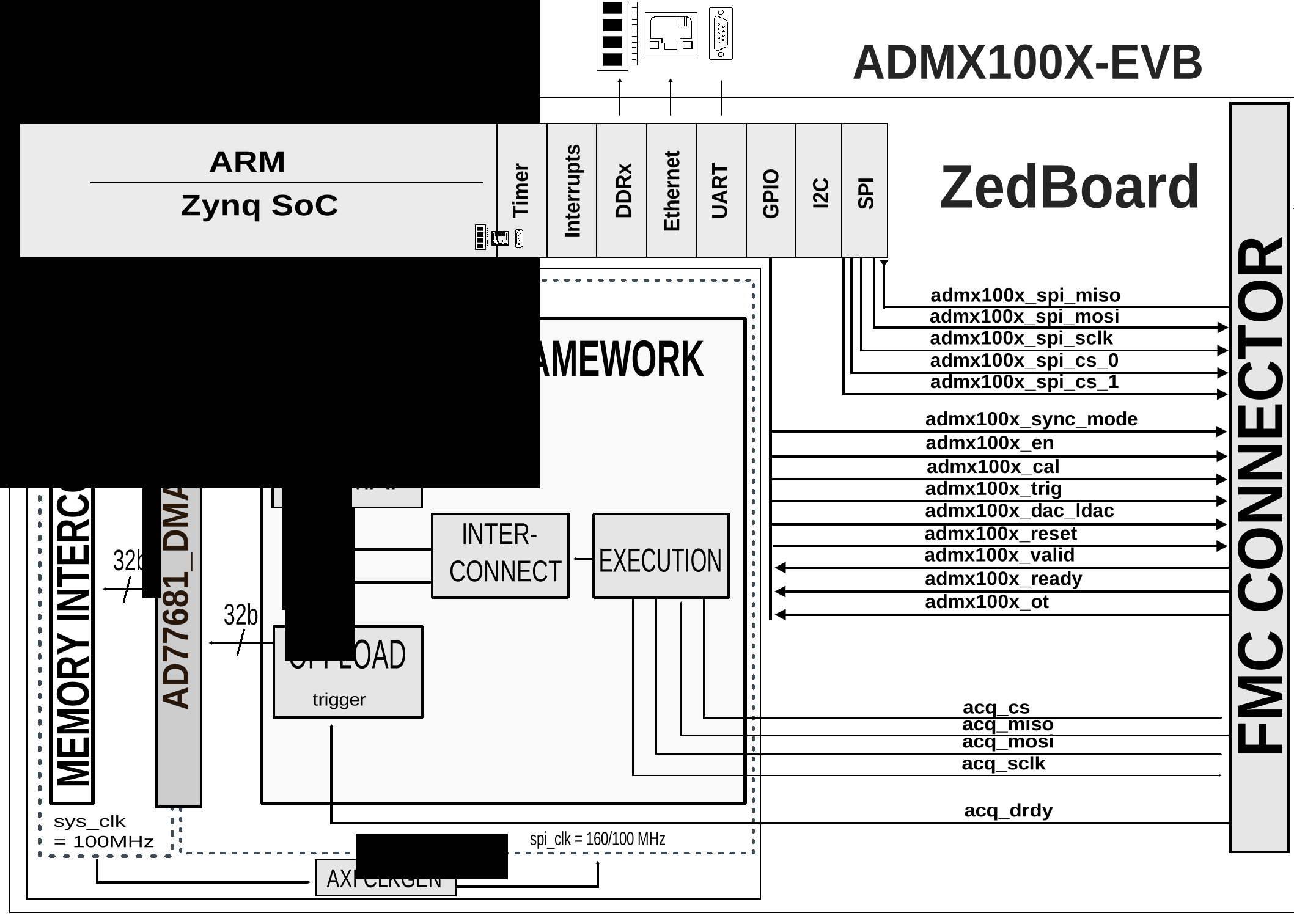
The reference design uses the SPI Engine Framework to interface with the ADAQ7768-1 precision ADC on the RX acquisition path. The SPI Engine Offload module is used to capture continuous samples at the maximum sample rate of 256 kSPS, triggered by the DRDY (data ready) signal of the ADAQ7768-1.
Warning
The VADJ for the Zedboard must be set to 3.3V.
Block diagram
The data path and clock domains are depicted in the below diagram:
SPI connections
SPI type |
SPI manager instance |
SPI subordinate |
CS |
|---|---|---|---|
PS |
SPI 0 |
CS_FPGA |
0 |
PS |
SPI 0 |
CS_DAC |
1 |
PL |
axi_spi_engine |
ADAQ7768-1 |
0 |
GPIOs
The Software GPIO number is calculated as follows:
Zynq-7000: if PS7 is used, then offset is 54
GPIO signal |
Direction |
HDL GPIO EMIO |
Software GPIO |
|---|---|---|---|
(from FPGA view) |
Zynq-7000 |
||
ACQ_DRDY |
IN |
43 |
97 |
ACQ_RESET |
OUT |
42 |
96 |
ACQ_SYNQ_IN_FMC |
OUT |
41 |
95 |
ADMX100X_TRIG |
IN |
40 |
94 |
ADMX100X_DAC_LDAC |
OUT |
39 |
93 |
ADMX100X_CAL |
IN |
38 |
92 |
ADMX100X_VALID |
OUT |
37 |
91 |
ADMX100X_READY |
OUT |
36 |
90 |
ADMX100X_EN |
OUT |
35 |
89 |
ADMX100X_SYNC_MODE |
IN |
34 |
88 |
ADMX100X_RESET |
OUT |
33 |
87 |
ADMX100X_OT |
OUT |
32 |
86 |
CPU/Memory interconnects addresses
The addresses are dependent on the architecture of the FPGA, having an offset added to the base address from HDL(see more at CPU/Memory interconnects addresses).
Instance |
Zynq |
|---|---|
spi_adaq77681_axi_regmap |
0x44A0_0000 |
axi_adaq77681_dma |
0x44A3_0000 |
spi_clkgen |
0x44A7_0000 |
Interrupts
Below are the Programmable Logic interrupts used in this project.
Instance name |
HDL |
Linux Zynq |
Actual Zynq |
|---|---|---|---|
axi_adaq77681_dma |
13 |
57 |
89 |
spi_adaq77681 |
12 |
56 |
88 |
Building the HDL project
The design is built upon ADI’s generic HDL reference design framework. ADI distributes the bit/elf files of these projects as part of the ADI Kuiper Linux. If you want to build the sources, ADI makes them available on the HDL repository. To get the source you must clone the HDL repository.
Linux/Cygwin/WSL
Building the ZedBoard project:
~$
cd hdl/projects/admx100xevb/zed
~/hdl/projects/admx100xevb/zed$
make
A more comprehensive build guide can be found in the Build an HDL project user guide.
Resources
More information
Support
Analog Devices, Inc. will provide limited online support for anyone using the reference design with ADI components via the EngineerZone FPGA reference designs forum.
For questions regarding the ADI Linux device drivers, device trees, etc. from our Linux GitHub repository, the team will offer support on the EngineerZone Linux software drivers forum.
For questions concerning the ADI No-OS drivers, from our No-OS GitHub repository, the team will offer support on the EngineerZone microcontroller No-OS drivers forum.
It should be noted, that the older the tools’ versions and release branches are, the lower the chances to receive support from ADI engineers.