

AD9740-FMC HDL project
The AD9740, AD9742, AD9744 and AD9748 are wideband, 3G members of the TxDAC® series of high performance, low power CMOS, digital-to-analog converters (DACs). The TxDAC family, consisting of pin-compatible 14-, 12-, 10-, and 8-bit DACs, is specifically optimized for the transmit signal path of communication systems. All the devices share the same interface options, small outline package, and pinout. The AD9740, AD9742, AD9744 and AD9748 also provide an upward or downward component selection path based on performance, resolution and financial cost, offering exceptional AC and DC performance while supporting update rates up to 210 MSPS.
The EVAL-AD9740, EVAL-AD9742, EVAL-AD9744 and EVAL-AD9748 evaluation boards are FMC form-factor boards with FMC connector that is compatible to the Vita 57.1 standard. This board provides the user with the flexibility to operate the AD9740, AD9742, AD9744 and AD9748 in various configurations.
Output configurations include transformer-coupled, resistor terminated, and single and differential outputs. The digital inputs are designed to be driven from various word generators with the onboard option to add a resistor network for proper load termination. Provisions are also made to operate the AD9740, AD9742, AD9744 and AD9748 with either the onboard clock source (ADF4351) or with external clock configuration.
Supported boards
Supported devices
Supported carriers
Evaluation board |
Carrier |
FMC slot |
|---|---|---|
FMC-LPC |
||
FMC-LPC |
||
FMC-LPC |
||
FMC-LPC |
Block design
Warning
The VADJ for Zedboard must be set to 3.3V.
Block diagram
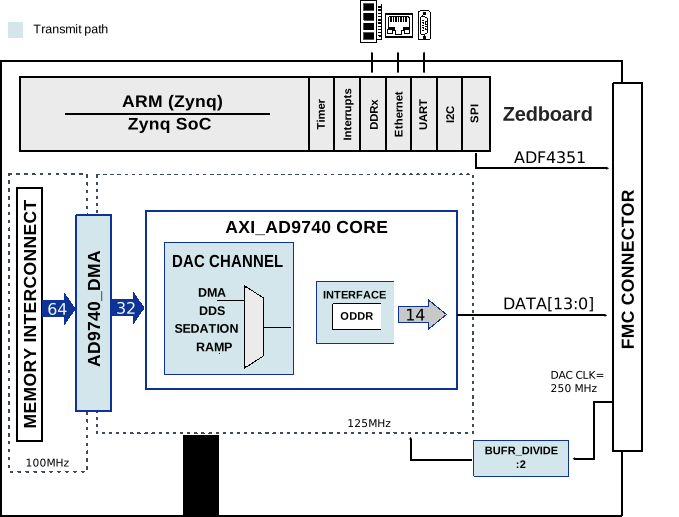
The data path and clock domains are depicted in the below diagram:
Clock architecture
The ADF4351 on the evaluation board generates a 250 MHz differential clock.
In system_top.v, this clock is received by an IBUFGDS and then divided by 2
using a BUFR primitive, producing a 125 MHz logic clock. This 125 MHz clock
drives both the AXI AD9740 DAC core (dac_clk) and the DMA FIFO read
clock (fifo_rd_clk). The axi_ad9740 IP uses ODDR primitives to output two
samples per clock cycle (DDR), achieving a 250 MSPS DAC update rate.
Configuration
The project supports four target devices selected via the DEVICE environment
variable at build time:
DEVICE |
DAC_RESOLUTION |
Description |
|---|---|---|
AD9748 |
8 |
8-bit DAC |
AD9740 |
10 |
10-bit DAC |
AD9742 |
12 |
12-bit DAC |
AD9744 (default) |
14 |
14-bit DAC |
The AXI AD9740 IP is configured with:
Parameter |
Value |
Description |
|---|---|---|
CLK_RATIO |
2 |
DDR output, two samples per clock cycle |
DDS_CORDIC_DW |
22 |
CORDIC data width for higher DDS precision |
DDS_CORDIC_PHASE_DW |
22 |
CORDIC phase width for higher DDS precision |
The AXI DMAC is configured with:
Parameter |
Value |
Description |
|---|---|---|
DMA_DATA_WIDTH_SRC |
64 |
Memory side data width (HP1 port) |
DMA_DATA_WIDTH_DEST |
32 |
DAC side data width (2 × 16-bit samples) |
CYCLIC |
1 |
Cyclic transfer support enabled |
CPU/Memory interconnects addresses
The addresses are dependent on the architecture of the FPGA, having an offset added to the base address from HDL (see more at CPU/Memory interconnects addresses).
Instance |
Zynq |
|---|---|
ad9740_dac |
0x44A7_0000 |
ad9740_dma |
0x44A4_0000 |
Interrupts
Below are the Programmable Logic interrupts used in this project.
Instance name |
HDL |
Linux Zynq |
Actual Zynq |
|---|---|---|---|
ad9740_dma |
13 |
57 |
89 |
Building the HDL project
The design is built upon ADI’s generic HDL reference design framework. ADI distributes the bit/elf files of these projects as part of the ADI Kuiper Linux. If you want to build the sources, ADI makes them available on the HDL repository. To get the source you must clone the HDL repository, and then build the project as follows:
Linux/Cygwin/WSL
~$
cd hdl/projects/ad9740_fmc/zed
~/hdl/projects/ad9740_fmc/zed$
make
The default build targets the AD9744 (14-bit). To build for a different
device, set the DEVICE environment variable:
~$
cd hdl/projects/ad9740_fmc/zed
~/hdl/projects/ad9740_fmc/zed$
make DEVICE=AD9740
A more comprehensive build guide can be found in the Build an HDL project user guide.
Resources
More information
Support
Analog Devices, Inc. will provide limited online support for anyone using the reference design with ADI components via the EngineerZone FPGA reference designs forum.
For questions regarding the ADI Linux device drivers, device trees, etc. from our Linux GitHub repository, the team will offer support on the EngineerZone Linux software drivers forum.
For questions concerning the ADI No-OS drivers, from our No-OS GitHub repository, the team will offer support on the EngineerZone microcontroller No-OS drivers forum.
It should be noted, that the older the tools’ versions and release branches are, the lower the chances to receive support from ADI engineers.