AD-96TOF1-EBZ
Overview
The AD-96TOF1-EBZ is a proven hardware platform for depth perception. When paired with a processor board from the 96Boards ecosystem or Raspberry Pi family, it can be used for 3D software and algorithm development. This modular platform can be used as a baseline to design a ToF system.
Features:
VGA resolution (640x480) at up to 30fps
Multiple range modes: Near (25-80cm), Medium (30cm-4.5m), Far (3-6m) with <2% accuracy
940nm VCSEL with 110° x 85° diffuser, FoV 90° x 69.2°
96Board mezzanine and Raspberry Pi camera connector compatibility
USB, Ethernet and WiFi connectivity options
Operating temperature -20°C to 85°C
Applications:
3D software and algorithm development
Depth perception prototyping
Robotics and autonomous navigation
Object detection and tracking
Hardware
The full system hardware includes:
Laser Transmitter Board
AFE Receiver Board
High level specification
 *Range
   *Near: 25cm to 80cm
   *Medium: 30cm to 4.5m (Rev.B: 80cm to 3m)
   *Far: 3m to 6m
   *Accuracy: < 2% for all ranges
 *Frame Rate upto 30fps dependent on processor board, OS and interface to host computer
 *Resolution 640 x 480 pixels
 *Operating Temperature -20⁰C to 85⁰C
* 940nm VCSEL with 110⁰ x 85⁰ batwing profile diffuser
 *Receive lens: FoV 90⁰ x 69.2⁰ including 940nm BPF
 *96Board mezzanine high speed and low speed expansion connector compatibility
 *Raspberry Pi camera connector to connect to any compatible processor board
 *Connectivity support for USB or Network(WiFi, Ethernet)
 *5V DC Input
 *20W max power consumption
Laser Board
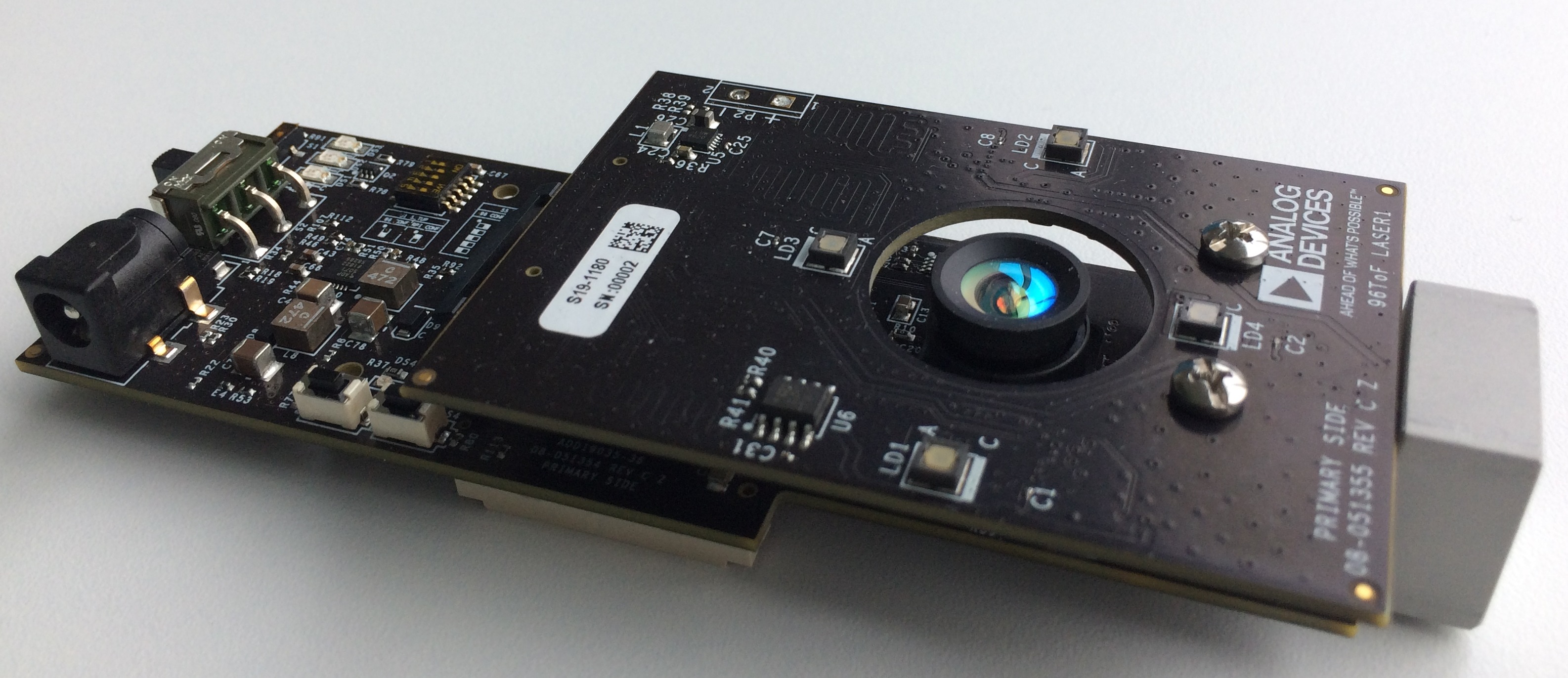
The laser board generates the IR light pulses to illuminate the scene. It connects directly to the AFE board and is powered and controlled through the interface connector, with an option of external power if needed for specific use case with different VCSEL.
The laser board has 4 individual lasers with appropriate precision driver and power components for accurate firing of the lasers.
The board is designed with the lasers positioned so that they fit around the AFE board CCD sensor when mated together. This position gives optimum performance for a wide range of use cases minimizing any effects of shadowing.
It receives power and all control I/O through the interface connector.
Key parts:
VCSEL: Finisar I940-G2332-NBC-D1-110B85R
MOSFET driver: ADP5202
MOSFET: EPC2007C
Temperature measurement: ADT7410
Power: ADP2504
Note
The previous board versions (Rev. B and Rev. C) use MOSFET driver: ADP3624
Note
To be added.
Download
Rev. B Hardware design files (including schematics, BoM and layout) Rev. C Hardware design files (including schematics, BoM and layout) Rev. D Hardware design files (including schematics, BoM and layout)
AFE Board
The AD-96TOF1-EBZ AFE Board from factor is compliant with the 96Boards mezzanine specification and can connect to compatible 96Board processor family or to Raspberry Pi compatible boards via an additional MIPI connector interface on the PCB. It has an EEPROM to store the ToF AFE firmware and system calibration data. System temperature measurement is enabled through an embedded temperature sensor.
The AFE board contains a Panasonic CCD Sensor combined with ADDI9036 TOF Signal Processor with necessary power and timing signal chains.
Optics are fitted to the board using industry standard mounting adapters to give a wide field of view, but can be changed based on individual use cases. There is a threaded adapter for mechanical mounting on an optional tripod stand.
Key parts:
CCD sensor: Panasonic MN34906BL
Optics: JCD J6920B lens with 940nm bandpass filter
ToF AFE: ADDI9036 TOF Signal Processor
EEPROM: AT24CM01-XHM-B
Temperature measurement: ADT7410
Note
To be added.
Download
Rev. B Hardware design files (including schematics, BoM and layout) Rev. C Hardware design files (including schematics, BoM and layout)
Note
For more information and how to buy the system please goto the Analog Devices AD-96TOF1-EBZ Product page
System setup & evaluation
The development kit is delivered with an SD card containing the evaluation software for the supported embedded platforms and a set of accessories required to put the system together and get it up and running in no time.
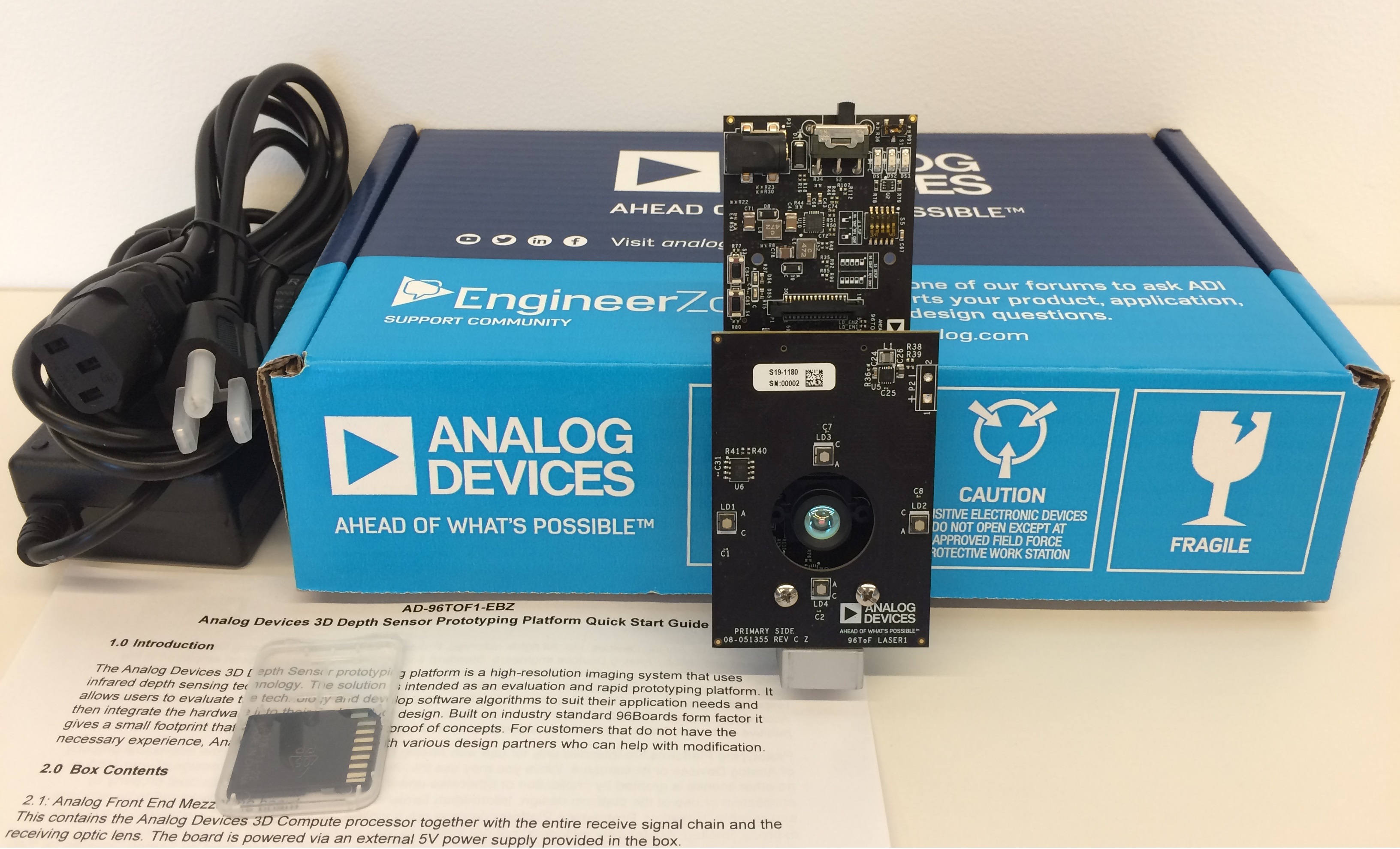
Development kit contents:
Laser Board
AFE Mezzanine Board
5V power supply for the AFE board and power cords
SD card with the evaluation software
One page Quick Start Guide
Note
Getting the system up and running
Host computer
Embedded platforms
Application Development
The system has options of USB, Ethernet or Wi-Fi to connect to a host computer, this flexibility enables evaluation across a wide range of use cases and environments. Sampling rates of up to 30fps are supported. Data is fed from the depth camera to the processor board over MIPI-CSI interface. This data is read using V4L2 capture driver and in-turn either feeds it to native SDK or sends it to the Host SDK over Ethernet, WiFi and USB interfaces. Native/Host SDK provides this data to user applications for further use. For ease of application, the SDK also provides OpenCV, Python and MATLAB wrappers such that developers can simply use these wrappers to develop application.
The Depth Perception Rapid Prototyping Platform supports a wide range of operating systems and programming languages. An open-source SDK that accompanies the hardware platform enables you to extract depth data from the camera on the processor and operating system of your choice. Windows and Linux support are built into the SDK as well as sample code and wrappers for various languages including Python, C/C++ and MATLAB. The SDK also integrates with 3rd party technologies like OpenCV and RoS.
Laser Safety
Important
This device complies with International Standards IEC 60825-1:2014 & 2007 for a Class 1 laser product. This device also complies with 21 CFR 1040.10 and 1040.11 except for deviations pursuant to Laser Notice No. 50, dated June 24, 2007. Only use Software and Firmware updates that are specifically provided for this solution.
Videos
Help and Support
For questions and more information please contact us on the Analog Devices Engineer Zone.