AD-FXTOF1-EBZ
Depth Perception Rapid Prototyping Platform with VGA Resolution ToF Camera.
Important
This system has reached its end of life and has a last time buy status.
Overview
The AD-FXTOF1-EBZ is a proven hardware platform for depth perception. When paired with a processor board from the Raspberry Pi or Nvidia family, it can be used for 3D software and algorithm development. The solution has VGA resolution which means that objects can be detected to a higher level of granularity than other 3D ToF solutions, an ability to detect depth in strong ambient light conditions and multiple range detection modes for increased accuracy.
A native and host SDK is provided. The SDK also provides OpenCV, Python®, MATLAB®, Open3D and RoS wrappers so that developers can use them to simplify application development.
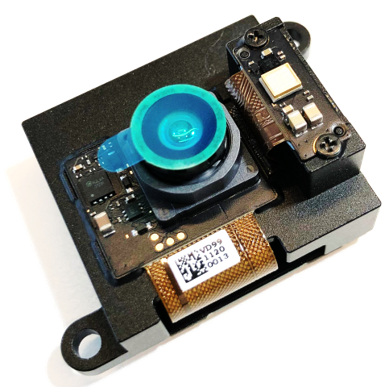
High level specification |
|
|---|---|
Range |
Near: 25cm to 80cm |
Medium: 30cm to 300cm |
|
Accuracy |
< 2% for all ranges |
Frame Rate |
30fps (depends on processor board, OS and interface to host computer) |
Resolution |
640 x 480 pixels |
Operating Temperature |
-20⁰C to 75⁰C |
Laser optics |
940nm VCSEL with 87⁰ x 67⁰ batwing profile diffuser |
Receive lens |
FoV 87⁰ x 67⁰ including 940nm BPF, F=1.2 |
Power input |
5V @ 2A |
Interface |
25 pins flex cable |
Features:
VGA resolution (640 x 480 pixels) for high granularity object detection
Depth detection in strong ambient light conditions
Multiple range detection modes for increased accuracy
Near range: 25cm to 80cm, Medium range: 30cm to 300cm
30fps frame rate capability
MIPI-CSI interface to processor board
Applications:
3D software and algorithm development
Computer vision applications
Depth perception systems
Robotics and autonomous systems
System setup & evaluation
The development kit can be connected to a number of processor boards for system evaluation and computer vision applications development. The evaluation software for the supported embedded platforms can be accessed by following the instructions in the user guides below.
Application Development
The system has options of USB, Ethernet or Wi-Fi to connect to a host computer, this flexibility enables evaluation across a wide range of use cases and environments. Sampling rates of up to 30fps are supported. Data is fed from the depth camera to the processor board over MIPI-CSI interface. This data is read using V4L2 capture driver and in-turn either feeds it to native SDK or sends it to the Host SDK over Ethernet, WiFi and USB interfaces. Native/Host SDK provides this data to user applications for further use. For ease of application, the SDK also provides OpenCV, Python and MATLAB wrappers such that developers can simply use these wrappers to develop application.
The Depth Perception Rapid Prototyping Platform supports a wide range of operating systems and programming languages. An open-source SDK that accompanies the hardware platform enables you to extract depth data from the camera on the processor and operating system of your choice. Windows and Linux support are built into the SDK as well as sample code and wrappers for various languages including Python, C/C++ and MATLAB. The SDK also integrates with 3rd party technologies like OpenCV and RoS.
Videos
Downloads
Note
To be added.
Note
For more information and how to buy the system please visit the AD-FXTOF1-EBZ Product page
Note
For an example of how to integrate the AD-FXTOF1-EBZ in a camera please visit the AD-3DSMARTCAM1-PRZ Product page
Laser Safety
Important
This device complies with International Standards IEC 60825-1:2014 & 2007 for a Class 1 laser product. This device also complies with 21 CFR 1040.10 and 1040.11 except for deviations pursuant to Laser Notice No. 50, dated June 24, 2007. Only use Software and Firmware updates that are specifically provided for this solution.
Warning
All the products described on this page include ESD (electrostatic discharge) sensitive devices. Electrostatic charges as high as 4000V readily accumulate on the human body or test equipment and can discharge without detection. Although the boards feature ESD protection circuitry, permanent damage may occur on devices subjected to high-energy electrostatic discharges. Therefore, proper ESD precautions are recommended to avoid performance degradation or loss of functionality. This includes removing static charge on external equipment, cables, or antennas before connecting to the device.
Help and Support
For questions and more information please contact us on the Analog Devices Engineer Zone.