AD-FMCMOTCON2-EBZ (Obsolete)
Complete Motor Drive Evaluation System on an FMC Board.
Overview
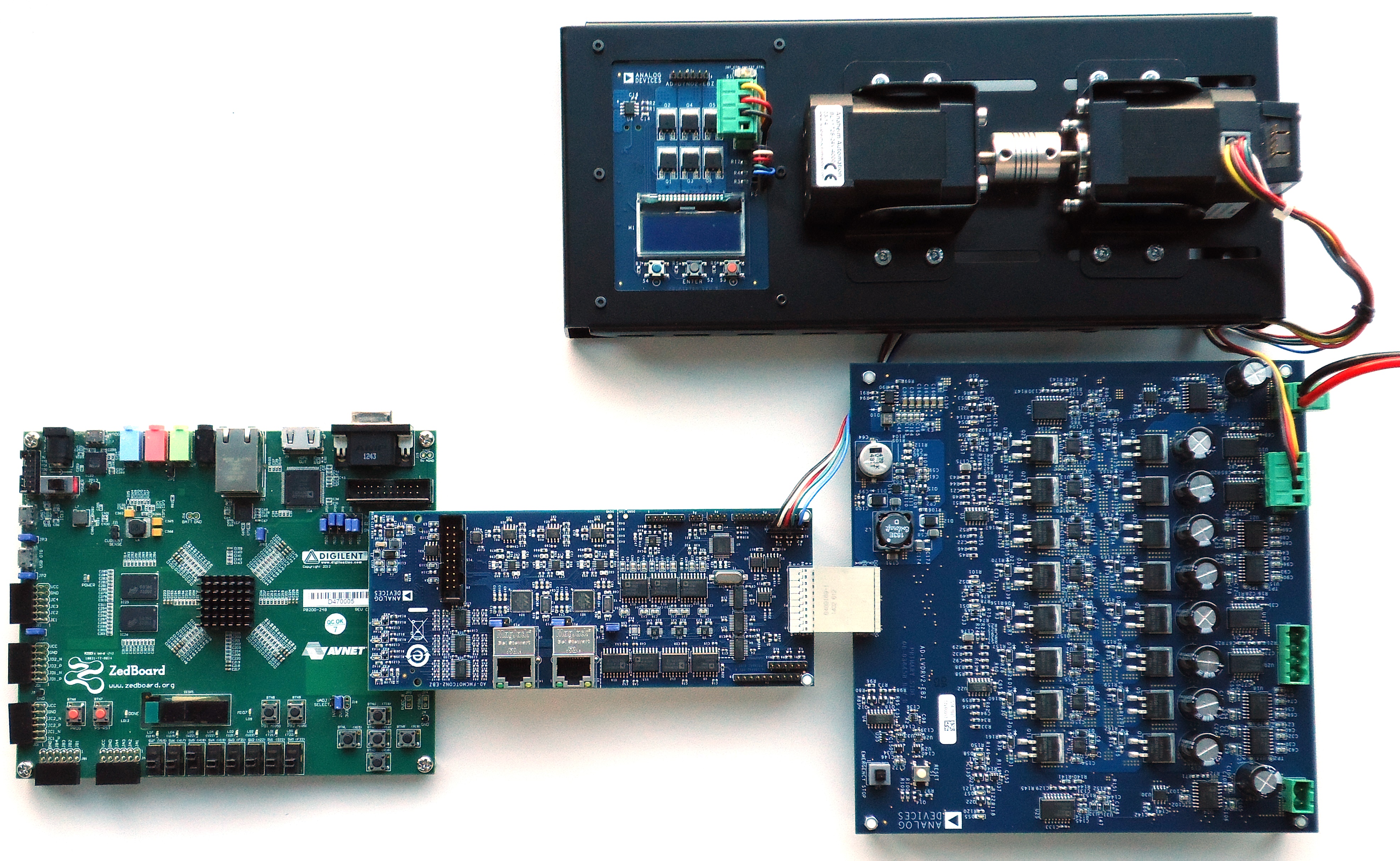
The AD-FMCMOTCON2-EBZ is a complete motor drive system on an FMC board, designed to demonstrate efficient and high dynamic control of three-phase PMSM, BLDC, induction, and Stepper motors up to 48 V and 20 A. Two motors can be driven simultaneously, each with a separate power supply.
The system incorporates high-quality power supplies; reliable power, control, and feedback signal isolation; accurate measurement of motor current and voltage signals; high-speed interfaces for control signals; industrial Ethernet interfaces; Hall, Differential Hall, Encoder, and Resolver position sensor interfaces; EnDat and BISS digital sensor interfaces; and a flexible FPGA/SoC control interface.
The AD-DYNO2-EBZ dynamometer acts as an electronically adjustable load for testing real-time motor control performance. It consists of two BLDC motors directly coupled through a rigid connection.
The system consists of:
AD-FMCMOTCON2-EBZ - Controller board, compatible with all AMD Xilinx FPGA platforms with FMC LPC or HPC connectors.
AD-DRVLV2-EBZ - Low voltage drive board. Drives Brushed DC / BLDC / PMSM / Stepper motors up to 48 V and 20 A.
AD-DYNO2-EBZ - Dynamometer drive system. Electronically adjustable load with two BLDC motors in a dyno setup (optional).
Note
The Controller and Drive boards are provided as a kit and cannot be purchased separately. Both are distributed under the AD-FMCMOTCON2-EBZ part number.
Features:
Complete motor drive system for PMSM, BLDC, Brushed DC, and Stepper motors up to 48 V and 20 A
Two motors driven simultaneously with independent power supplies
Reliable power, control, and feedback signal isolation
Accurate motor current and voltage measurement using isolated ADCs
2x Gbit Ethernet PHYs for high-speed industrial communication (RGMII)
Hall, Differential Hall, Encoder, and Resolver position sensor interfaces
EnDat and BISS digital sensor interfaces
Flexible FPGA/SoC control interface (FMC LPC/HPC compatible)
Complete HDL reference designs for AMD Xilinx FPGA/SoC platforms
MathWorks Simulink FOC controller integration
QDESYS EtherCAT and FOC IP support
Applications:
Industrial motor control prototyping and development
Multi-axis servo drive systems
Real-time EtherCAT motor control demonstrations
Algorithm verification before production
Academic research and teaching
Where to buy: FMCMOTCON2 Evaluation Kit
Recommendations
People who follow the flow that is outlined, have a much better experience with things. However, like many things, documentation is never as complete as it should be. If you have any questions, feel free to ask on our EngineerZone, but before that, please make sure you read our documentation thoroughly.
Table of contents
Using the evaluation board/full stack reference design that we offer:
Help and Support
If you have any questions regarding the ADI motor drive solutions or are experiencing any problems while using the boards or following any of the user guides, feel free to ask on our support community EngineerZone.
For questions regarding the hardware or the HDL reference design, post in the Motor Control Hardware Platforms or FPGA Reference Designs sub-communities. For questions regarding the Linux drivers for any of the components on the motor control boards, use the Linux Software Drivers sub-community.
When asking a question, please give a detailed description of your problem. Always include which platform you are using with the AD-FMCMOTCON2-EBZ, the steps you executed, the result you expected, and the result you actually got.
For more information also check:
Warning
All the products described on this page include ESD (electrostatic discharge) sensitive devices. Electrostatic charges as high as 4000V readily accumulate on the human body or test equipment and can discharge without detection. Although the boards feature ESD protection circuitry, permanent damage may occur on devices subjected to high-energy electrostatic discharges. Therefore, proper ESD precautions are recommended to avoid performance degradation or loss of functionality. This includes removing static charge on external equipment, cables, or antennas before connecting to the device.