EVAL-ADTF3175D-NXZ
Important
Support or Query: tof@analog.com
2025-09-12: Release 6.1.0 is available on GitHub; see ToF/releases.
Important
Please reference the release note to see important changes.
The documentation is now a part of the release and is also in the GitHub repo: External Link
Overview
Analog Devices 3D time of flight (ToF) camera products capture depth information, enabling advanced machine vision applications and allowing people and devices to sense, capture and interact with their spatial environments.
For more information see: Time of Flight Camera – System Overview
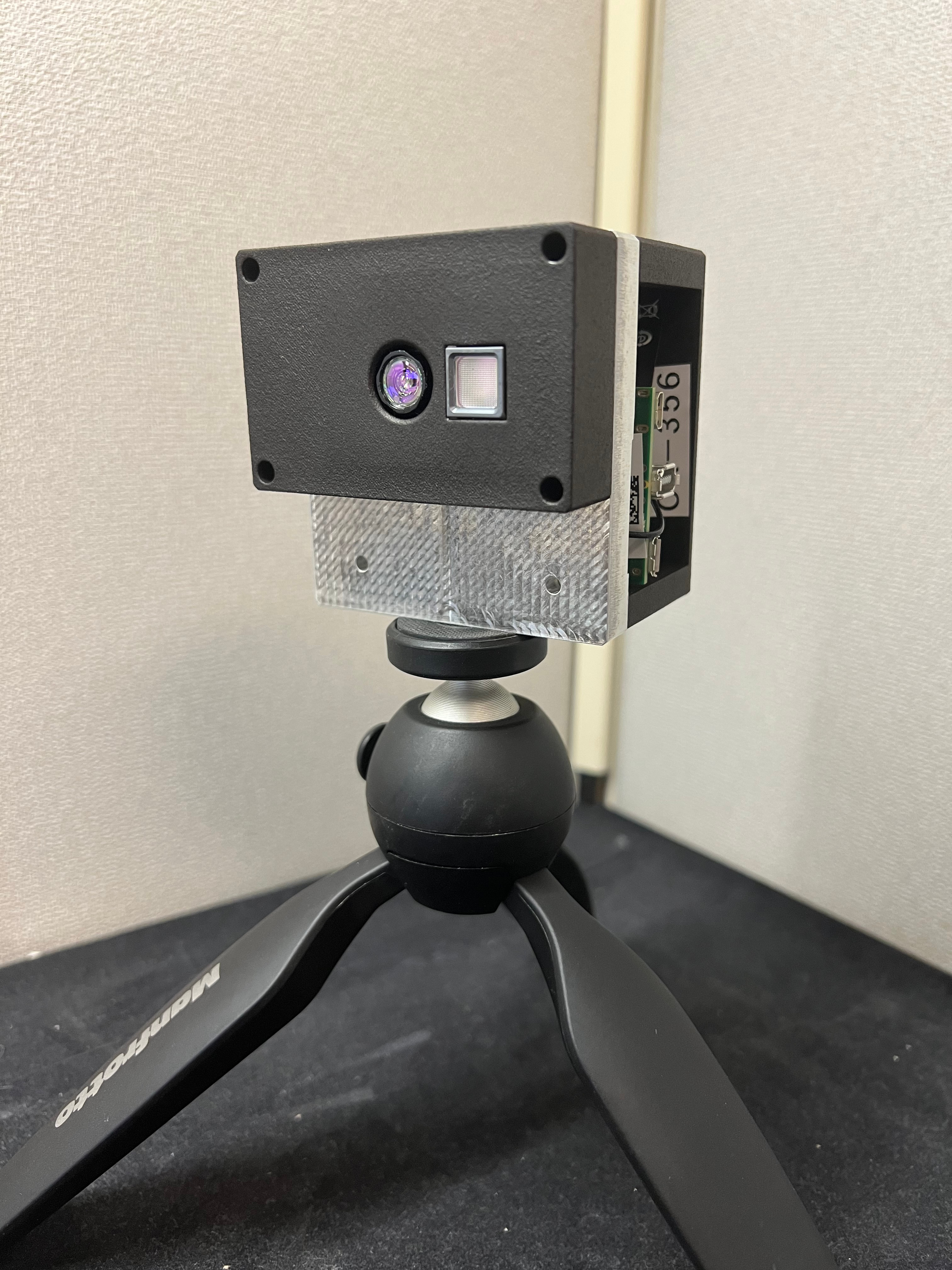
The EVAL-ADTF3175D-NXZ time of flight (ToF) evaluation kit showcases the ADTF3175 module with ADI’s depth ISP, the ADSD3500. The kit supports ethernet over USB connectivity to a PC for real-time visualization, capture and post processing of depth data. The kit includes host PC software (Windows) and an open source multi-platform SDK for custom application development.
Key Features
Resolution |
1024x1024 TOF sensor |
Illumination |
FOI 81°x81° - 940nm Lumentum VCSEL |
Field of view |
FOV 75°x75° |
Operating range |
0.4 to 4m @ 15% reflectance (native) |
Depth Noise |
<15mm |
Accuracy |
+/- 3mm depth error |
Modes of Operation
See the Mode Table section for mode configurations based on serial number.
Kit Contents
ADTF3175D Evaluation Module
ADTF3175 Module
i.MX8 M Plus SOM (SolidRun)
Camera Interface Board
ADSD3500 Interposer board
16GB flashed microSD card (Inserted in module sd card slot)
USB-C to USB-C cable. Supports PD 2.0, and USB 3.1
Tripod
System Overview
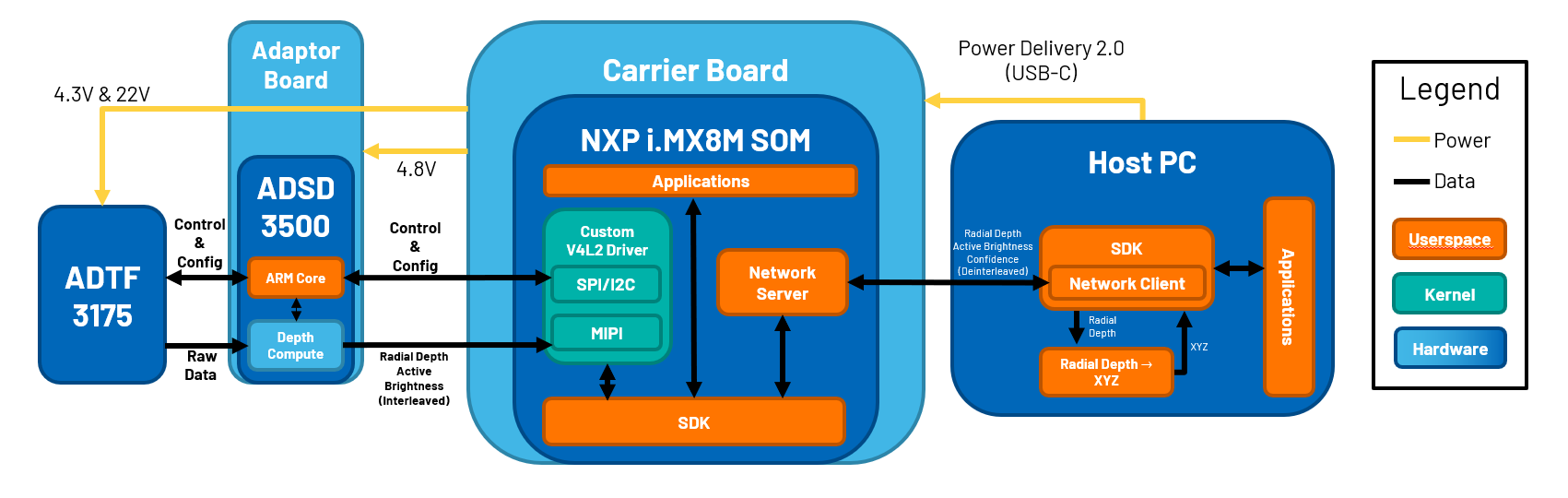
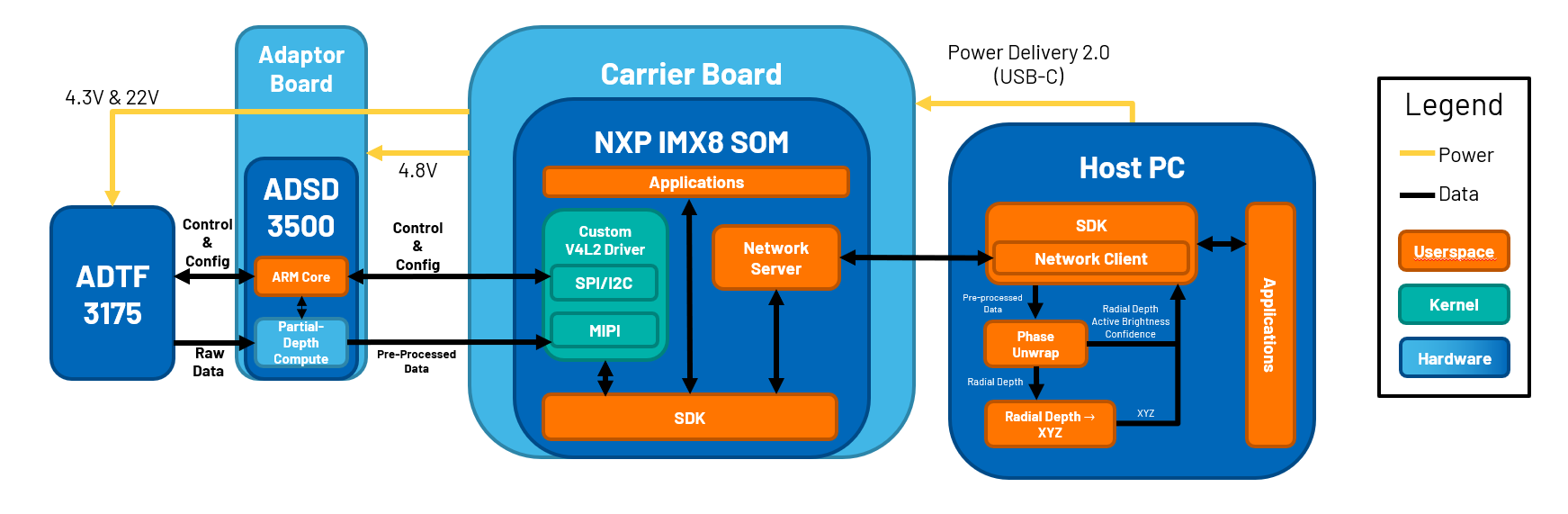
The EVAL-ADTF3175D-NXZ features three primary components:
- ADTF3175 ToF Module
A complete Time-Of-Flight module for high resolution 3D depth sensing. Integrates the ADSD3100 sensor, optical components, infrared illumination with driver circuitry, flash memory, and voltage regulators.
- ADSD3500 Depth ISP
This depth image signal processor computes raw ToF sensor data into processed depth and brightness frames. It greatly lightens the load on the host processor by handling depth computation at the edge.
- NXP i.MX8M Embedded System
An NXP SOM with carrier board manages power distribution and I/O connectivity. Runs V4L2 camera and USB video drivers, enabling data passthrough via ethernet-over-USB.
Quarter-MegaPixel (512x512)
MegaPixel (1024x1024)
System Information
USB and Power
Minimum Requirements
USB 3.0 (5Gbps)
USB Type-C cable
2.0A
Recommended Requirements
USB 3.1 Gen2
USB Type-C cable
3.0A
Note
Do not use USB Type-C to USB Type-A adapters.
Dimensions: 66mm x 58.6mm x 67.9mm
Enclosure Drawing: Link
Laser Safety: Class 1
Terms
FOI: Field of Illumination
FOV: Field of View
FPS: Frames per Second
SOM: System On Module
VCSEL: Vertical-Cavity Surface-Emitting Laser
Support Links
Module and Eval kit questions: EngineerZone
Software/SDK questions: ToF/issues
Lumentum VCSEL Information:
Recommendations
People who follow the flow outlined have a much better experience. However, like many things, documentation is never as complete as it should be. If you have any questions, feel free to ask on our EngineerZone forums, but before that, please make sure you read our documentation thoroughly.
Warning
All the products described on this page include ESD (electrostatic discharge) sensitive devices. Electrostatic charges as high as 4000V readily accumulate on the human body or test equipment and can discharge without detection. Although the boards feature ESD protection circuitry, permanent damage may occur on devices subjected to high-energy electrostatic discharges. Therefore, proper ESD precautions are recommended to avoid performance degradation or loss of functionality. This includes removing static charge on external equipment, cables, or antennas before connecting to the device.
Help and Support
Please go to Help and Support page.