EVAL ADICUP3029
Overview
The EVAL-ADICUP3029 is an Arduino-like development platform based on the ADUCM3029 ultra low power microcontroller, built around an ARM Cortex-M3 processor with integrated power management, embedded SRAM and flash, and an analog subsystem that includes an ADC together with clocking, reset, and power management. The board has an Arduino Uno form factor, two PMOD connectors, and an I2C Grove style connector for easily attaching sensors and signal conditioning add-on modules. On-board Bluetooth Low Energy and Wi-Fi connectivity make it IoT ready out of the box, complete with software and working hardware/software examples. It is programmed and debugged with the free, gcc/gdb based CrossCore Embedded Studio, and works with a range of Analog Devices add-on modules as well as 3rd party hardware.
Features:
ARM Cortex-M3 based ADUCM3029 ultra low power MCU with integrated power management, embedded SRAM/flash, and an ADC-based analog subsystem
Arduino Uno form factor with two PMOD connectors and an I2C Grove connector
On-board Bluetooth Low Energy and Wi-Fi connectivity — IoT ready out of the box
Free, gcc/gdb based CrossCore Embedded Studio programming and debugging toolchain
Broad ecosystem of Analog Devices shields, PMODs, and Grove add-on modules
Applications:
Internet of Things (IoT) sensor nodes
Wireless (BLE / Wi-Fi) data acquisition and monitoring
Rapid prototyping with sensors and signal-conditioning add-on modules
Low power embedded control and connectivity
Contents:
- EVAL-ADICUP3029 User Guide
- ADICUP3029 Compliance Testing and Results
- Hardware
- EVAL-ADICUP3029 Base Board
- EVAL-ADXL372-ARDZ Shield
- EVAL-CN0410-ARDZ Shield
- EVAL-CN0414-ARDZ Shield Overview
- EVAL-CN0415-ARDZ Shield
- EVAL-CN0416-ARDZ Shield Overview
- EVAL-CN0418-ARDZ Shield Overview
- Help and Support
- Introduction
- Hardware Cases and Enclosures
- Application Example Reference Designs
- AD5592/AD5593 PMOD Demo
- AD5770R PMOD Demo
- AD7124-8 PMOD EVAL_ADICUP3029 Demo (w/ EVAL-AD7124-8-PMDZ)
- ADT7420 Temperature Sensor Demo [with EVAL-ADT7420-PMDZ]
- Accelerometer Demo using Wi-Fi (with EVAL-ADXL362-ARDZ)
- ADXL372 Demo using Bluetooth
- ADXRS290 Gyroscope PMOD Command Line Interface Demo
- Blink LED Demo
- Command Line Interpreter Demo
- pH Monitor with Temperature Compensation Demo
- CO Toxic Gas Measurement Demo (with EVAL-CN0357-ARDZ)
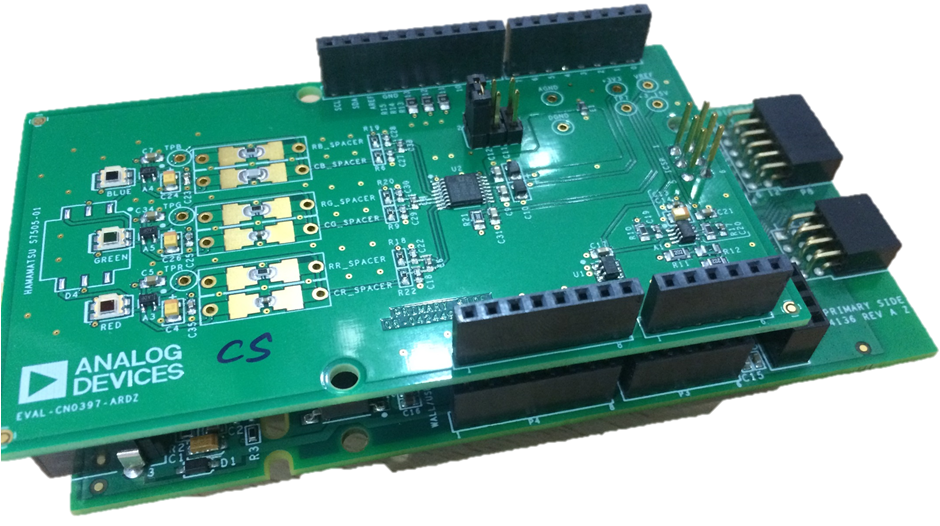
- Visible Light Detection Demo [with EVAL-CN0397-ARDZ]
- Soil Moisture and pH Measurement Demo using Wi-Fi
- CN0401 SPI to CAN FD Transceiver Demo
- EVAL-CN0410-ARDZ Shield Demo
- PLC Arduino Shield Input Demo
- Solenoid Closed Loop Control Demo
- PLC Arduino Shield Output Demo
- Optical Platform Setup Demo (w/ EVAL-CN0503-ADRZ)
- AD5791 PMOD Application with EVAL-ADICUP3029 (w/ EVAL-CN0531-ADRZ)
- Geiger Counter demo (EVAL-CN0536-ADRZ)
- Smoke Detector Demo (w/ EVAL-CN0537-ADRZ)
- Distributed Control System (DCS) Demo
- ADXL362 Accelerometer Demo [with PmodACL2]
- Smart Greenhouse Demo
- Bluetooth Smart Device Apps
- ADICUP3029 BLE Connection Documentation
- iOS Smart App Overview
- Software Pack and Board Support Packages
- ADICUP3029 Board Support Package (BSP)
- ADuCM302x Device Family Pack (DFP)
- BLE Software Pack
- Sensors Software Pack
- Wi-Fi Software Pack
- Tools and Driver Details
- ADICUP3029 PC/Laptop Drivers
- EVAL-ADICUP3029 Tool Chain
- CrossCore Embedded Studio Quickstart User Guide
- Unlocking a “Bricked” ADICUP3029
- Using Keil or IAR Tools with ADICUP3029
Recommendations
People who follow the flow that is outlined, have a much better experience with things. However, like many things, documentation is never as complete as it should be. If you have any questions, feel free to ask on our EngineerZone forums, but before that, please make sure you read our documentation thoroughly.
Warning
All the products described on this page include ESD (electrostatic discharge) sensitive devices. Electrostatic charges as high as 4000V readily accumulate on the human body or test equipment and can discharge without detection. Although the boards feature ESD protection circuitry, permanent damage may occur on devices subjected to high-energy electrostatic discharges. Therefore, proper ESD precautions are recommended to avoid performance degradation or loss of functionality. This includes removing static charge on external equipment, cables, or antennas before connecting to the device.
Help and support
Please go to Help and Support page.