C Installation and Examples
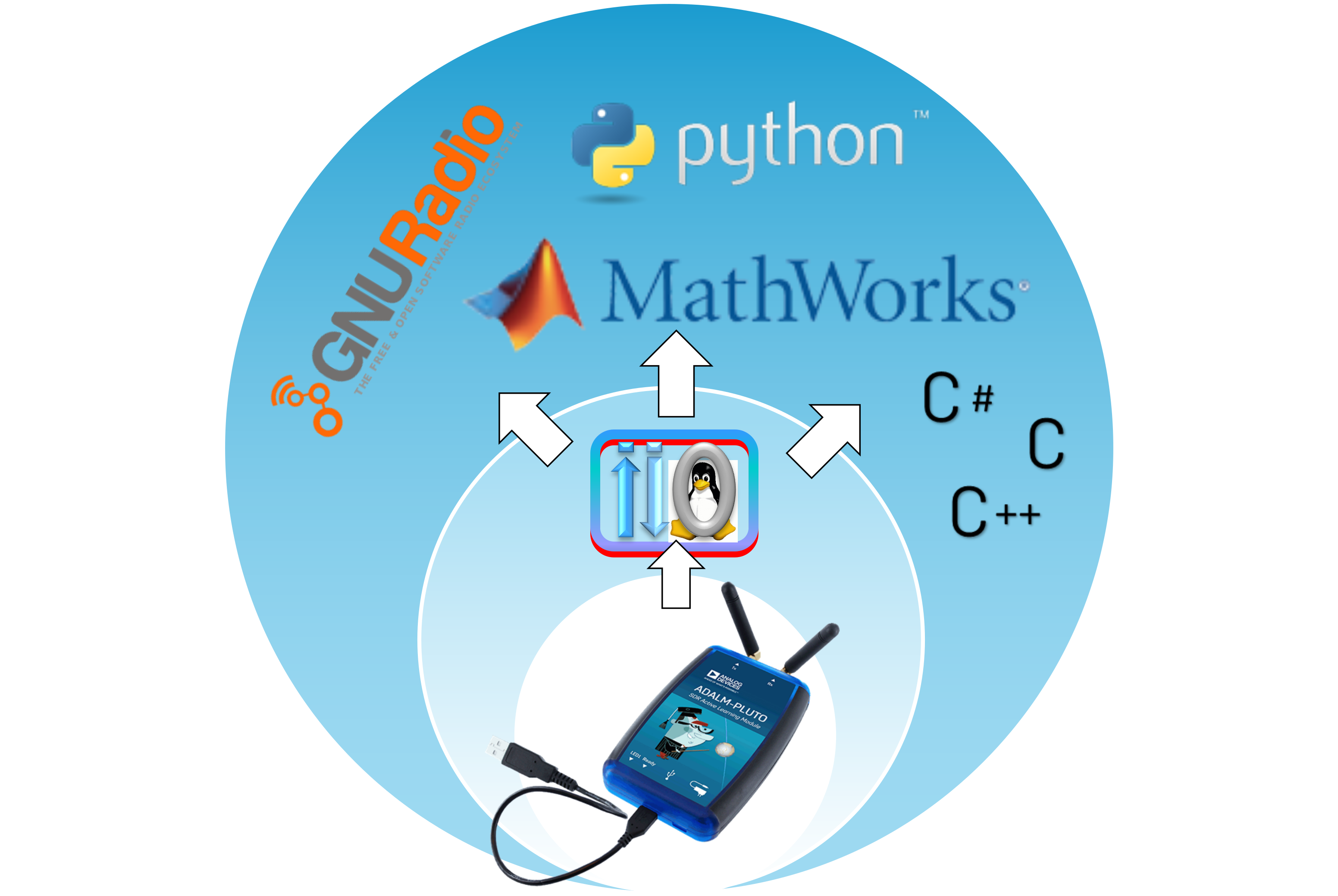
C
If you prefer to work with C, you can use the libiio library to interface with PlutoSDR. The libiio library provides a low-level API for controlling Pluto and accessing its data. You can install libiio from the Analog Devices website or using your package manager if it is available. Once you have libiio installed, you can use the following code to read samples from PlutoSDR in C:
// main.c
// Pluto (AD9361) RX streaming example using libiio over network.
//
// What it does:
//  1) Connects to Pluto at 192.168.2.1 via iiod
//  2) Configures RX (sample rate, RF bandwidth, gain mode, RX LO freq) via ad9361-phy
//  3) Streams one RX buffer from cf-ad9361-lpc
//  4) Prints first 10 IQ samples (assumes int16 interleaved I,Q)
//
// Build (WSL):
//   gcc -g main.c -o iio_rx $(pkg-config --cflags --libs libiio)
//
// Run:
//   ./iio_rx

#include <iio.h>
#include <stdio.h>
#include <stdint.h>
#include <errno.h>
#include <string.h>


static int write_attr(struct iio_channel *ch, const char *attr, const char *val,
                      const char *ch_name)
{
    int ret = iio_channel_attr_write(ch, attr, val);
    if (ret < 0) {
        // libiio often returns -errno style values
        int e = -ret;
        fprintf(stderr,
                "ERROR: write %s.%s = %s failed, ret=%d (errno=%d: %s)\n",
                ch_name, attr, val, ret, e, strerror(e));
    } else {
        printf("OK: %s.%s = %s\n", ch_name, attr, val);
    }
    return ret;
}

static void panic(const char *msg)
{
    fprintf(stderr, "ERROR: %s\n", msg);
}


int main(void)
{
    int ret = 0;

    // 1) Create a network context (Pluto default IP)
    struct iio_context *ctx = iio_create_context_from_uri("ip:192.168.2.1");
    if (!ctx) {
        panic("Failed to create IIO context (ip:192.168.2.1). Is iiod running / reachable?");
        return 1;
    }

    printf("Context: %s\n", iio_context_get_name(ctx));
    printf("Description: %s\n", iio_context_get_description(ctx));
    printf("Devices: %u\n\n", iio_context_get_devices_count(ctx));

    // 2) Find control device
    struct iio_device *phy = iio_context_find_device(ctx, "ad9361-phy");
    if (!phy) {
        panic("Failed to find device: ad9361-phy");
        ret = 1;
        goto cleanup_ctx;
    }

    // 3) Find the RX control channel on ad9361-phy
    // From your dump: voltage0 (input) exists; voltage1 does NOT.
    struct iio_channel *phy_rx = iio_device_find_channel(phy, "voltage0", false);
    if (!phy_rx) {
        panic("Failed to find RX control channel voltage0 (input) on ad9361-phy");
        ret = 1;
        goto cleanup_ctx;
    }

    // RX LO is altvoltage0 (output) on ad9361-phy
    struct iio_channel *rx_lo = iio_device_find_channel(phy, "altvoltage0", true);
    if (!rx_lo) {
        panic("Failed to find RX LO channel altvoltage0 (output) on ad9361-phy");
        ret = 1;
        goto cleanup_ctx;
    }

    // 4) Configure RX path
    // sample rate
    int rc;

    rc = write_attr(phy_rx, "sampling_frequency", "1000000", "ad9361-phy:voltage0(in)");
    if (rc < 0) goto cleanup_ctx;

    rc = write_attr(phy_rx, "rf_bandwidth", "1000000", "ad9361-phy:voltage0(in)");
    if (rc < 0) goto cleanup_ctx;

    rc = write_attr(phy_rx, "gain_control_mode", "slow_attack", "ad9361-phy:voltage0(in)");
    if (rc < 0) goto cleanup_ctx;

    rc = write_attr(rx_lo, "frequency", "2400000000", "ad9361-phy:altvoltage0(out)");
    if (rc < 0) goto cleanup_ctx;

    // 5) Find RX streaming device
    struct iio_device *rx = iio_context_find_device(ctx, "cf-ad9361-lpc");
    if (!rx) {
        panic("Failed to find RX streaming device cf-ad9361-lpc");
        ret = 1;
        goto cleanup_ctx;
    }

    // 6) Find RX streaming channels (I/Q) on cf-ad9361-lpc
    struct iio_channel *rx_i = iio_device_find_channel(rx, "voltage0", false);
    struct iio_channel *rx_q = iio_device_find_channel(rx, "voltage1", false);
    if (!rx_i || !rx_q) {
        panic("Failed to find RX streaming channels voltage0/voltage1 on cf-ad9361-lpc");
        ret = 1;
        goto cleanup_ctx;
    }

    iio_channel_enable(rx_i);
    iio_channel_enable(rx_q);

    // 7) Create RX buffer
    const size_t samples_per_buffer = 4096;
    struct iio_buffer *buf = iio_device_create_buffer(rx, samples_per_buffer, false);
    if (!buf) {
        panic("Failed to create RX buffer");
        ret = 1;
        goto disable_channels;
    }

    // 8) Refill buffer once
    const ssize_t nbytes = iio_buffer_refill(buf);
    if (nbytes < 0) {
        fprintf(stderr, "ERROR: iio_buffer_refill failed (ret=%zd)\n", nbytes);
        ret = 1;
        goto destroy_buffer;
    }

    // 9) Print first 10 IQ pairs
    const ptrdiff_t step = iio_buffer_step(buf);
    char *p   = (char *)iio_buffer_first(buf, rx_i);
    char *end = (char *)iio_buffer_end(buf);

    printf("Refilled %zd bytes, step=%td bytes\n", nbytes, step);

    int printed = 0;
    for (; p < end && printed < 10; p += step) {
        // Most Pluto streams are interleaved int16: I then Q.
        int16_t i_sample = ((int16_t *)p)[0];
        int16_t q_sample = ((int16_t *)p)[1];
        printf("Sample %d: I=%d  Q=%d\n", printed, i_sample, q_sample);
        printed++;
    }

destroy_buffer:
    iio_buffer_destroy(buf);

disable_channels:
    iio_channel_disable(rx_q);
    iio_channel_disable(rx_i);

cleanup_ctx:
    iio_context_destroy(ctx);
    return ret ? 1 : 0;
}
Note
For questions or help with the Pluto SDR, please visit: EngineerZone