EVAL-ADPD410X-ARDZ
ADPD4100/ADPD4101 Arduino Shields
Overview
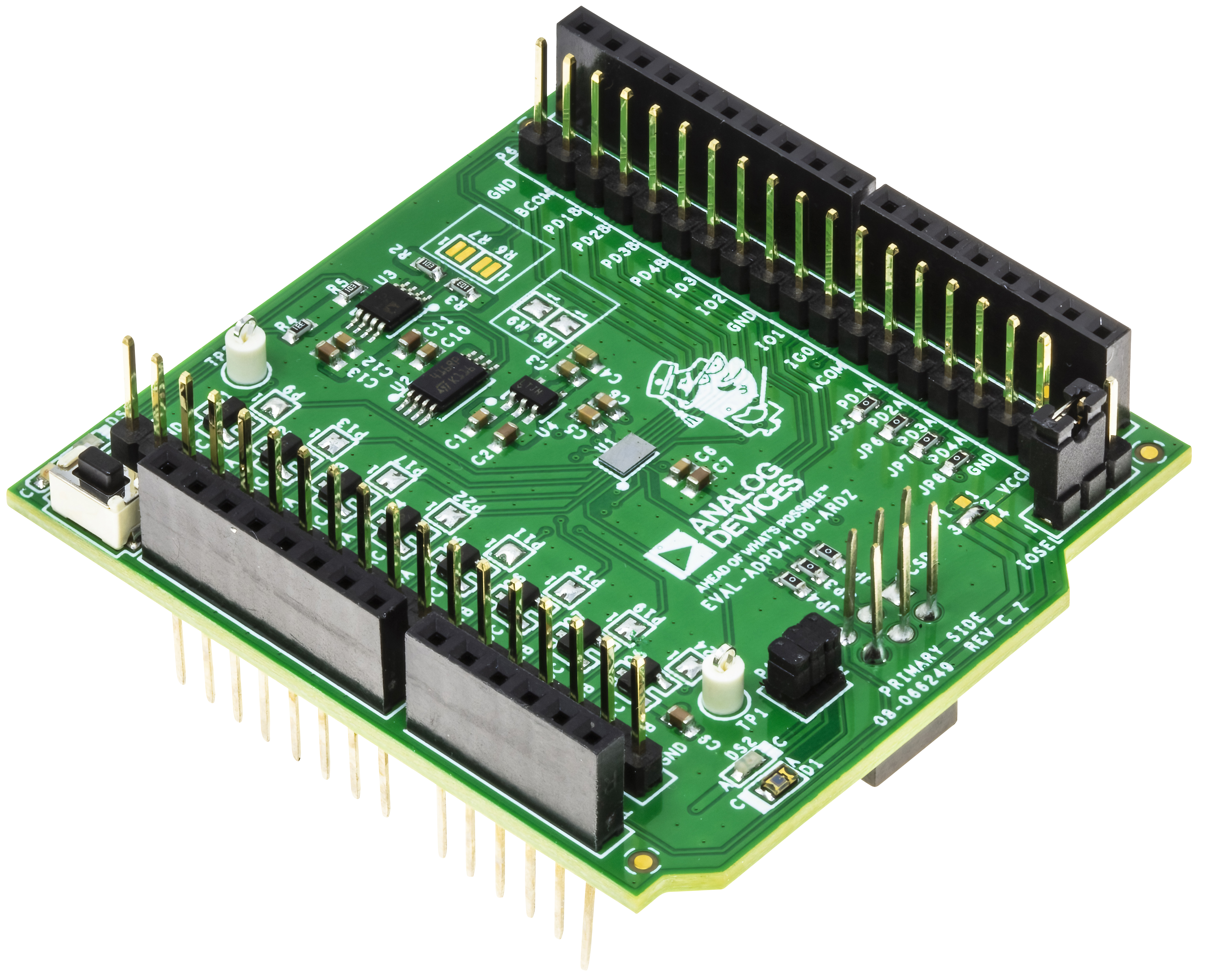
EVAL-ADPD4100-ARDZ and EVAL-ADPD4101-ARDZ are simple, Arduino form-factor breakout board for developing ADPD4100 and ADPD4101 applications, respectively. The ADPD4101, interfaced through I2C, and the ADPD4100, interfaced through SPI, are highly versatile, multimodal sensor front ends, stimulating up to eight light emitting diodes (LEDs) and measuring the return signal on up to eight separate current inputs.
There are a number of other evaluation platforms for these devices, including the EVAL-ADPD4100Z-PPG, optimized for photoplethysmograph applications, and the reference design CN0503, optimized for optical liquid analysis applications (colorimetry, turbidity, fluorescence). The EVAL-ADPD410X-ARDZ boards come in handy for adapting these evaluation boards to meet specific application requirements, as well as for “ground up” development of new applications.
Features
On-board LED for quick and easy bring up
Breakaway Prototyping Board for customized application needs
8-Channels of LEDs and photodiodes connections
Standard 0.1 inch headers
Applications
Wearable health and fitness monitors: heart rate monitors (HRMs), heart rate variability (HRV), stress, blood pressure estimation, SpO2, hydration, body composition
Industrial monitoring: CO, CO2, smoke, and aerosol detection
Home patient monitoring
Getting Started
The EVAL-ADPD410x-ARDZ can be used for a wide range of applications, and the following demos are meant to show examples of the flexibility of the board. To get started with setup, configuration, and example use cases, please proceed to the Quick Start Guide and follow the provided demo pages.
Recommendations
People who follow the flow that is outlined, have a much better experience with things. However, like many things, documentation is never as complete as it should be. If you have any questions, feel free to ask on our Analog Devices EngineerZone forum, but before that, please make sure you read our documentation thoroughly.
Warning
All the products described on this page include ESD (electrostatic discharge) sensitive devices. Electrostatic charges as high as 4000V readily accumulate on the human body or test equipment and can discharge without detection. Although the boards feature ESD protection circuitry, permanent damage may occur on devices subjected to high-energy electrostatic discharges. Therefore, proper ESD precautions are recommended to avoid performance degradation or loss of functionality. This includes removing static charge on external equipment, cables, or antennas before connecting to the device.
Help and support
Please go to Analog Devices EngineerZone page.