EVAL-LTC23XX
Low noise, high speed SAR ADC family - 16/18/20-bit, up to 2 MSPS.
Overview
The LTC23xx family consists of low noise, low power, high speed successive approximation register (SAR) ADCs with resolutions of 16-bit, 18-bit, and 20-bit and maximum sampling rates from 250 kSPS to 2 MSPS. Operating from a 2.5V or 5V supply, these ADCs feature either fully differential or pseudo-differential input configurations with VREF ranging from 2.5V to 5.1V.
The LTC2338-18 is a special variant operating from a single 5V supply with a ±10.24V true bipolar input range, making it ideal for high voltage applications requiring a wide dynamic range.
All devices in the family feature a high-speed SPI-compatible serial interface that supports 1.8V, 2.5V, 3.3V, and 5V logic while also featuring a daisy-chain mode. The fast throughput with no cycle latency makes the LTC23xx family ideally suited for a wide variety of high-speed applications. An internal oscillator sets the conversion time, easing external timing considerations. The devices automatically power down between conversions, leading to reduced power dissipation that scales with the sampling rate.
Several variants - including the LTC2376, LTC2377, LTC2378, LTC2379, and LTC2380 series - feature a unique digital gain compression (DGC) function. When enabled, DGC maps zero-scale code from 0V to 0.1 x VREF and full-scale code from VREF to 0.9 x VREF, eliminating the driver amplifier’s negative supply while preserving the full ADC resolution.
Features:
16-bit, 18-bit, and 20-bit resolution options
Up to 2 MSPS throughput with no cycle latency
Low power: 21 mW at 1 MSPS, scales proportionally with sample rate
104 dB SNR (typ) at fIN = 2 kHz (LTC2378-20)
-125 dB THD (typ) at fIN = 2 kHz (LTC2378-20)
±2 ppm INL maximum, guaranteed no missing codes at 20 bits
Digital gain compression (DGC) on selected variants
Fully differential or pseudo-differential input configurations
VREF range: 2.5V to 5.1V
SPI-compatible serial interface with daisy-chain mode
1.8V to 5V I/O voltages
Internal conversion clock
16-lead MSOP and 4 mm x 3 mm DFN packages
Applications:
Medical imaging
High-speed data acquisition
Portable or compact instrumentation
Industrial process control
Low power battery-operated instrumentation
ATE
Recommendations
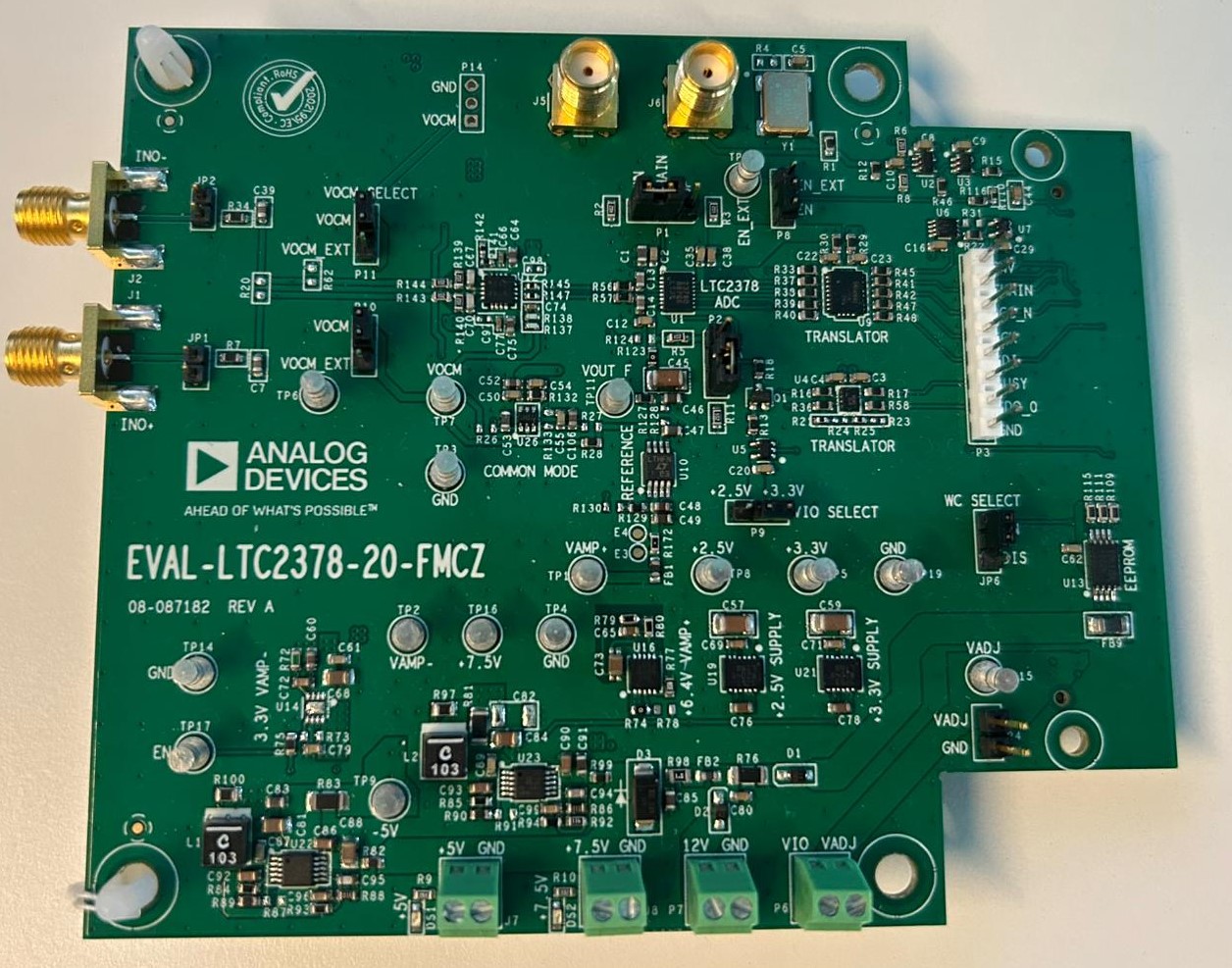
To better understand the LTC23xx family, we recommend using the evaluation board with the ZedBoard FPGA development kit for Linux-based evaluation. For no-OS, you can use a demonstration board.
Important
This guide focuses on LTC2378-20 with the ZedBoard for Linux (the primary and most supported path) and the DC2135A with the MAX32666FTHR for no-OS. The setup applies to all other supported devices as they share the same FMC connector and pin-compatible interface.
People who follow the flow outlined in this documentation have a much better experience. If you have any questions, feel free to ask on our EngineerZone, but please read the documentation thoroughly first.
Table of contents
Using the evaluation board/full-stack reference design:
Prerequisites - what you need to get started
-
Using the ZedBoard with Linux
Using the DC2135A with no-OS
Linux applications:
Design with the LTC23xx family:
LTC2378-20 product page
Resources for designing a custom LTC23xx-based platform:
For Linux software:
About the device driver:
About the SPI Engine framework:
LTC2378-FMC HDL project for the ZedBoard.
Supported devices
Device |
Resolution |
Max Rate |
Supply |
Notes |
|---|---|---|---|---|
16-bit |
2 MSPS |
2.5V |
DGC, fully differential |
|
18-bit |
2 MSPS |
2.5V |
DGC, fully differential |
|
16-bit |
2 MSPS |
2.5V |
Pseudo-differential unipolar |
|
20-bit |
1 MSPS |
2.5V |
DGC, fully differential |
|
18-bit |
1 MSPS |
2.5V |
DGC, fully differential |
|
16-bit |
1 MSPS |
2.5V |
DGC, fully differential |
|
18-bit |
1 MSPS |
5V |
±10.24V true bipolar input |
|
20-bit |
500 kSPS |
2.5V |
DGC, fully differential |
|
18-bit |
500 kSPS |
2.5V |
DGC, fully differential |
|
16-bit |
500 kSPS |
2.5V |
DGC, fully differential |
|
18-bit |
500 kSPS |
2.5V |
Pseudo-differential |
|
18-bit |
500 kSPS |
2.5V |
Pseudo-differential |
|
16-bit |
500 kSPS |
2.5V |
Pseudo-differential |
|
20-bit |
250 kSPS |
2.5V |
DGC, fully differential |
|
18-bit |
250 kSPS |
2.5V |
DGC, fully differential |
|
16-bit |
250 kSPS |
2.5V |
DGC, fully differential |
|
18-bit |
250 kSPS |
2.5V |
Pseudo-differential |
|
16-bit |
250 kSPS |
2.5V |
Pseudo-differential |
|
18-bit |
250 kSPS |
2.5V |
Pseudo-differential |
|
16-bit |
250 kSPS |
2.5V |
Pseudo-differential |
Warning
All the products described on this page include ESD (electrostatic discharge) sensitive devices. Electrostatic charges as high as 4000V readily accumulate on the human body or test equipment and can discharge without detection. Although the boards feature ESD protection circuitry, permanent damage may occur on devices subjected to high-energy electrostatic discharges. Therefore, proper ESD precautions are recommended to avoid performance degradation or loss of functionality. This includes removing static charge on external equipment, cables, or antennas before connecting to the device.