DEMO High-Performance Analog Meets AI
Extracting data from high-performance, high-data-rate analog signal chains for AI model training and real-time inference presents significant challenges due to the complexity of interfaces, processing, and integration requirements. Analog Devices addresses these challenges by providing a comprehensive, open-source data extraction and integration software stack, which ensures seamless connectivity between advanced signal chains and high-performance compute platforms.
Resources
HDL branch: adrv9009_qsfp_10G
Linux branch: adr9009zu11eg_100MHZ_qsfp
Corundum branch: corundum
PyADI-IIO branch: jupiter_modulation
Block diagram
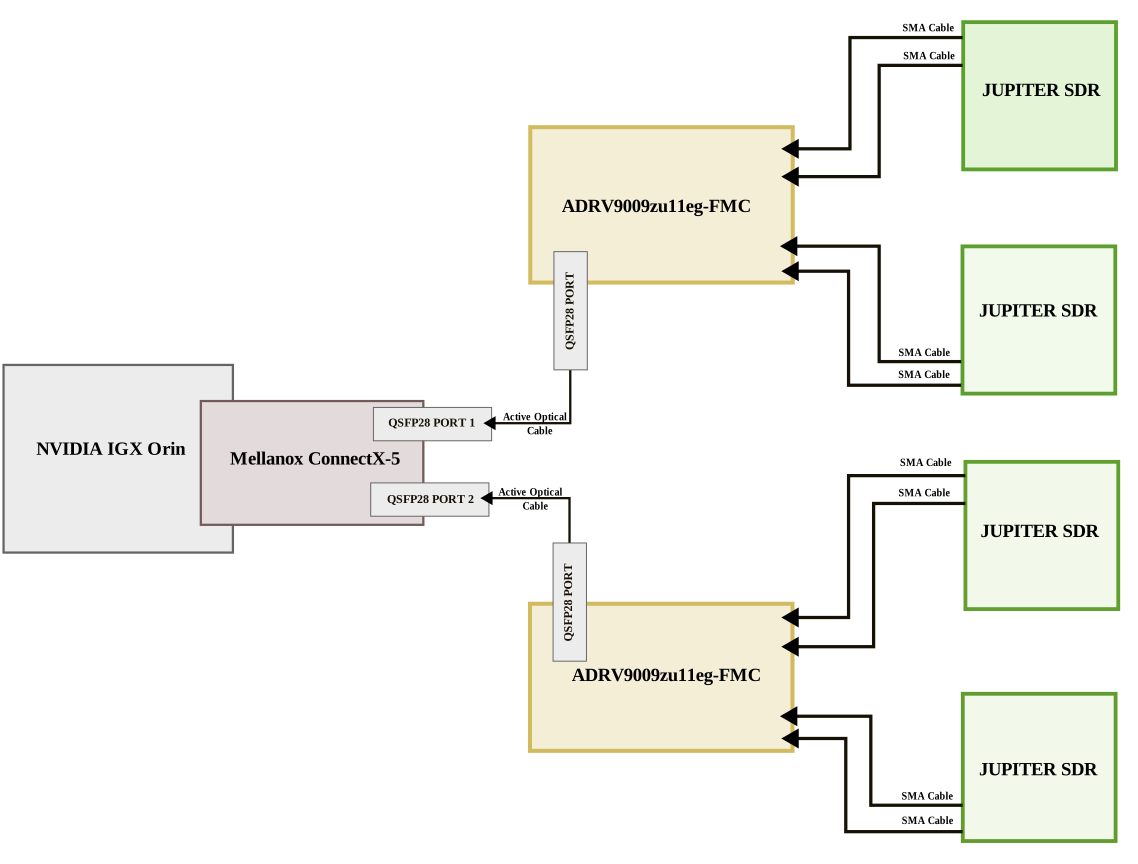
Demo description
This demo illustrates an AI-based multi-channel RF modulation scheme recognition workflow for signal intelligence applications. Four AD-JUPITER-EBZ systems are used to generate RF signals with different modulation schemes across a total of eight channels. The signals are then digitized by two ADRV9009-ZU11EG SoMs, which stream the raw IQ data to a host PC via 10Gb Ethernet links. The AI model, derived from a MathWorks reference design, is deployed on the NVIDIA GPU hosted in the PC. The NVIDIA Holoscan AI infrastructure manages the efficient transfer of data from the network interfaces into GPU memory, where the AI model is executed. By combining ADI’s high-performance data extraction infrastructure with MathWorks development tools and NVIDIA deployment frameworks, the system enables efficient AI application development and real-time execution for advanced signal intelligence tasks.
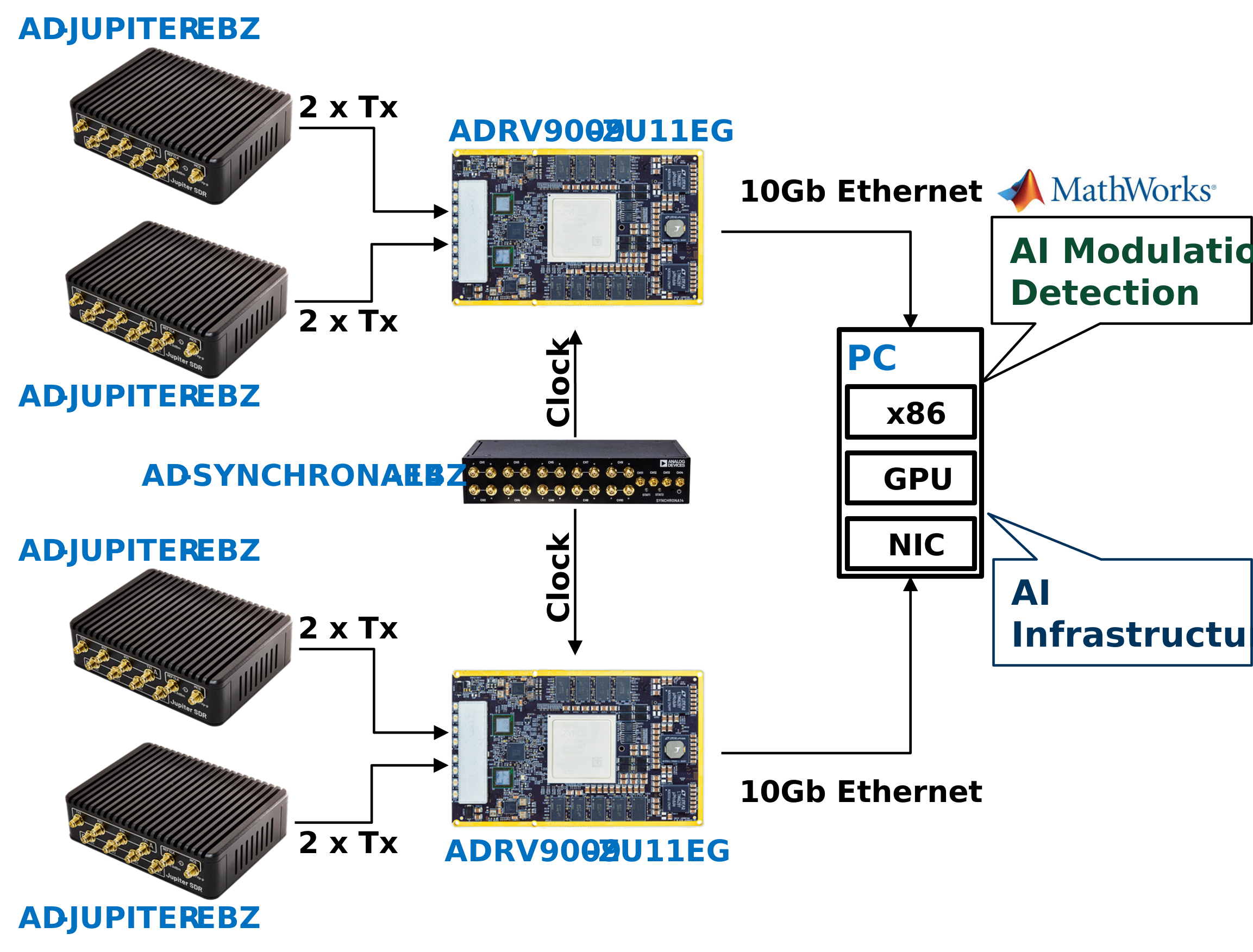
System Capabilities
The system demonstrates an advanced, end-to-end data extraction and AI-based signal processing workflow designed for high-performance signal intelligence applications. It combines Analog Devices’ high-speed RF hardware and data infrastructure with third-party AI frameworks to deliver real-time modulation recognition and efficient AI model development.
Key capabilities include:
High-Performance Data Extraction
Supports real-time acquisition of high-bandwidth RF data from multi-channel signal chains.
Seamlessly bridges physical interfaces, FPGA-based logic, and low-level software drivers to enable reliable data transfer from ADI RF front ends to edge processors.
Flexible connectivity options, including Ethernet, PCIe, USB, and UART, allow integration with a wide range of compute platforms.
Real-Time AI Modulation Recognition
Demonstrates multi-channel RF modulation scheme classification using AI models deployed on NVIDIA GPUs.
The NVIDIA Holoscan AI infrastructure ensures efficient data movement between network interfaces and GPU memory, supporting low-latency inference.
Multi-Channel & Multi-Device Synchronization
Incorporates multiple AD-JUPITER-EBZ boards and ADRV9009-ZU11EG SoMs to generate and digitize RF signals across eight channels.
Provides accurate clock distribution and synchronization through AD-SYNCHRONA14-EBZ, ensuring deterministic latency and coherent signal processing across multiple systems.
Seamless Data Integration Stack
Enables flexible partitioning of data flow between edge and host compute devices, improving scalability and system optimization.
Utilizes an open-source ADI software stack that simplifies the setup of data collection pipelines for AI model training and real-time inference.
Integration with Industry-Standard AI Frameworks
Compatible with MathWorks reference designs for AI model generation, MATLAB-based workflows, NVIDIA Holoscan, and ROS2.
Bridges data science workflows with embedded environments to enable real-world dataset generation, model optimization, and deployment.
End-to-End AI Development Ecosystem
ADI’s AI Fusion tools within CodeFusion Studio™ enable model optimization, deployment, and real-time performance analysis.
Supports rapid development cycles by providing actionable insights and performance metrics for system tuning.
Required Hardware
The following hardware components are required to set up and run the multi-channel RF modulation recognition demo:
Component |
Role |
Quantity |
Notes |
|---|---|---|---|
Versatile 2 x RxTx software-defined-radio platform based on ADRV9002 and Xilinx Zynq UltraScale+ MPSoC. Generates RF signals with configurable modulation schemes. |
4 |
Used to generate 8-channel RF input for AI recognition. |
|
RF System-on-Module with dual ADRV9009 wideband transceivers. Performs high-speed digitization and streaming of IQ data to the host. |
2 |
Provides synchronized multi-channel data acquisition. |
|
Clock synchronization and distribution board based on AD9545 and HMC7044. Ensures accurate multi-channel phase alignment. |
1 |
Synchronizes all RF signal paths and data capture timing. |
|
NVIDIA IGX Orin platform |
High-performance computing system with NVIDIA GPU acceleration. Runs Holoscan AI infrastructure and the AI modulation recognition model. |
1 |
Requires 10Gb Ethernet connectivity. |
SMA Cables |
RF connection between the SDR transmit and receive channels. |
8 |
High-quality coaxial cables recommended for minimal signal loss. |
100G QSFP28 Active Optical Cable |
Provides high-speed data connection between the RF-SOM and the host compute platform. |
1 |
Supports low-latency, high-bandwidth Ethernet link. |
Network switch with at least 4 PoE ports |
Provides Ethernet connectivity and power delivery to connected devices. |
1 |
Use a managed switch compatible with 10GbE interfaces. |
SD Card Configuration
For the Jupiter SDR platform, the boot files are generated using the Using Kuiper Image:
For the ADRV9009-ZU11EG, begin by checking out the HDL branch, then navigate to the adrv2crr_fmc directory.
Run the following command to enable Corundum support and build the design: make CORUNDUM=1 Once the build process is complete, generate the necessary boot files: boot.bin, device tree, and uImage by following the steps:
BOOT.BIN: Build the boot image BOOT.BIN
Devicetree: Building the Zynq Linux kernel and devicetrees from source
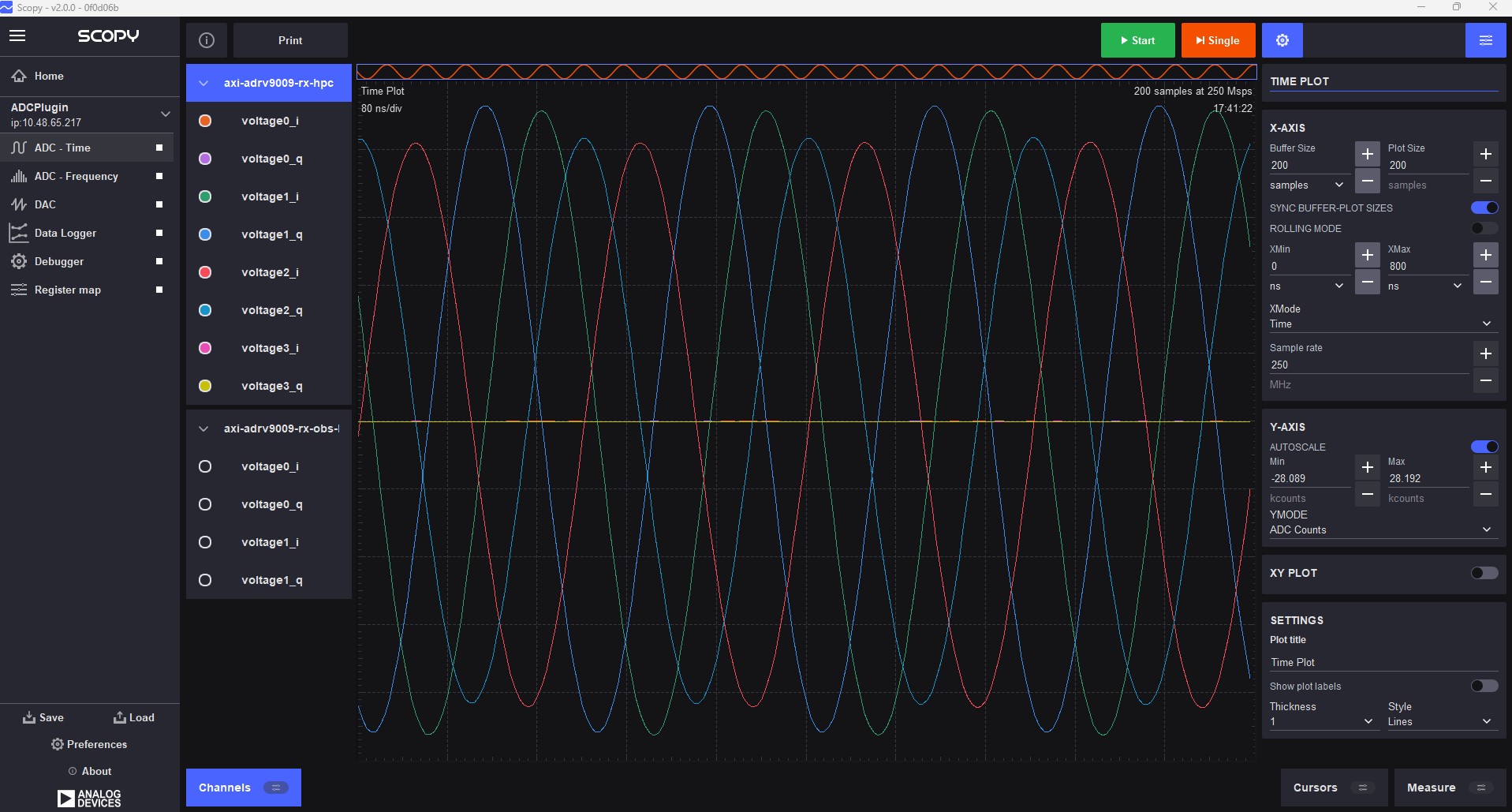
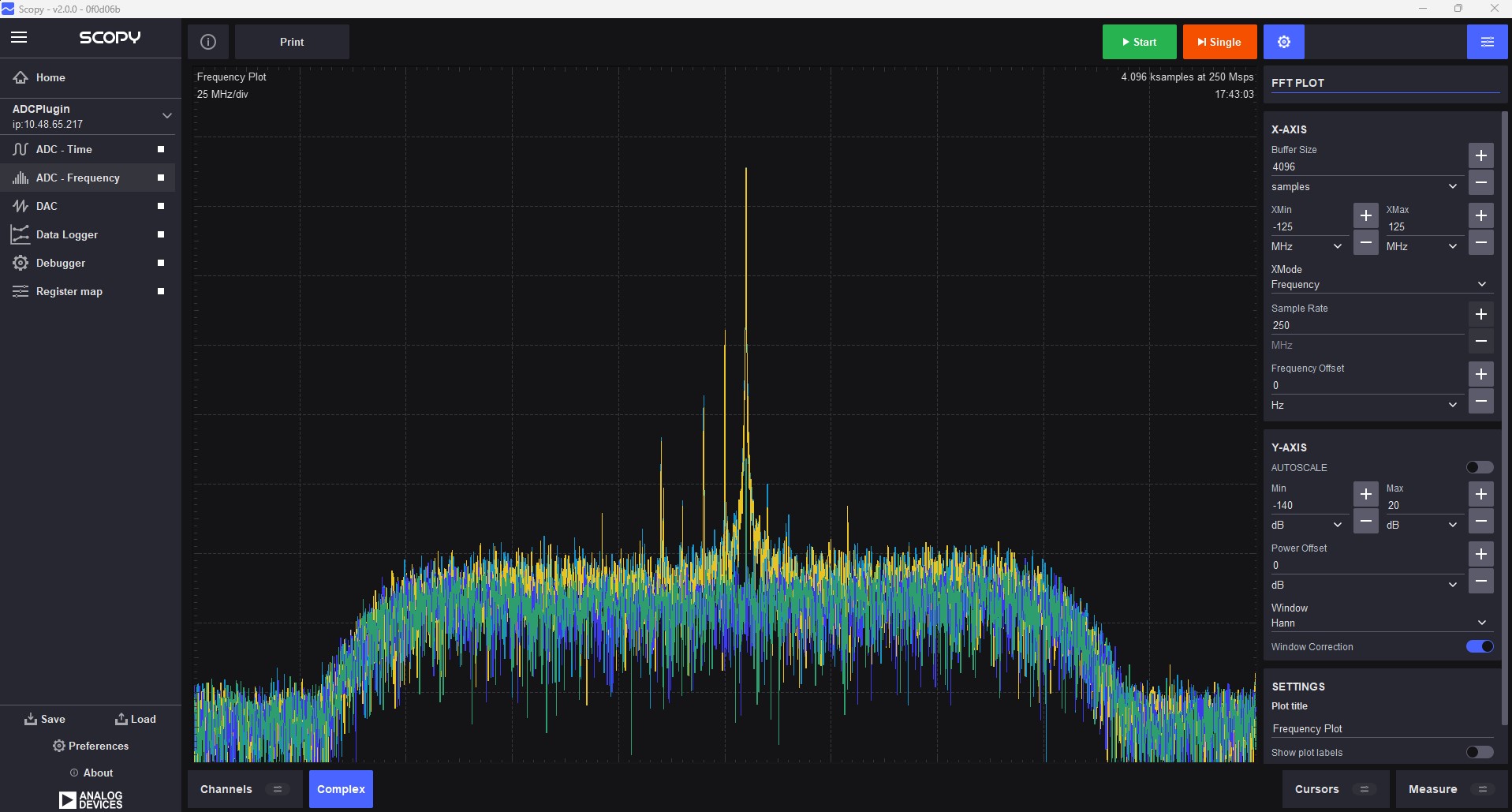
Capture in Data Using Scopy2.0
Captured RF Signal in Time Domain
Captured RF Signal in Frequency Domain
AI Modulation Detection Applications
The following applications are available: