KCU105 Quick Start Guide
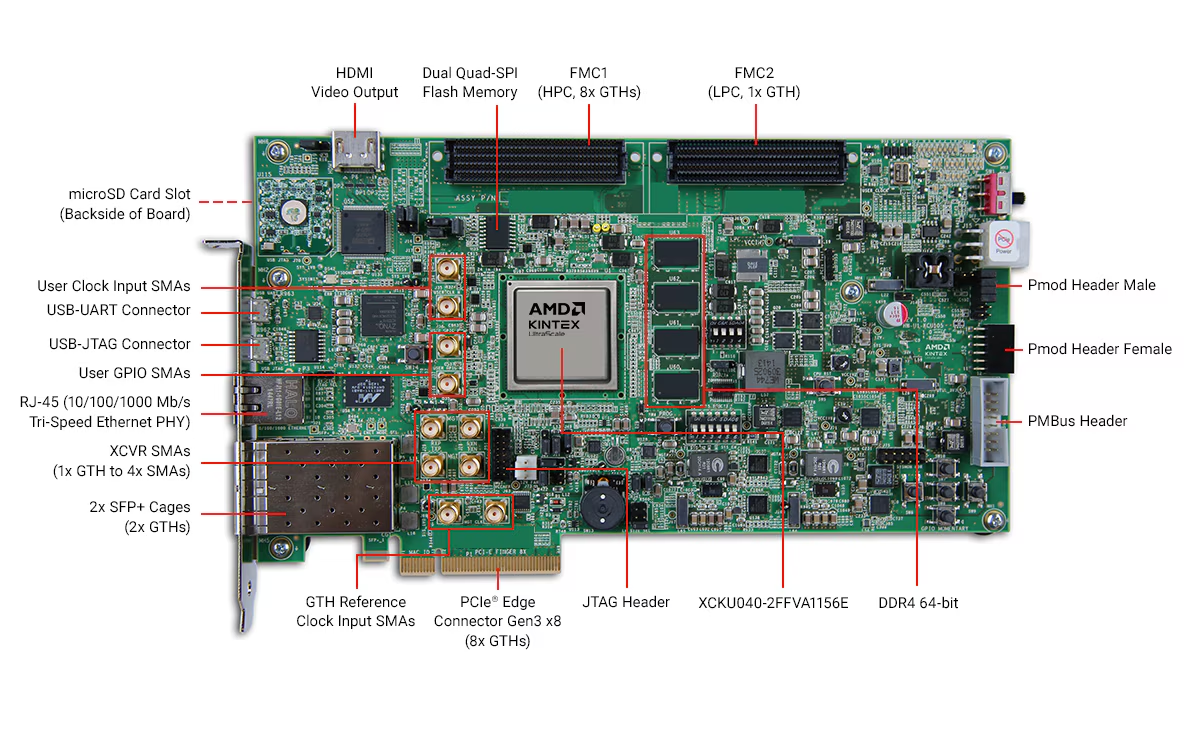
This guide provides some quick instructions on how to setup the EVAL-ADRV9371 on:
All the products described on this page include ESD (electrostatic discharge) sensitive devices. Electrostatic charges as high as 4000V readily accumulate on the human body or test equipment and can discharge without detection. Although the boards feature ESD protection circuitry, permanent damage may occur on devices subjected to high-energy electrostatic discharges. Therefore, proper ESD precautions are recommended to avoid performance degradation or loss of functionality. This includes removing static charge on external equipment, cables, or antennas before connecting to the device.
Using Linux as software
Necessary files
Note
This carrier only has programming logic (PL) and, thus, a MicroBlaze soft core is necessary to run Linux. As such, the files required for running Linux need to be manually built.
The following files are needed for the system to boot:
HDL bitstream file:
system_top.bitLinux Kernel image:
simpleImage.strip
Instructions on how to manually build the boot files from source can be found here:
ADRV9371x HDL reference design build documentation. More HDL build details at Build an HDL project
Important
Some projects provide multiple devicetree files. Make sure you select the devicetree that matches your specific use case when building the simpleImage.
Required Software
AMD Xilinx Vivado and Vitis (downloading Vitis from here will include Vivado as well)
A UART terminal (Putty/Tera Term/Minicom, etc.) with baud rate 115200 (8N1)
Required Hardware
KCU105 FPGA board and its power supply
EVAL-ADRV9371 FMC evaluation board
(Optional) 2x SMA cable for analog signal loopback
(Optional) External clock generator
2x Micro-USB cable (UART and JTAG)
(Optional) Ethernet cable
More details as to why you need these, can be found at Prerequisites.
Testing
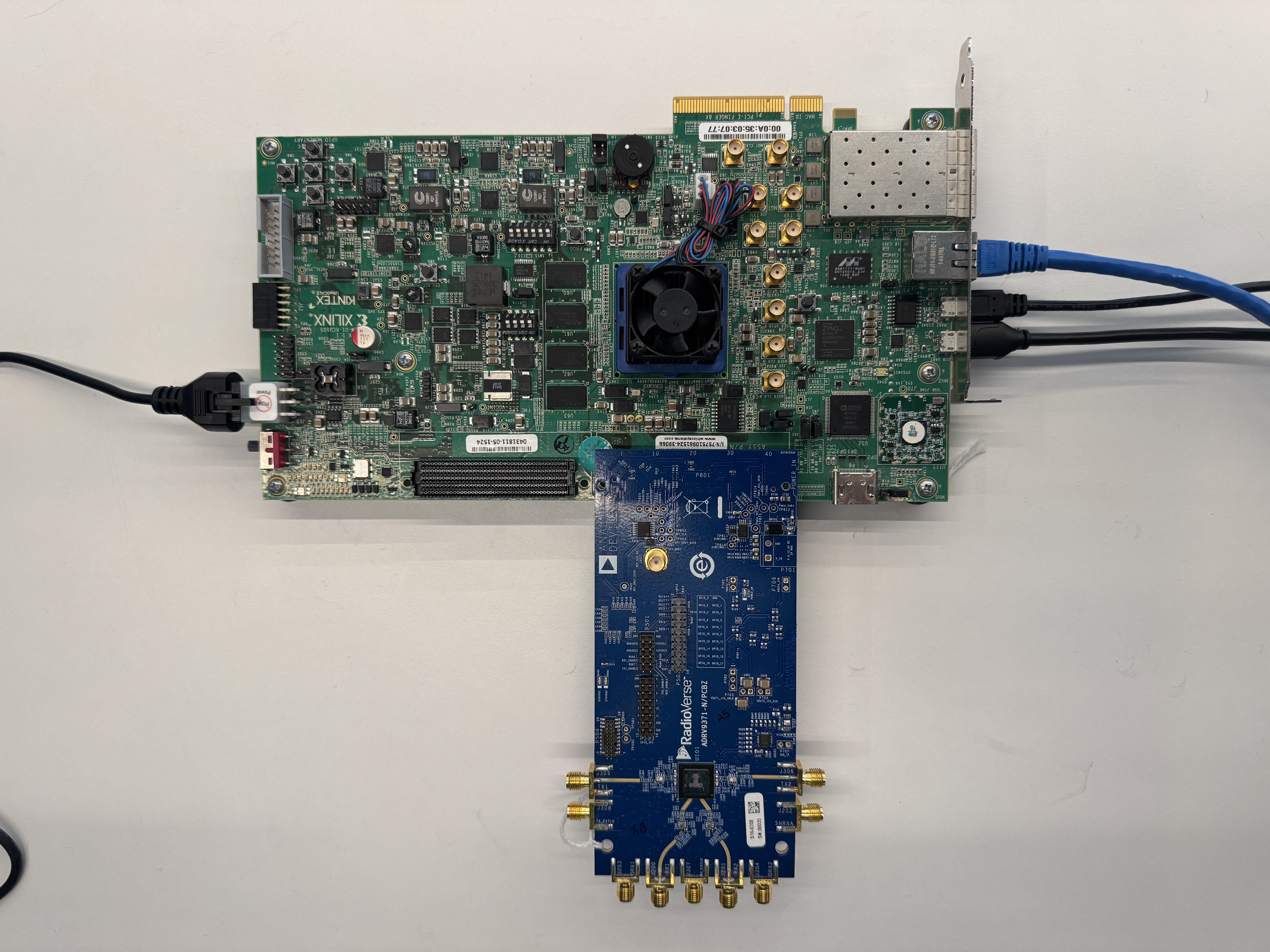
Creating the setup
Caution
This project was tested with VADJ = 1.8 V
Follow the steps in this order, to avoid damaging the components:
Connect the EVAL-ADRV9371 FMC board to the KCU105 FMC HPC socket
Connect USB UART J4 (Micro-USB) to your host PC
Connect USB JTAG J87 (Micro-USB) to your host PC
(Optional) Connect the external clock generator and/or loopback cables
(Optional) Plug-in an Ethernet cable from your router/switch to the Ethernet port on the FPGA board
Plug in the power supply and turn on the power switch on the FPGA board
Program the FPGA using the steps shown here.
Observe console output messages on your terminal (use the first ttyUSB or COM port registered)
Booting the System
After turning on the power switch the following messages should appear on the serial console:
Ramdisk addr 0x00000000,
Compiled-in FDT at 0x8084a498
earlycon: uartlite_a0 at MMIO 0x40600000 (options '115200n8')
printk: legacy bootconsole [uartlite_a0] enabled
cma: Reserved 512 MiB at 0x8fc00000 on node -1
Linux version 6.12.0-gc894bed472b7 (vsts@runnervmrr3dg) (microblazeel-xilinx-elf-gcc (crosstool-NG 1.26.0) 13.2.0, GNU ld (crosstool-NG 1.26.0) 2.40) #9 Wed Apr  1 14:47:04 UTC 2026
setup_memory: max_mapnr: 0x7ffff
setup_memory: min_low_pfn: 0x80000
setup_memory: max_low_pfn: 0xb0000
setup_memory: max_pfn: 0xfffff
Zone ranges:
  DMA      [mem 0x0000000080000000-0x00000000afffffff]
  Normal   empty
  HighMem  [mem 0x00000000b0000000-0x00000000ffffefff]
Movable zone start for each node
Early memory node ranges
  node   0: [mem 0x0000000080000000-0x00000000ffffefff]
Initmem setup node 0 [mem 0x0000000080000000-0x00000000ffffefff]
setup_cpuinfo: initialising
setup_cpuinfo: Using full CPU PVR support
wt_msr_noirq
pcpu-alloc: s0 r0 d32768 u32768 alloc=1*32768
pcpu-alloc: [0] 0
Kernel command line: earlycon
Dentry cache hash table entries: 32768 (order: 5, 131072 bytes, linear)
Inode-cache hash table entries: 16384 (order: 4, 65536 bytes, linear)
Built 1 zonelists, mobility grouping on.  Total pages: 524287
mem auto-init: stack:all(zero), heap alloc:off, heap free:off
SLUB: HWalign=32, Order=0-3, MinObjects=0, CPUs=1, Nodes=1
NR_IRQS: 64, nr_irqs: 64, preallocated irqs: 0
irq-xilinx: mismatch in kind-of-intr param
irq-xilinx: /amba_pl/interrupt-controller@41200000: num_irq=16, edge=0xffff0470
/amba_pl/timer@41c00000: irq=1
clocksource: xilinx_clocksource: mask: 0xffffffff max_cycles: 0xffffffff, max_idle_ns: 19112604467 ns
xilinx_timer_shutdown
xilinx_timer_set_periodic
sched_clock: 32 bits at 100MHz, resolution 10ns, wraps every 21474836475ns
Console: colour dummy device 80x25
printk: legacy console [tty0] enabled
printk: legacy bootconsole [uartlite_a0] disabled
Ramdisk addr 0x00000000,
Compiled-in FDT at 0x8084a498
earlycon: uartlite_a0 at MMIO 0x40600000 (options '115200n8')
printk: legacy bootconsole [uartlite_a0] enabled
cma: Reserved 512 MiB at 0x8fc00000 on node -1
Linux version 6.12.0-gc894bed472b7 (vsts@runnervmrr3dg) (microblazeel-xilinx-elf-gcc (crosstool-NG 1.26.0) 13.2.0, GNU ld (crosstool-NG 1.26.0) 2.40) #9 Wed Apr  1 14:47:04 UTC 2026
setup_memory: max_mapnr: 0x7ffff
setup_memory: min_low_pfn: 0x80000
setup_memory: max_low_pfn: 0xb0000
setup_memory: max_pfn: 0xfffff
Zone ranges:
  DMA      [mem 0x0000000080000000-0x00000000afffffff]
  Normal   empty
  HighMem  [mem 0x00000000b0000000-0x00000000ffffefff]
Movable zone start for each node
Early memory node ranges
  node   0: [mem 0x0000000080000000-0x00000000ffffefff]
Initmem setup node 0 [mem 0x0000000080000000-0x00000000ffffefff]
setup_cpuinfo: initialising
setup_cpuinfo: Using full CPU PVR support
wt_msr_noirq
pcpu-alloc: s0 r0 d32768 u32768 alloc=1*32768
pcpu-alloc: [0] 0
Kernel command line: earlycon
Dentry cache hash table entries: 32768 (order: 5, 131072 bytes, linear)
Inode-cache hash table entries: 16384 (order: 4, 65536 bytes, linear)
Built 1 zonelists, mobility grouping on.  Total pages: 524287
mem auto-init: stack:all(zero), heap alloc:off, heap free:off
SLUB: HWalign=32, Order=0-3, MinObjects=0, CPUs=1, Nodes=1
NR_IRQS: 64, nr_irqs: 64, preallocated irqs: 0
irq-xilinx: mismatch in kind-of-intr param
irq-xilinx: /amba_pl/interrupt-controller@41200000: num_irq=16, edge=0xffff0470
/amba_pl/timer@41c00000: irq=1
clocksource: xilinx_clocksource: mask: 0xffffffff max_cycles: 0xffffffff, max_idle_ns: 19112604467 ns
xilinx_timer_shutdown
xilinx_timer_set_periodic
sched_clock: 32 bits at 100MHz, resolution 10ns, wraps every 21474836475ns
Console: colour dummy device 80x25
printk: legacy console [tty0] enabled
printk: legacy bootconsole [uartlite_a0] disabled
Calibrating delay loop... 49.35 BogoMIPS (lpj=246784)
pid_max: default: 32768 minimum: 301
Mount-cache hash table entries: 1024 (order: 0, 4096 bytes, linear)
Mountpoint-cache hash table entries: 1024 (order: 0, 4096 bytes, linear)
Memory: 1533144K/2097148K available (8489K kernel code, 698K rwdata, 7136K rodata, 208K init, 193K bss, 39240K reserved, 524288K cma-reserved, 1310716K highmem)
devtmpfs: initialized
clocksource: jiffies: mask: 0xffffffff max_cycles: 0xffffffff, max_idle_ns: 19112604462750000 ns
futex hash table entries: 256 (order: -1, 3072 bytes, linear)
NET: Registered PF_NETLINK/PF_ROUTE protocol family
DMA: preallocated 256 KiB GFP_KERNEL pool for atomic allocations
DMA: preallocated 256 KiB GFP_KERNEL|GFP_DMA pool for atomic allocations
pps_core: LinuxPPS API ver. 1 registered
pps_core: Software ver. 5.3.6 - Copyright 2005-2007 Rodolfo Giometti <giometti@linux.it>
PTP clock support registered
jesd204: found 0 devices and 0 topologies
vgaarb: loaded
clocksource: Switched to clocksource xilinx_clocksource
NET: Registered PF_INET protocol family
IP idents hash table entries: 4096 (order: 3, 32768 bytes, linear)
tcp_listen_portaddr_hash hash table entries: 1024 (order: 0, 4096 bytes, linear)
Table-perturb hash table entries: 65536 (order: 6, 262144 bytes, linear)
TCP established hash table entries: 2048 (order: 1, 8192 bytes, linear)
TCP bind hash table entries: 2048 (order: 2, 16384 bytes, linear)
TCP: Hash tables configured (established 2048 bind 2048)
UDP hash table entries: 256 (order: 0, 4096 bytes, linear)
UDP-Lite hash table entries: 256 (order: 0, 4096 bytes, linear)
NET: Registered PF_UNIX/PF_LOCAL protocol family
RPC: Registered named UNIX socket transport module.
RPC: Registered udp transport module.
RPC: Registered tcp transport module.
RPC: Registered tcp-with-tls transport module.
RPC: Registered tcp NFSv4.1 backchannel transport module.
PCI: CLS 0 bytes, default 32
workingset: timestamp_bits=30 max_order=19 bucket_order=0
Key type cifs.idmap registered
jffs2: version 2.2. (NAND) (SUMMARY)  © 2001-2006 Red Hat, Inc.
romfs: ROMFS MTD (C) 2007 Red Hat, Inc.
bounce: pool size: 64 pages
io scheduler mq-deadline registered
io scheduler kyber registered
Serial: 8250/16550 driver, 4 ports, IRQ sharing disabled
40600000.serial: ttyUL0 at MMIO 0x40600000 (irq = 4, base_baud = 0) is a uartlite
printk: legacy console [ttyUL0] enabled
uartlite 41400000.serial: error -EINVAL: could not read current-speed
uartlite 41400000.serial: probe with driver uartlite failed with error -22
brd: module loaded
xilinx_axienet 40e00000.ethernet: missing/invalid xlnx,addrwidth property, using default
i2c_dev: i2c /dev entries driver
pca954x 0-0075: supply vdd not found, using dummy regulator
i2c i2c-0: Added multiplexed i2c bus 1
at24 2-0050: supply vcc not found, using dummy regulator
at24 2-0050: 256 byte 24c02 EEPROM, writable, 1 bytes/write
i2c i2c-0: Added multiplexed i2c bus 2
i2c i2c-0: Added multiplexed i2c bus 3
i2c i2c-0: Added multiplexed i2c bus 4
pca954x 0-0075: registered 4 multiplexed busses for I2C mux pca9544
ad9528 spi0.0: supply vcc not found, using dummy regulator
axi_sysid 45000000.axi-sysid-0: AXI System ID core version (1.01.a) found
axi_sysid 45000000.axi-sysid-0: [adrv9371x] [RX:M=4 L=2 S=1 TX:M=4 L=4 S=1 RX_OS:M=2 L=2 S=1 DAC_OFFLOAD:TYPE=0 SIZE=1048576] on [kcu105] git branch <hdl_2026_r1> git <5da8736cb717e92a827934dd1c272b5c07c8e871> clean [2026-04-01 03:23:51] UTC
Initializing XFRM netlink socket
NET: Registered PF_INET6 protocol family
Segment Routing with IPv6
In-situ OAM (IOAM) with IPv6
sit: IPv6, IPv4 and MPLS over IPv4 tunneling driver
NET: Registered PF_PACKET protocol family
NET: Registered PF_KEY protocol family
Key type dns_resolver registered
Key type encrypted registered
axi_adxcvr_drv 44a60000.axi-adxcvr-rx: AXI-ADXCVR-RX (17.05.a) using CPLL on GTH3. Number of lanes: 2.
axi_adxcvr_drv 44a50000.axi-adxcvr-rx-os: AXI-ADXCVR-RX (17.05.a) using CPLL on GTH3. Number of lanes: 2.
axi_adxcvr_drv 44a80000.axi-adxcvr-tx: AXI-ADXCVR-TX (17.05.a) using QPLL on GTH3. Number of lanes: 4.
axi-jesd204-rx 44aa0000.axi-jesd204-rx: AXI-JESD204-RX (1.07.a). Encoder 8b10b, width 4/4, lanes 2.
axi-jesd204-rx 44ab0000.axi-jesd204-rx: AXI-JESD204-RX (1.07.a). Encoder 8b10b, width 4/4, lanes 2.
axi-jesd204-tx 44a90000.axi-jesd204-tx: AXI-JESD204-TX (1.06.a). Encoder 8b10b, width 4/4, lanes 4.
ad9371 spi0.1: ad9371_probe : enter
random: crng init done
ad9371 spi0.1: AD9371 Rev 4, Firmware 5.2.2 API version: 1.5.2.3566 successfully initialized
cf_axi_dds 44a04000.axi-ad9371-tx-hpc: Analog Devices CF_AXI_DDS_DDS MASTER (9.02.b) at 0x44A04000 mapped to 0xd896f056, probed DDS AD9371
cf_axi_adc 44a00000.axi-ad9371-rx-hpc: ADI AIM (10.03.) probed ADC AD9371 as MASTER
clk: Disabling unused clocks
Freeing unused kernel image (initmem) memory: 208K
This architecture does not have kernel memory protection.
Run /init as init process
  with arguments:
    /init
  with environment:
    HOME=/
    TERM=linux
Starting syslogd: OK
Starting klogd: OK
Running sysctl: OK
Saving 256 bits of creditable seed for next boot
Starting network: udhcpc: started, v1.36.1
xilinx_axienet 40e00000.ethernet eth0: PHY [axienet-40e00000:07] driver [Marvell 88E1111] (irq=POLL)
xilinx_axienet 40e00000.ethernet eth0: configuring for phy/sgmii link mode
udhcpc: broadcasting discover
xilinx_axienet 40e00000.ethernet eth0: Link is Up - 1Gbps/Full - flow control off
udhcpc: broadcasting discover
udhcpc: broadcasting discover
udhcpc: broadcasting select for 10.48.65.165, server 10.48.65.20
udhcpc: lease of 10.48.65.165 obtained from 10.48.65.20, lease time 21600
deleting routers
adding dns 10.32.51.110
adding dns 10.64.53.110
Starting dropbear sshd: OK
Starting IIO Server Daemon

Welcome to Buildroot
buildroot login:
Note
When prompted for login, use the following credentials:
username: root
password: analog
Useful commands for the serial terminal
The below commands are to be run in the serial terminal connected to the FPGA.
To find out the IP of the FPGA board, run the following command and take the IP specified at “eth0 inet”:
~$
ifconfig
To see the IIO devices detected, run:
# iio_info | grep :device
iio:device0: ad7291
iio:device1: ad9528-1
iio:device2: ad9371-phy
iio:device3: axi-ad9371-rx-obs-hpc (buffer capable)
iio:device4: axi-ad9371-tx-hpc (buffer capable)
iio:device5: axi-ad9371-rx-hpc (buffer capable)
To use the JESD204 status utility, run:
~$
jesd_status
To power off the system, run the following command, and wait for the final message to be printed, then power off the FPGA board from the switch as well.
~$
poweroff
Using no-OS as software
Necessary files
The following files are needed for the system to boot:
HDL boot file:
system_top.xsano-OS project: projects/ad9371
Instructions on how to build the boot files from source can be found here:
ADRV9371x HDL reference design. More HDL build details at Build an HDL project
AD9371 no-OS Example Project. More no-OS build details at No-OS Build Guide
Required Software
AMD Xilinx Vivado and Vitis (downloading Vitis from here will include Vivado as well)
An UART terminal (Putty/Tera Term/Minicom, etc.), Baud rate 115200 (8N1)
Required Hardware
AMD Xilinx KCU105 FPGA board and its power supply
EVAL-ADRV9371 FMC evaluation board
2x Micro-USB cables, one for UART and one for JTAG
(Optional) 2x SMA cable for analog signal loopback
(Optional) External clock generator
More details as to why you need these, can be found at Prerequisites.
Testing
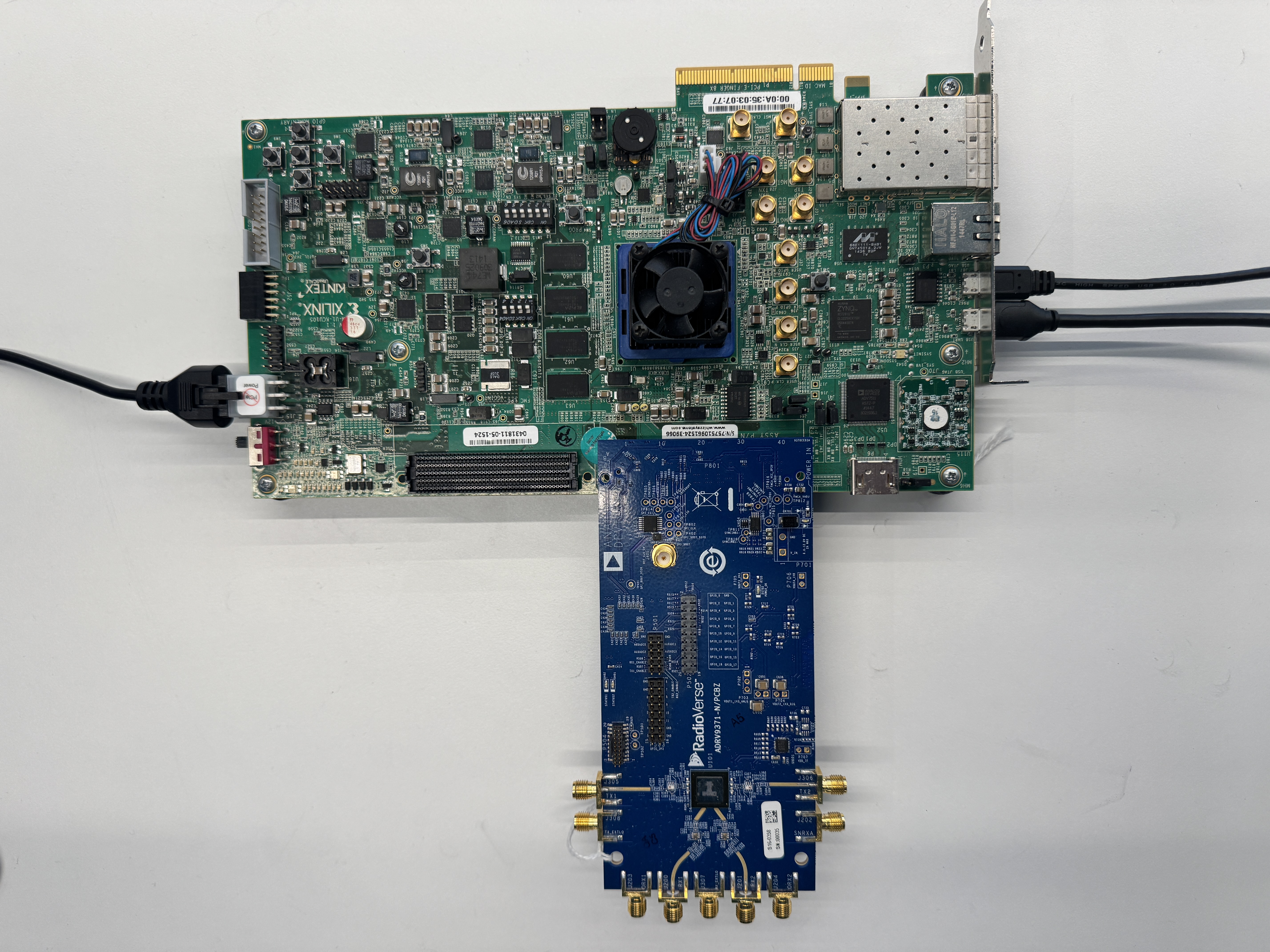
Creating the setup
Caution
This project was tested with VADJ = 1.8 V
Follow the steps in this order, to avoid damaging the components:
Connect the EVAL-ADRV9371 FMC board to the KCU105 FMC HPC socket
Connect USB UART J4 (Micro-USB) to your host PC
Connect USB JTAG J87 (Micro-USB) to your host PC
(Optional) Connect the external clock generator and/or loopback cables
Plug in the power supply and turn on the power switch on the FPGA board
Build and run the project using the steps shown here.
Observe console output messages on your terminal (use the first ttyUSB or COM port registered)
Console output
The following is what is printed in the serial console, after you have connected to the proper ttyUSB or COM port:
Please wait...
WARNING: AD9528_initialize() issues. Possible cause: REF_CLK not connected.
rx_clkgen: MMCM-PLL locked (122880000 Hz)
tx_clkgen: MMCM-PLL locked (122880000 Hz)
rx_os_clkgen: MMCM-PLL locked (122880000 Hz)
MCS successful
CLKPLL locked
AD9371 ARM version 5.2.2
PLLs locked
Calibrations completed successfully
tx_adxcvr: OK (4915200 kHz)
rx_adxcvr: OK (4915200 kHz)
rx_os_adxcvr: OK (4915200 kHz)
rx_jesd status:
        Link is enabled
        Measured Link Clock: 122.878 MHz
        Reported Link Clock: 122.880 MHz
        Lane rate: 4915.200 MHz
        Lane rate / 40: 122.880 MHz
        LMFC rate: 3.840 MHz
        Link status: DATA
        SYSREF captured: Yes
        SYSREF alignment error: No
rx_jesd lane 0 status:
Errors: 0
        CGS state: DATA
        Initial Frame Synchronization: Yes
        Lane Latency: 1 Multi-frames and 66 Octets
        Initial Lane Alignment Sequence: Yes
        DID: 0, BID: 0, LID: 0, L: 2, SCR: 1, F: 4
        K: 32, M: 4, N: 16, CS: 0, N': 16, S: 1, HD: 0
        FCHK: 0x47, CF: 0
        ADJCNT: 0, PHADJ: 0, ADJDIR: 0, JESDV: 1, SUBCLASS: 1
        FC: 4915200 kHz
rx_jesd lane 1 status:
Errors: 0
        CGS state: DATA
        Initial Frame Synchronization: Yes
        Lane Latency: 1 Multi-frames and 65 Octets
        Initial Lane Alignment Sequence: Yes
        DID: 0, BID: 0, LID: 1, L: 2, SCR: 1, F: 4
        K: 32, M: 4, N: 16, CS: 0, N': 16, S: 1, HD: 0
        FCHK: 0x48, CF: 0
        ADJCNT: 0, PHADJ: 0, ADJDIR: 0, JESDV: 1, SUBCLASS: 1
        FC: 4915200 kHz
tx_jesd status:
        Link is enabled
        Measured Link Clock: 122.876 MHz
        Reported Link Clock: 122.880 MHz
        Lane rate: 4915.200 MHz
        Lane rate / 40: 122.880 MHz
        LMFC rate: 7.680 MHz
        SYNC~: deasserted
        Link status: DATA
        SYSREF captured: Yes
        SYSREF alignment error: No
rx_os_jesd status:
        Link is enabled
        Measured Link Clock: 122.876 MHz
        Reported Link Clock: 122.880 MHz
        Lane rate: 4915.200 MHz
        Lane rate / 40: 122.880 MHz
        LMFC rate: 7.680 MHz
        Link status: DATA
        SYSREF captured: Yes
        SYSREF alignment error: No
rx_os_jesd lane 0 status:
Errors: 0
        CGS state: DATA
        Initial Frame Synchronization: Yes
        Lane Latency: 2 Multi-frames and 2 Octets
        Initial Lane Alignment Sequence: Yes
        DID: 0, BID: 0, LID: 0, L: 2, SCR: 1, F: 2
        K: 32, M: 2, N: 16, CS: 0, N': 16, S: 1, HD: 0
        FCHK: 0x43, CF: 0
        ADJCNT: 0, PHADJ: 0, ADJDIR: 0, JESDV: 1, SUBCLASS: 1
        FC: 4915200 kHz
rx_os_jesd lane 1 status:
Errors: 0
        CGS state: DATA
        Initial Frame Synchronization: Yes
        Lane Latency: 1 Multi-frames and 62 Octets
        Initial Lane Alignment Sequence: Yes
        DID: 0, BID: 0, LID: 1, L: 2, SCR: 1, F: 2
        K: 32, M: 2, N: 16, CS: 0, N': 16, S: 1, HD: 0
        FCHK: 0x44, CF: 0
        ADJCNT: 0, PHADJ: 0, ADJDIR: 0, JESDV: 1, SUBCLASS: 1
        FC: 4915200 kHz
tx_dac: Successfully initialized (245755004 Hz)
rx_adc: Successfully initialized (122877502 Hz)
rx_obs_adc: Successfully initialized (245751953 Hz)
Done