AD-FMCOMMS2/3/4/5 Basic IQ Datafiles
DDS Mode - DAC Buffer Output allows loading of Binary and ASCII TEXT sample files.
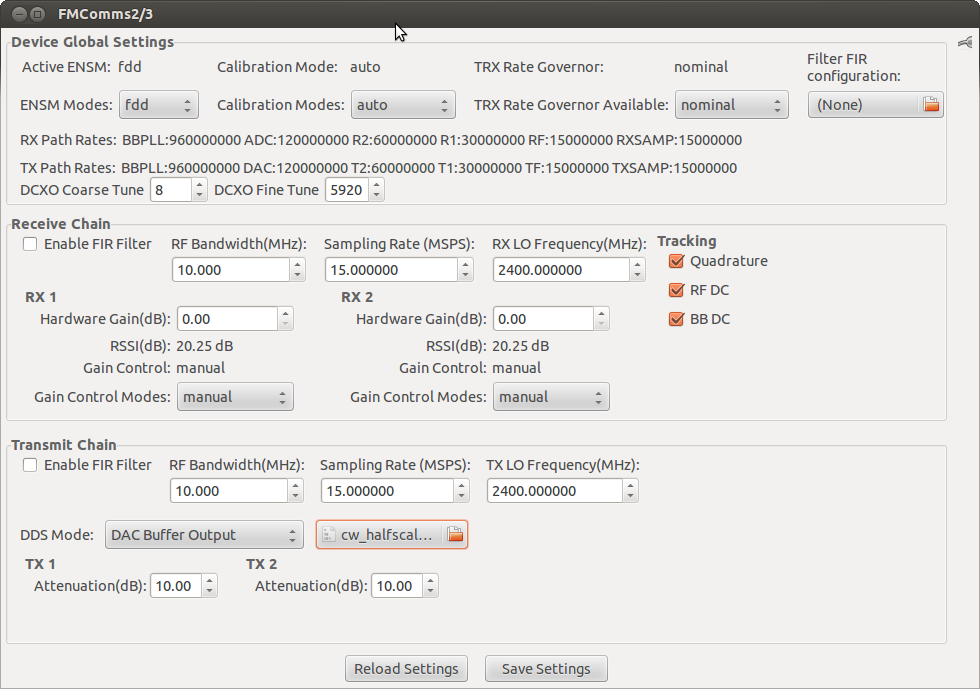
Example files
Filename |
File type |
suggested sample rate |
what it is |
|---|---|---|---|
10.txt |
text file |
any |
basic IQ imbalance test waveform. The frequency that you will see will be determined by the sample rate. |
11.txt |
text file |
any |
basic IQ imbalance test waveform The frequency that you will see will be determined by the sample rate. |
1M_10M_nyq.txt |
text file |
any |
10 point sine wave, generating 1 MHz tone @ 10 MSPS |
LTE5.mat |
MATLAB file |
7.68 MSPS |
Created via lte_example |
LTE10.mat |
MATLAB file |
15.36 MSPS |
Created via lte_example |
LTE15.mat |
MATLAB file |
23.04 MSPS |
Created via lte_example |
LTE20.mat |
MATLAB file |
30.72 MSPS |
Created via lte_example |
msk_20M.txt |
text file |
30.72 MSPS |
MSK waveform |
qam16_20M.txt |
text file |
30.72 MSPS |
16-QAM waveform |
qpsknofilt_30M.txt |
text file |
30.72 MSPS |
QPSK waveforms |
qpskwithfilt_30.72M.txt |
text file |
30.72 MSPS |
QPSK waveforms |
sinewave_0.3.mat |
MATLAB file |
any |
A sine wave with the amplitude of 0.3 for one I & Q channel. This should be scaled to 30% of full scale. The I/Q channel will be duplicated on channel 1 and 2. |
sinewave_0.3_2ch.mat |
MATLAB file |
any |
A sine wave with the amplitude of 0.3 for two I & Q channels. This should be scaled to 30% of full scale. Separate data will be sent on channel 1 and 2. |
sinewave_0.6.mat |
MATLAB file |
any |
A sine wave with the amplitude of 0.6 for one I & Q channel. This should be scaled to 60% of full scale. The I/Q channel will be duplicated on channel 1 and 2. |
sinewave_0.6_2ch.mat |
MATLAB file |
any |
A sine wave with the amplitude of 0.6 for two I & Q channels. This should be scaled to 60% of full scale. Separate data will be sent on channel 1 and 2. |
sinewave_0.9.mat |
MATLAB file |
any |
A sine wave with the amplitude of 0.9 for one I & Q channel. This should be scaled to 90% of full scale. The I/Q channel will be duplicated on channel 1 and 2. |
sinewave_0.9_2ch.mat |
MATLAB file |
any |
A sine wave with the amplitude of 0.9 for two I & Q channels. This should be scaled to 90% of full scale. Separate data will be sent on channel 1 and 2. |
Important
The modulated waveforms (QPSK, MSK, etc) are designed to go through a receiver design. (this would include root raised cosine decimator, equalization, frequency compensation, retiming, etc. and is best looked at by a MathWorks example here). Since there is no default receiver in the default HDL design that ADI provides - looking at things with the osc application - you will not see good results. This is expected, and normal.
Important
These waveforms are provided with IIO-Scope for demonstration purposes, which can be loaded into different devices. However, these are generally not meant for transceiver characterization or demodulation. If you want to do such tasks, we would recommend creation of your own waveforms from tools such as MATLAB.
MATLAB format
The ./osc application uses the MAT File I/O Library to be able to read MATLAB files into the system.
There are two ways to scale the data:
less than ±1.0 : ±1.0 will be assumed as full scale, so something that is ±0.5 will come out as half scale.
more than ±1.0 : The max point in the data will be found, and this will be assumed to be full scale.
There are two ways to arrange the data:
vectors of complex data
vectors of real data. The first vector is Q (real) and second is I (imaginary)
Basic examples are checked into the waveforms directory, which can be loaded up in MATLAB for further explanation.
Binary Format
In binary format each I or Q word is in 16-bit signed format. The AD9361 bus-width is 12-bit. Therefore Bit# 11 becomes Bit# 15. So they are shifted by 4 and the lower 4 bits are ignored.
Buffer Bit |
15 |
14 |
13 |
12 |
11 |
10 |
9 |
8 |
7 |
6 |
5 |
4 |
3 |
2 |
1 |
0 |
|---|---|---|---|---|---|---|---|---|---|---|---|---|---|---|---|---|
AD9361 Bit |
11 |
10 |
9 |
8 |
7 |
6 |
5 |
4 |
3 |
2 |
1 |
0 |
X |
X |
X |
X |
An I and Q word together make up one complex symbol for one output channel.
The AD9361 features two outputs. In the 2TX output configuration a complete sample consists of two complex IQ symbols, one for each transmitter. It’s therefore 64-bit wide.
TX 0 |
TX 1 |
||
I0 |
Q0 |
I1 |
Q1 |
ASCII Format
A valid ASCII file is prefixed with a ‘TEXT’ magic string. Values are delimited by either comma, spaces or tabs.
Samples are separated by rows.
In a 2TX configuration, with only one symbol given per line - it will be repeated for the second TX.
TEXT
501.000000000   -1.000000000
405.000000000   294.000000000
155.000000000   476.000000000
-154.000000000  475.000000000
...
Two Symbols per line - one for TX1 and TX2
TEXT
0.0002274,0.0002274,0.0002274,-0.0002274
-0.002085,-0.002085,-0.002085,0.002085
-0.001768,-0.001768,-0.001768,0.001768
0.001351,0.001351,0.001351,-0.001351
...
Tip
The file is being analyzed and automatically scalexd to full scale!
The latest version of the fmcomms IIO scope plug-in supports the TEXTU option. Valid range with the ‘TEXTU’ option is:
Board |
Range |
|---|---|
fmcomms1 |
+/- 32767.0 |
fmcomms2/3/4 |
+/- 2047.0 |
Sample C code Application
#include <stdio.h>
#include <stdlib.h>
#include <stdint.h>
#include <stdarg.h>
#include <errno.h>
#include <unistd.h>
#include <math.h>

int main (int argc , char* argv[])
{
    FILE *file;
    int i, c, f = 10, j, d = 1;
    unsigned int *buf;
    double ampl;
    short ipart, qpart;

    while ((c = getopt (argc, argv, "f:a:s")) != -1)
        switch (c) {
        case 'f':
            f = atoi(optarg);
            break;
        case 'a':
            ampl = atof(optarg);
            break;
        case 's':
            d = 0;
            break;
        default:
            return 0;
    }

    buf = malloc(f * (d ? 8 : 4));

    if (ampl > 1.0)
        ampl = 1.0;
    else if (ampl < 0.0)
        ampl = 0.0;

    /* AD9361 12-bit MSB aligned [(2^(12-1) - 1) * 16]
     * AD9122 16-bit         [2^(16-1) - 1]
     */

    ampl = ampl * 32767;

    printf("32-bit Word: I : Q\n");

    for (i = 0, j = 0; i < (f); i++) {
        ipart = ampl * sin(2 * M_PI * (double)i / (double)(f));
        qpart = ampl * cos(2 * M_PI * (double)i / (double)(f));

        printf("0x%.8X : %d : %d\n", (ipart << 16) | (qpart & 0xFFFF),  ipart, qpart);

        buf[j++] = (ipart << 16) | (qpart & 0xFFFF);

        if (d) /* Second Channel */
            buf[j++] = (ipart << 16) | (qpart & 0xFFFF);

    }

    file = fopen(argv[optind], "w");
    if (file == NULL) {
        free(buf);
        exit(EXIT_FAILURE);
    }

    fwrite(buf, (d ? 8 : 4), f, file);
    fclose(file);
    free(buf);

    exit(EXIT_SUCCESS);
}
Compiling the Sample Application
This specifies any shell prompt running on the target
root@linaro-ubuntu-desktop:/opt# gcc do_iq.c -o do_iq -lm
Usage Examples
This specifies any shell prompt running on the target
root@linaro-ubuntu-desktop:/opt# ./do_iq -a 1.0 -f 20 cw_fullscale_f20.bin
32-bit Word: I : Q
0x00007FFF : 0 : 32767
0x278D79BB : 10125 : 31163
0x4B3B678D : 19259 : 26509
0x678D4B3B : 26509 : 19259
0x79BB278D : 31163 : 10125
0x7FFF0000 : 32767 : 0
0x79BBD873 : 31163 : -10125
0x678DB4C5 : 26509 : -19259
0x4B3B9873 : 19259 : -26509
0x278D8645 : 10125 : -31163
0x00008001 : 0 : -32767
0xD8738645 : -10125 : -31163
0xB4C59873 : -19259 : -26509
0x9873B4C5 : -26509 : -19259
0x8645D873 : -31163 : -10125
0x80010000 : -32767 : 0
0x8645278D : -31163 : 10125
0x98734B3B : -26509 : 19259
0xB4C5678D : -19259 : 26509
0xD87379BB : -10125 : 31163
This specifies any shell prompt running on the target
root@linaro-ubuntu-desktop:/opt# ./do_iq -a 0.5 -f 20 cw_halfscale_f20.bin
32-bit Word: I : Q
0x00003FFF : 0 : 16383
0x13C63CDD : 5062 : 15581
0x259D33C6 : 9629 : 13254
0x33C6259D : 13254 : 9629
0x3CDD13C6 : 15581 : 5062
0x3FFF0000 : 16383 : 0
0x3CDDEC3A : 15581 : -5062
0x33C6DA63 : 13254 : -9629
0x259DCC3A : 9629 : -13254
0x13C6C323 : 5062 : -15581
0x0000C001 : 0 : -16383
0xEC3AC323 : -5062 : -15581
0xDA63CC3A : -9629 : -13254
0xCC3ADA63 : -13254 : -9629
0xC323EC3A : -15581 : -5062
0xC0010000 : -16383 : 0
0xC32313C6 : -15581 : 5062
0xCC3A259D : -13254 : 9629
0xDA6333C6 : -9629 : 13254
0xEC3A3CDD : -5062 : 15581
root@linaro-ubuntu-desktop:/opt#