EVAL-ADAQ7980-SDZ
16-Bit SAR ADC Subsystem with Integrated Signal Conditioning.
Overview
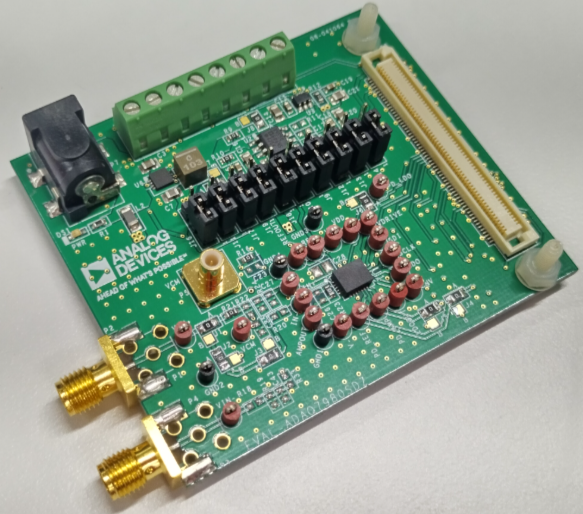
The EVAL-ADAQ7980-SDZ evaluation board enables quick and easy evaluation of the performance and features of the ADAQ7980 and ADAQ7988 16-bit analog-to-digital converter (ADC) subsystems.
The ADAQ7980/ADAQ7988 are 16-bit analog-to-digital converter (ADC) subsystems that integrate four common signal processing and conditioning blocks into a system in package (SiP) design that supports a variety of applications. These devices contain the most critical passive components, eliminating many of the design challenges associated with traditional signal chains that use successive approximation register (SAR) ADCs. These passive components are crucial to achieving the specified device performance.
The ADAQ7980/ADAQ7988 contain a high accuracy, low power, 16-bit SAR ADC, a low power, high bandwidth, high input impedance ADC driver, a low power, stable reference buffer, and an efficient power management block. Housed within a tiny, 5 mm x 4 mm LGA package, these systems simplify the design process for data acquisition systems. The level of system integration of the ADAQ7980/ADAQ7988 solves many design challenges, while the devices still provide the flexibility of a configurable ADC driver feedback loop to allow gain and/or common-mode adjustments. A set of four device supplies provides optimal system performance; however, single-supply operation is possible with minimal impact on device operating specifications.
Using the SDI input, the SPI-compatible serial interface features the ability to daisy-chain multiple devices on a single, 3-wire bus and provides an optional busy indicator. The user interface is compatible with 1.8 V, 2.5 V, 3 V, or 5 V logic. Specified operation of these devices is from -55°C to +125°C.
This user guide will discuss how to use the ZedBoard FPGA development board and evaluation software to configure and collect data from the EVAL-ADAQ7980-SDZ.
Features:
High accuracy 16-bit SAR ADC subsystem
Integrated ADC driver with configurable feedback loop
Low power, stable reference buffer
Efficient power management block
SPI-compatible serial interface with daisy-chain capability
Wide supply voltage compatibility (1.8 V to 5 V logic)
Extended temperature range (-55°C to +125°C)
Applications:
Automated test equipment (ATE)
Battery powered instrumentation
Communications
Data acquisition
Process control
Medical instruments
Recommendations
People who follow the flow that is outlined, have a much better experience with things. However, like many things, documentation is never as complete as it should be. If you have any questions, feel free to ask on our EngineerZone forums, but before that, please make sure you read our documentation thoroughly.
Table of Contents
Getting Started with the Evaluation Board
User guide - evaluation board overview
Prerequisites - required hardware and software
Quickstart - step-by-step setup with ZedBoard
Understanding the Design
Simplified functional block diagram - system architecture overview
SPI Engine Framework - communication interface
Designing Custom Platforms
Product Resources
Simplified functional block diagram
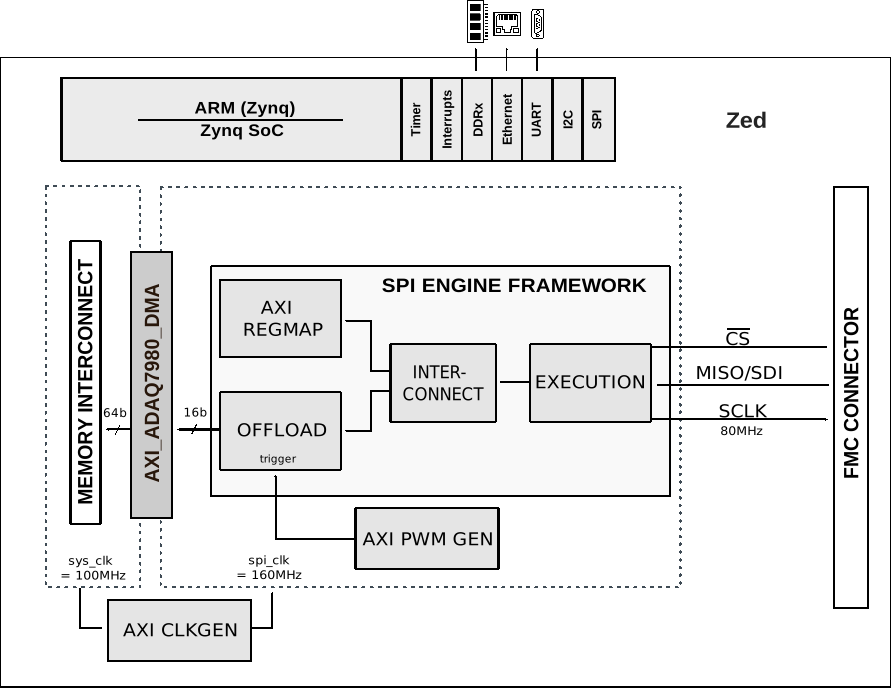
The reference design uses the standard SPI Engine Framework with an integrated pulse generator, which provides the required conversion rate for the ADC.
More Information and Useful Links
Software Projects and Platforms
Warning
All the products described on this page include ESD (electrostatic discharge) sensitive devices. Electrostatic charges as high as 4000V readily accumulate on the human body or test equipment and can discharge without detection. Although the boards feature ESD protection circuitry, permanent damage may occur on devices subjected to high-energy electrostatic discharges. Therefore, proper ESD precautions are recommended to avoid performance degradation or loss of functionality. This includes removing static charge on external equipment, cables, or antennas before connecting to the device.