ADV7511
225 MHz High-Definition Multimedia Interface (HDMI®) transmitter
Overview
The ADV7511 is a 225 MHz High-Definition Multimedia Interface (HDMI®) transmitter designed for applications requiring high-performance video and audio over HDMI. The ADV7511 supports HDMI 1.4 features including 3D video and xvYCC™ color spaces.
The ADV7511 is integrated into several Xilinx evaluation boards including Artix-7, Kintex-7, Virtex-7, and Zynq platforms. This reference design provides the video and audio interface between the FPGA and the on-board ADV7511.
The video uses a 16-bit 422 YCbCr interface (except VC707 which uses 36-bit 444 RGB interface) and the audio uses a single-bit SPDIF interface.
Features:
HDMI 1.4 compliant transmitter
Support for video resolutions up to 1080p
Integrated HDCP engine with key storage
Audio support via I2S, S/PDIF, or DSD
On-chip EDID buffer
RGB, YCbCr 4:4:4, and YCbCr 4:2:2 color space support
CEC support
225 MHz maximum pixel clock
Applications:
Video processing and distribution
Set-top boxes and DVD/Blu-ray players
Gaming consoles
Professional AV equipment
FPGA development and prototyping
Recommendations
People who follow the flow that is outlined, have a much better experience with things. However, like many things, documentation is never as complete as it should be. If you have any questions, feel free to ask on our EngineerZone forums, but before that, please make sure you read our documentation thoroughly.
To better understand the ADV7511, we recommend using the evaluation boards with the ADV7511 integrated on them.
Table of contents
Using the evaluation board/full stack reference design that we offer:
User guide - what you need to know about the evaluation board
Prerequisites - what you need to get started with the setup
Configure an SD Card with Kuiper
Design with the ADV7511
Resources for designing a custom ADV7511-based platform software
For Linux software:
About the device driver:
About the device tree:
HDL reference design which you must use in your FPGA.
Guides for ADV7511
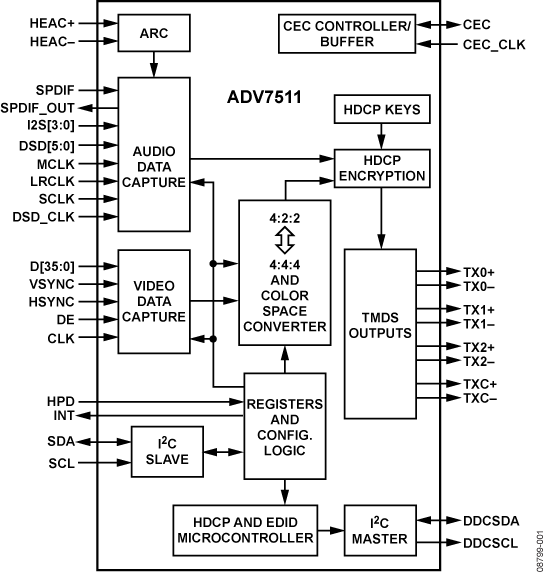
Block diagram
Warning
All the products described on this page include ESD (electrostatic discharge) sensitive devices. Electrostatic charges as high as 4000V readily accumulate on the human body or test equipment and can discharge without detection. Although the boards feature ESD protection circuitry, permanent damage may occur on devices subjected to high-energy electrostatic discharges. Therefore, proper ESD precautions are recommended to avoid performance degradation or loss of functionality. This includes removing static charge on external equipment, cables, or antennas before connecting to the device.