Pulsar ADC
Evaluating 14-/16-/18-Bit ADCs from the 8/10 LEAD PulSAR® Family
Overview
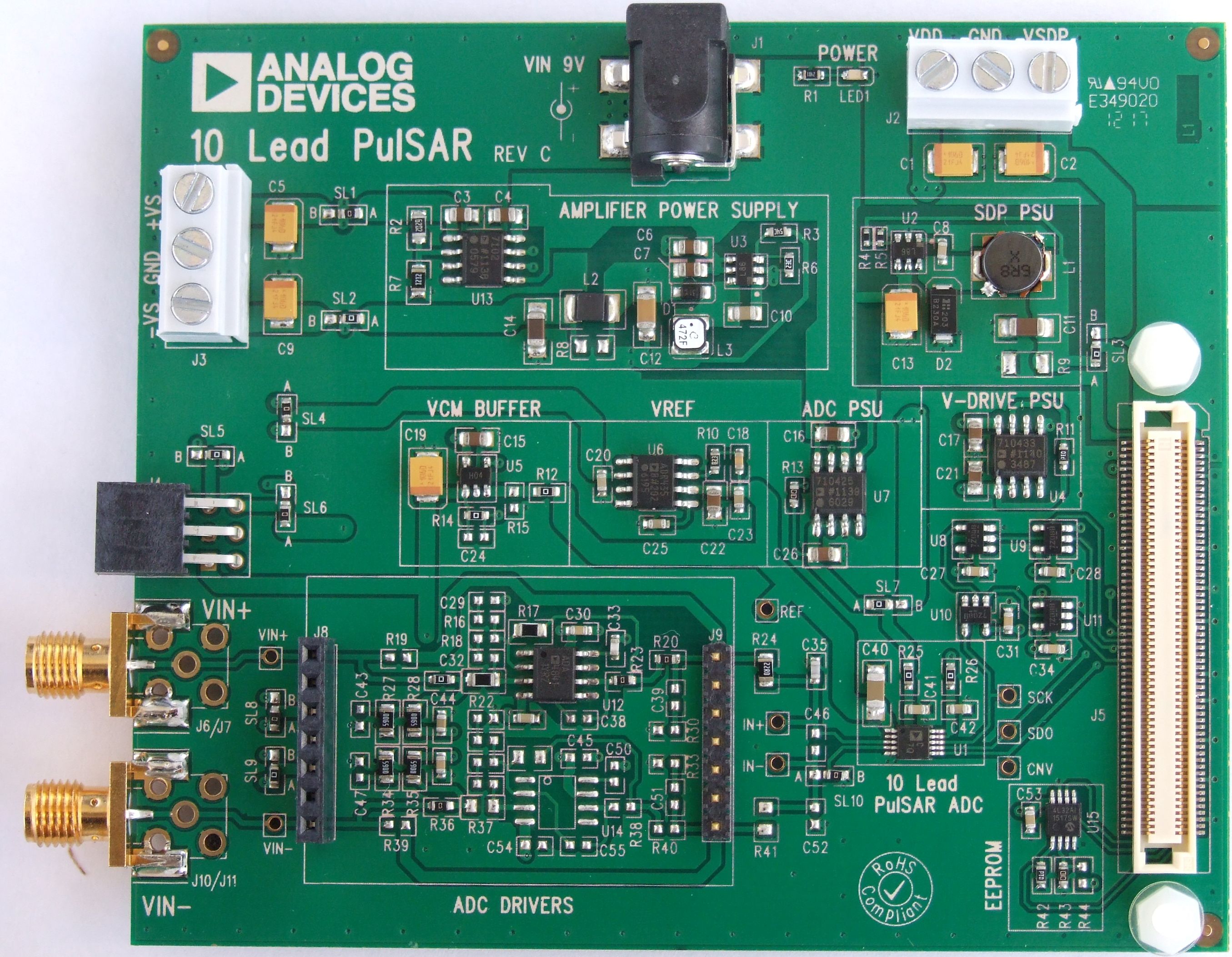
Full-featured evaluation board for 8/10 lead PulSAR® ADCs. Versatile analog signal conditioning circuitry. On-board reference, reference buffers and ADC Drivers. PC software for control and data analysis of time and frequency domain.
These low power ADCs offer very high performance of up to 20 bits with throughputs ranging from 100 kSPS to 2 MSPS. The evaluation boards are designed to demonstrate the ADC’s performance and to provide an easy to understand interface for a variety of system applications. A full description of these products is available in their respective data sheets and should be consulted when utilizing the evaluation boards. On-board components include a high precision buffered band gap 5.0V reference (ADR435), reference buffers (AD8032), a signal conditioning circuit with two op-amps (ADA4841-1) and regulators to derive necessary voltage levels on board (ADP3334, ADP3303). SMB connectors are provided for the low noise analog signal source.
Features:
Full-featured evaluation board for 8/10 lead PulSAR® ADCs
Versatile analog signal conditioning circuitry
On-board reference, reference buffers and ADC Drivers
PC software for control and data analysis of time and frequency domain
Compatible with FPGA carriers via FMC and PMOD connectors
Evaluation Boards:
EVAL-AD400x-FMCZ (FMC connector variant)
EVAL-ADAQ40xx (PMOD connector variant)
Supported Devices
FMC connector variant (EVAL-AD400x-FMCZ) — ZedBoard carrier:
Part Name |
Resolution |
Description |
|---|---|---|
16-bit |
2 MSPS/1 MSPS/500 kSPS, Precision, Pseudo Differential, SAR ADCs |
|
16-bit |
2 MSPS/1 MSPS, Precision, Differential SAR ADCs |
|
18-bit |
2 MSPS/1 MSPS/500 kSPS, Precision, Pseudo Differential, SAR ADCs |
|
18-bit |
2 MSPS/1 MSPS/500 kSPS, Easy Drive, Differential SAR ADCs |
|
16-bit |
2 MSPS/1 MSPS/500 kSPS, Precision, Pseudo Differential, SAR ADCs |
|
16-bit |
2 MSPS/1 MSPS, Precision, Differential SAR ADCs |
|
18-bit |
2 MSPS/1 MSPS/500 kSPS, Precision, Pseudo Differential, SAR ADCs |
|
18-bit |
2 MSPS/1 MSPS/500 kSPS, Easy Drive, Differential SAR ADCs |
|
16-bit |
2 MSPS/1 MSPS/500 kSPS, Precision, Pseudo Differential, SAR ADCs |
|
18-bit |
2 MSPS/1 MSPS/500 kSPS, Precision, Pseudo Differential, SAR ADCs |
|
18-bit |
2 MSPS/1 MSPS/500 kSPS, Easy Drive, Differential SAR ADCs |
|
20-bit |
1.8 MSPS/1 MSPS/500 kSPS, Easy Drive, Differential SAR ADCs |
|
20-bit |
1.8 MSPS/1 MSPS/500 kSPS, Easy Drive, Differential SAR ADCs |
|
18-bit |
2 MSPS, Precision DAQ, Differential SAR ADCs |
PMOD connector variant (EVAL-AD7xxx) — CoraZ7S carrier:
Part Name |
Resolution |
Description |
|---|---|---|
16-bit |
250 kSPS PulSAR ADC in MSOP/QFN |
|
16-bit |
500 kSPS PulSAR A/D Converter in MSOP/QFN |
|
16-bit |
1.5 LSB INL, 250 kSPS PulSAR Differential ADC in MSOP/QFN |
|
16-bit |
500 kSPS Differential PulSAR A/D Converter in µSOIC/QFN |
|
16-bit |
8-Channel, 250 kSPS PulSAR ADC |
|
18-bit |
1.5 LSB INL, 400 kSPS PulSAR Differential ADC in MSOP/QFN |
|
18-bit |
1.5 LSB INL, 250 kSPS PulSAR Differential ADC in MSOP/QFN |
|
16-bit |
±0.5 LSB, 500 kSPS PulSAR Differential A/D Converter in MSOP/QFN |
|
16-bit |
250 kSPS PulSAR Differential ADC in MSOP/LFCSP |
|
16-bit |
500 kSPS PulSAR Differential ADC in MSOP/LFCSP |
|
14-bit |
250 kSPS PulSAR, Pseudo Differential ADC in MSOP/LFCSP |
|
14-bit |
500 kSPS PulSAR ADC in MSOP |
|
16-bit |
1 MSPS, PulSAR ADC in MSOP/LFCSP |
|
18-bit |
1 MSPS PulSAR Differential ADC in MSOP/LFCSP |
|
16-bit |
1.33 MSPS PulSAR ADC in MSOP/LFCSP |
|
18-bit |
1.33 MSPS PulSAR Differential ADC in MSOP/LFCSP |
|
16-bit |
Lower Power PulSAR ADCs in MSOP/LFCSP |
|
16-bit |
Lower Power PulSAR ADCs in MSOP/LFCSP |
Recommendations
People who follow the flow that is outlined, have a much better experience with things. However, like many things, documentation is never as complete as it should be. If you have any questions, feel free to ask on our EngineerZone forums, but before that, please make sure you read our documentation thoroughly.
Table of contents
Using the evaluation board/full stack reference design that we offer:
Prerequisites - what you need to get started
-
Using the ZedBoard / Zynq-7000 SoC
Using the CoraZ7-07S / Zynq-7000 SoC
Configure an SD Card with Kuiper
Linux Applications
Design with the PulSAR ADC
Design a custom PulSAR ADC based platform
HDL software
PulSAR ADC HDL Reference Design which you must use in your FPGA.
Linux software
No-OS software
More information
Functional Block Diagram
Additional Information and Useful Links
Software Projects and Platforms
Warning
All the products described on this page include ESD (electrostatic discharge) sensitive devices. Electrostatic charges as high as 4000V readily accumulate on the human body or test equipment and can discharge without detection. Although the boards feature ESD protection circuitry, permanent damage may occur on devices subjected to high-energy electrostatic discharges. Therefore, proper ESD precautions are recommended to avoid performance degradation or loss of functionality. This includes removing static charge on external equipment, cables, or antennas before connecting to the device.
Help and support
Please go to Help and Support page.