MicroBlaze Quick Start Guide
Warning
Support for the AD-FMCJESDADC1-EBZ was discontinued starting with the 2022_R2 Kuiper Linux release and it won’t be supported in future releases. The last release with pre-built files is 2022_r2 - see all releases at ADI kuiper repository (releases). The project source code can still be found on the hdl_2022_r2 branch.
This guide provides step-by-step instructions on how to set up the AD-FMCJESDADC1-EBZ on:
Required Software
Bitfile and Linux ELF image.
Xilinx ISE Microprocessor Debugger (XMD) is sufficient for the demo.
A UART terminal (Tera Term/Hyperterminal), baud rate 115200 (8N1).
Required Hardware
Xilinx VC707 or KC705
AD-FMCJESDADC1-EBZ FMC Board
Micro/Mini-USB Cable
Testing
Connect the AD-FMCJESDADC1-EBZ FMC board to the FPGA carrier: on the KC705: FMC HPC, or on the VC707: FMC1 HPC connector.
Connect USB JTAG (Micro USB) to your host PC.
Turn on the power switch on the FPGA board.
Open XMD console to configure the FPGA and download the ELF image.
Loading
Download the pre-built image for your device from the last supported release (2022_r2) at ADI kuiper repository (releases).
There are two ways of loading the design. One is using the XMD command line. Open an XMD command window/shell and enter the commands manually.
Below is an example and the file names may vary.
Dave@HAL9000:~$ xmd

* Xilinx Microprocessor Debugger (XMD) Engine
* XMD v2014.2 (64-bit)
  *** SW Build 932637 on Wed Jun 11 13:12:06 MDT 2014
    ** Copyright 1986-2014 Xilinx, Inc. All Rights Reserved.

XMD% fpga -f download.bit
Configuring Device 1 (xcku040) with Bitstream -- download.bit
....10....20....30....40....50....60.....70....80....90....Done
Successfully downloaded bit file.

JTAG chain configuration
Device   ID Code        IR Length    Part Name
 1       03822093           6        xcku040

0
XMD% connect mb mdm

JTAG chain configuration
Device   ID Code        IR Length    Part Name
 1       03822093           6        xcku040

MicroBlaze Processor Configuration :
Version............................9.3
Optimization.......................Performance
Interconnect.......................AXI-LE
MMU Type...........................Full_MMU
No of PC Breakpoints...............1
No of Read Addr/Data Watchpoints...0
No of Write Addr/Data Watchpoints..0
Instruction Cache Support..........on
Instruction Cache Base Address.....0x80000000
Instruction Cache High Address.....0xbfffffff
Data Cache Support.................on
Data Cache Base Address............0x80000000
Data Cache High Address............0xbfffffff
Exceptions  Support................on
FPU  Support.......................off
Hard Divider Support...............on
Hard Multiplier Support............on - (Mul64)
Barrel Shifter Support.............on
MSR clr/set Instruction Support....on
Compare Instruction Support........on
PVR Supported......................on
PVR Configuration Type.............Full
Data Cache Write-back Support......off
Fault Tolerance Support............off
Stack Protection Support...........off

Connected to "mb" target. id = 0
Starting GDB server for "mb" target (id = 0) at TCP port no 1234

XMD% dow /home/dace/linux/arch/microblaze/boot/simpleImage.kcu105_ad_fmcdaq2_ebz
System Reset .... DONE
Downloading Program -- /home/michael/linux/arch/microblaze/boot/simpleImage.kcu105_ad_fmcdaq2_ebz
    section, .text: 0x80000000-0x8031cda7
    section, .init.text: 0x803fc000-0x804185eb
    section, .init.ivt: 0x8041afac-0x8041afd3
    section, __fdt_blob: 0x8031cda8-0x80324da7
    section, .rodata: 0x80325000-0x803b950f
    section, __ksymtab: 0x803b9510-0x803be90f
    section, __ksymtab_gpl: 0x803be910-0x803c1e27
    section, __ksymtab_strings: 0x803c1e28-0x803d4dd7
    section, __param: 0x803d4dd8-0x803d5147
    section, __modver: 0x803d5148-0x803d5fff
    section, __ex_table: 0x803d6000-0x803d75df
    section, .notes: 0x803d75e0-0x803d7603
    section, .sdata2: 0x803d7604-0x803d7fff
    section, .data: 0x803d8000-0x803fbc5f
    section, .init.data: 0x804185ec-0x8041afab
    section, .init.setup: 0x8041afd4-0x8041b327
    section, .initcall.init: 0x8041b328-0x8041b683
    section, .con_initcall.init: 0x8041b684-0x8041b68b
    section, .init.ramfs: 0x8041b68c-0x806f97b3
    section, .bss: 0x806fa000-0x8070f8db
Download Progress........10.......20.......30.......40.......50........60.......70.......80.......90........Done
Setting PC with Program Start Address 0x80000000
XMD% con
Processor started. Type "stop" to stop processor

RUNNING> XMD%
XMD has been replaced with XSCT/XSDB in newer releases of Vivado. In Windows, you can run the XSCT terminal from Start menu -> Xilinx Design Tools -> Xilinx Software Command Line Tool.
* Xilinx System Debugger (XSDB) v2021.1
  *** Build date : Jun 10 2021-20:11:58
    ** Copyright 1986-2020 Xilinx, Inc. All Rights Reserved.


xsdb% connect
attempting to launch hw_server

* Xilinx hw_server v2021.1
  *** Build date : Jun 10 2021 at 20:11:57
    ** Copyright 1986-2021 Xilinx, Inc. All Rights Reserved.

INFO: hw_server application started
INFO: Use Ctrl-C to exit hw_server application

INFO: To connect to this hw_server instance use url: TCP:127.0.0.1:3121

tcfchan#0
xsdb% fpga -f system_top.bit
100%    4MB   1.7MB/s  00:02
xsdb% targets
  1  xc7k325t
     2  MicroBlaze Debug Module at USER2
        3  MicroBlaze #0 (Running)
xsdb% target 3
xsdb% dow simpleImage.kc705_fmcomms2-3.strip
Downloading Program -- /home/liacob/microblaze/simpleImage.kc705_fmcomms2-3/simpleImage.kc705_fmcomms2-3.strip
        section, .text: 0x80000000 - 0x804763ab
        section, __fdt_blob: 0x804763ac - 0x804863ab
        section, .rodata: 0x80487000 - 0x808b110f
        section, .builtin_fw: 0x808b1110 - 0x808b1133
        section, __ksymtab: 0x808b1134 - 0x808b746b
        section, __ksymtab_gpl: 0x808b746c - 0x808bc483
        section, __ksymtab_strings: 0x808bc484 - 0x808d6973
        section, __param: 0x808d6974 - 0x808d6e5f
        section, __modver: 0x808d6e60 - 0x808d6fff
        section, __ex_table: 0x808d7000 - 0x808d844f
        section, .notes: 0x808d8450 - 0x808d848b
        section, .sdata2: 0x808d848c - 0x808d8fff
        section, .data: 0x808d9000 - 0x8095893f
        section, .init.text: 0x80959000 - 0x8097a75b
        section, .init.data: 0x8097a75c - 0x8097c053
        section, .init.ivt: 0x8097c054 - 0x8097c07b
        section, .init.setup: 0x8097c07c - 0x8097c3f3
        section, .initcall.init: 0x8097c3f4 - 0x8097c80f
        section, .con_initcall.init: 0x8097c810 - 0x8097c813
        section, .init.ramfs: 0x8097c814 - 0x80c2a9fb
        section, .bss: 0x80c2b000 - 0x80c4225b
100%   12MB   0.2MB/s  00:56
Setting PC to Program Start Address 0x80000000
Successfully downloaded /home/liacob/microblaze/simpleImage.kc705_fmcomms2-3/simpleImage.kc705_fmcomms2-3.strip
xsdb% Info: MicroBlaze #0 (target 3) Stopped at 0x0 (Stop)
xsdb% con
Info: MicroBlaze #0 (target 3) Running
xsdb%
The second method is to run the TCL script which takes care of loading the bitfile and the Linux image. Run Vivado TCL Shell from Windows Start menu -> Xilinx Design Suite -> Vivado -> Vivado TCL Shell. (In Linux, source the settings.sh file first.)
Then run the TCL script:
* Xilinx System Debugger (XSDB) v2021.1
  *** Build date : Jun 10 2021-20:11:58
    ** Copyright 1986-2020 Xilinx, Inc. All Rights Reserved.


xsdb% source run.tcl
attempting to launch hw_server

* Xilinx hw_server v2021.1
  *** Build date : Jun 10 2021 at 20:11:57
    ** Copyright 1986-2021 Xilinx, Inc. All Rights Reserved.

INFO: hw_server application started
INFO: Use Ctrl-C to exit hw_server application

INFO: To connect to this hw_server instance use url: TCP:127.0.0.1:3121

100%    4MB   1.7MB/s  00:02
Downloading Program -- /home/liacob/microblaze/simpleImage.kc705_fmcomms2-3/simpleImage.kc705_fmcomms2-3.strip
        section, .text: 0x80000000 - 0x804763ab
        section, __fdt_blob: 0x804763ac - 0x804863ab
        section, .rodata: 0x80487000 - 0x808b110f
        section, .builtin_fw: 0x808b1110 - 0x808b1133
        section, __ksymtab: 0x808b1134 - 0x808b746b
        section, __ksymtab_gpl: 0x808b746c - 0x808bc483
        section, __ksymtab_strings: 0x808bc484 - 0x808d6973
        section, __param: 0x808d6974 - 0x808d6e5f
        section, __modver: 0x808d6e60 - 0x808d6fff
        section, __ex_table: 0x808d7000 - 0x808d844f
        section, .notes: 0x808d8450 - 0x808d848b
        section, .sdata2: 0x808d848c - 0x808d8fff
        section, .data: 0x808d9000 - 0x8095893f
        section, .init.text: 0x80959000 - 0x8097a75b
        section, .init.data: 0x8097a75c - 0x8097c053
        section, .init.ivt: 0x8097c054 - 0x8097c07b
        section, .init.setup: 0x8097c07c - 0x8097c3f3
        section, .initcall.init: 0x8097c3f4 - 0x8097c80f
        section, .con_initcall.init: 0x8097c810 - 0x8097c813
        section, .init.ramfs: 0x8097c814 - 0x80c2a9fb
        section, .bss: 0x80c2b000 - 0x80c4225b
100%   12MB   0.2MB/s  00:56
Setting PC to Program Start Address 0x80000000
Successfully downloaded /home/liacob/microblaze/simpleImage.kc705_fmcomms2-3/simpleImage.kc705_fmcomms2-3.strip
Info: MicroBlaze #0 (target 3) Running
xsdb% Info: tcfchan#0 closed
xsdb%
Linux Boot Log
If you are interested in the Linux console messages and command line interface, connect a USB cable to the USB UART port. Terminal settings are 115200, 8N1.
There are two users:
user |
password |
|---|---|
root |
analog |
analog |
analog |
If your FPGA carrier board (KC705, VC707) features an LCD display and is connected to a DHCP-enabled network, you should also see the IP address printed on the display. This allows remote connection to the board (SSH, libiio remote).
If the IP address shows as 192.168.2.2, DHCP has failed and the board is using its default address, which may not be within your subnet.
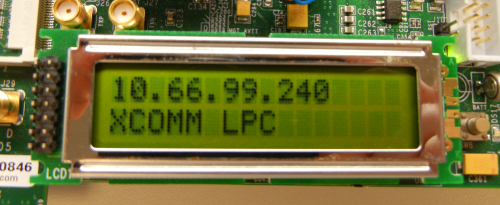
You should see the kernel start-up messages as follows:
Early console on uartlite at 0x40600000
bootconsole [earlyser0] enabled
Ramdisk addr 0x00000000,
Compiled-in FDT at 80323fe8
Linux version 3.17.0-126736-gdf1ca8f-dirty (michael@mhenneri-D04) (gcc version 4.8.3 20140131 (prerelease) (crosstool-NG 1.18.0) ) #1943 Wed Dec 17 11:03:18 CET 2014
setup_cpuinfo: initialising
setup_cpuinfo: Using full CPU PVR support
wt_msr_noirq
setup_memory: max_mapnr: 0x30000
setup_memory: min_low_pfn: 0x80000
setup_memory: max_low_pfn: 0xb0000
setup_memory: max_pfn: 0xb0000
Zone ranges:
  DMA      [mem 0x80000000-0xafffffff]
  Normal   empty
Movable zone start for each node
Early memory node ranges
  node   0: [mem 0x80000000-0xbfffffff]
On node 0 totalpages: 196608
free_area_init_node: node 0, pgdat 8040751c, node_mem_map 81000000
  DMA zone: 1536 pages used for memmap
  DMA zone: 0 pages reserved
  DMA zone: 196608 pages, LIFO batch:31
early_printk_console remapping from 0x40600000 to 0xffffd000
pcpu-alloc: s0 r0 d32768 u32768 alloc=1\*32768
pcpu-alloc: [0] 0
Built 1 zonelists in Zone order, mobility grouping on.  Total pages: 195072
Kernel command line: console=ttyUL0,115200
PID hash table entries: 4096 (order: 2, 16384 bytes)
Dentry cache hash table entries: 131072 (order: 7, 524288 bytes)
Inode-cache hash table entries: 65536 (order: 6, 262144 bytes)
Memory: 768436K/786432K available (3215K kernel code, 148K rwdata, 724K rodata, 5988K init, 86K bss, 17996K reserved)
Kernel virtual memory layout:
  * 0xffffe000..0xfffff000  : fixmap
  * 0xffffd000..0xffffe000  : early ioremap
  * 0xb0000000..0xffffd000  : vmalloc & ioremap
NR_IRQS:128
/axi@0/axi-intc@41200000: num_irq=21, edge=0x3810
/axi@0/axi-timer@41c00000: irq=1
xilinx_timer_set_mode: shutdown
xilinx_timer_set_mode: periodic
sched_clock: 32 bits at 99MHz, resolution 10ns, wraps every 43383508981ns
Calibrating delay loop... 48.94 BogoMIPS (lpj=244736)
pid_max: default: 32768 minimum: 301
Mount-cache hash table entries: 2048 (order: 1, 8192 bytes)
Mountpoint-cache hash table entries: 2048 (order: 1, 8192 bytes)
devtmpfs: initialized
regulator-dummy: no parameters
NET: Registered protocol family 16
Switched to clocksource xilinx_clocksource
xilinx_timer_set_mode: oneshot
NET: Registered protocol family 2
TCP established hash table entries: 8192 (order: 3, 32768 bytes)
TCP bind hash table entries: 8192 (order: 3, 32768 bytes)
TCP: Hash tables configured (established 8192 bind 8192)
TCP: reno registered
UDP hash table entries: 512 (order: 1, 8192 bytes)
UDP-Lite hash table entries: 512 (order: 1, 8192 bytes)
NET: Registered protocol family 1
RPC: Registered named UNIX socket transport module.
RPC: Registered udp transport module.
RPC: Registered tcp transport module.
RPC: Registered tcp NFSv4.1 backchannel transport module.
XGpio: /axi@0/gpio@40020000: registered, base is 243
XGpio: /axi@0/gpio@40020000: dual channel registered, base is 235
Skipping unavailable RESET gpio -2 (reset)
futex hash table entries: 256 (order: -1, 3072 bytes)
jffs2: version 2.2. (NAND) (SUMMARY)  © 2001-2006 Red Hat, Inc.
msgmni has been set to 1500
Block layer SCSI generic (bsg) driver version 0.4 loaded (major 253)
io scheduler noop registered
io scheduler deadline registered
io scheduler cfq registered (default)
Serial: 8250/16550 driver, 4 ports, IRQ sharing disabled
40600000.serial: ttyUL0 at MMIO 0x40600000 (irq = 4, base_baud = 0) is a uartlite
console [ttyUL0] enabled
console [ttyUL0] enabled
bootconsole [earlyser0] disabled
bootconsole [earlyser0] disabled
brd: module loaded
Xilinx SystemACE device driver, major=254
xilinx_lcd 40010000.gpio_lcd: Device Tree Probing 'gpio_lcd'
xilinx_lcd 40010000.gpio_lcd: LCD 0x40010000 mapped to 0xb0140000
xilinx_spi 44a70000.axi-quad-spi: at 0x44A70000 mapped to 0xb0160000, irq=13
libphy: Fixed MDIO Bus: probed
xilinx_emaclite 40e00000.network: Device Tree Probing
libphy: Xilinx Emaclite MDIO: probed
xilinx_emaclite 40e00000.network: MAC address is now 00:0a:35:00:00:10
xilinx_emaclite 40e00000.network: Xilinx EmacLite at 0x40E00000 mapped to 0xB0034000, irq=2
i2c /dev entries driver
i2c i2c-0: Added multiplexed i2c bus 1
at24 2-0050: 256 byte 24c02 EEPROM, writable, 1 bytes/write
at24 2-0054: 256 byte 24c02 EEPROM, writable, 1 bytes/write
i2c i2c-0: Added multiplexed i2c bus 2
i2c i2c-0: Added multiplexed i2c bus 3
i2c i2c-0: Added multiplexed i2c bus 4
i2c i2c-0: Added multiplexed i2c bus 5
i2c i2c-0: Added multiplexed i2c bus 6
i2c i2c-0: Added multiplexed i2c bus 7
i2c i2c-0: Added multiplexed i2c bus 8
pca954x 0-0074: registered 8 multiplexed busses for I2C switch pca9548
platform 44a10000.axi-ad9250-hpc-0: Driver cf_axi_adc requests probe deferral
platform 44a20000.axi-ad9250-hpc-1: Driver cf_axi_adc requests probe deferral
spi spi32765.2: Driver ad9467 requests probe deferral
spi spi32765.3: Driver ad9467 requests probe deferral
platform 44a91000.axi-jesd204b-rx: Driver cf_axi_jesd204b_v51 requests probe deferral
platform 44a60000.axi-jesd-gt-rx-tx: Driver cf_axi_jesd204b_gt requests probe deferral
ad9517 spi32765.1: probed
TCP: cubic registered
NET: Registered protocol family 17
platform 44a10000.axi-ad9250-hpc-0: Driver cf_axi_adc requests probe deferral
platform 44a20000.axi-ad9250-hpc-1: Driver cf_axi_adc requests probe deferral
spi spi32765.2: Driver ad9467 requests probe deferral
spi spi32765.3: Driver ad9467 requests probe deferral
platform 44a91000.axi-jesd204b-rx: Driver cf_axi_jesd204b_v51 requests probe deferral
cf_axi_jesd204b_gt 44a60000.axi-jesd-gt-rx-tx: AXI-JESD204B (6.00.b) at 0x44A60000 mapped to 0xb01a0000,
platform 44a10000.axi-ad9250-hpc-0: Driver cf_axi_adc requests probe deferral
platform 44a20000.axi-ad9250-hpc-1: Driver cf_axi_adc requests probe deferral
spi spi32765.2: Driver ad9467 requests probe deferral
spi spi32765.3: Driver ad9467 requests probe deferral
cf_axi_jesd204b_v51 44a91000.axi-jesd204b-rx: AXI-JESD204B 5.2 Rev 1, at 0x44A91000 mapped to 0xb0032000,
platform 44a10000.axi-ad9250-hpc-0: Driver cf_axi_adc requests probe deferral
platform 44a20000.axi-ad9250-hpc-1: Driver cf_axi_adc requests probe deferral
ad9467 spi32765.2: AD9250 PLL LOCKED, JESD204B Link Ready
ad9467 spi32765.3: AD9250 PLL LOCKED, JESD204B Link Ready
cf_axi_adc 44a10000.axi-ad9250-hpc-0: ADI AIM (8.00.b) at 0x44A10000 mapped to 0xb01e0000, probed ADC AD9250 as MASTER
cf_axi_adc 44a20000.axi-ad9250-hpc-1: ADI AIM (8.00.b) at 0x44A20000 mapped to 0xb0200000, probed ADC AD9250 as MASTER
Freeing unused kernel memory: 5988K (80409000 - 809e2000)
Starting logging: OK
Starting network...
Starting network...
udhcpc (v1.22.1) started
Sending discover...
xilinx_emaclite 40e00000.network eth0: Link is Down
Sending discover...
xilinx_emaclite 40e00000.network eth0: Link is Up - 100Mbps/Full - flow control off
Sending discover...
Sending select for 10.44.2.153...
Lease of 10.44.2.153 obtained, lease time 86400
deleting routers
adding dns 10.32.51.110
adding dns 10.64.53.110
random: ssh-keygen urandom read with 45 bits of entropy available
Starting sshd: OK
Starting IIO Server Daemon: OK


Welcome to Buildroot

buildroot login:
IIO Oscilloscope Remote
Please see also here: IIO Oscilloscope
The IIO Oscilloscope application can be used to connect to another platform that has a connected device in order to configure the device and read data from it.
Build and start osc on a network-enabled Linux host.
Once the application is launched, go to Settings -> Connect and enter the IP address of the target in the popup window.