Jupiter vs. Pluto
A common question is: “How does Jupiter differ from Pluto?” Pluto (ADALM-PLUTO) is a software-defined radio platform that is geared toward flexibility and teaching electrical engineering topics like SDR, RF, and communications. The PlutoSDR is self-contained and is entirely USB-powered with the default firmware. It comes in at about $300 and is based on the AD9363 transceiver and the Zynq Z-7010 SoC. In contrast, the Jupiter SDR is about $4k, has a more powerful SoC, and allows for multiple-unit synchronization, where the Pluto does not. Another difference is that Pluto is more customizable, allowing easier changes to the LOs. While Pluto is typically used for education, Jupiter is typically used for industry applications in aerospace, defense, and communications.
Feature |
AD-JUPITER-EBZ |
ADALM-PLUTO |
|---|---|---|
Transceiver |
ADRV9002 |
AD9363 |
Multi-Chip Sync |
Yes |
No |
DPD |
Yes |
No |
Channels |
2Tx / 2Rx |
1Tx / 1Rx |
Frequency Range |
30 MHz – 6 GHz |
325 MHz – 3.8 GHz |
IBW |
12 KHz – 40 MHz |
200 kHz - 20 MHz |
FPGA/SoC |
Zynq Ultrascale+ MPSoC |
Zynq Z-7010 |
Form Factor |
Ruggedized aluminum case |
Small USB dongle |
Power |
USB-C or PoE |
USB |
When should I choose Jupiter?
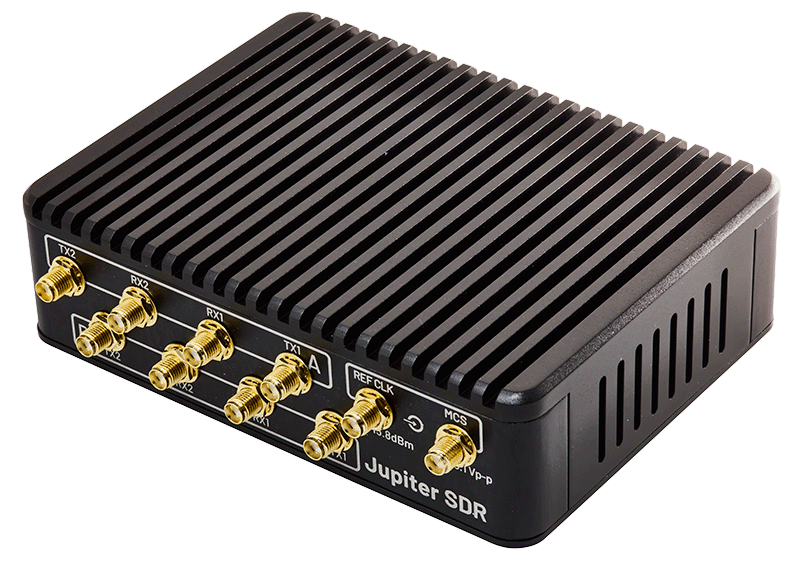
Jupiter is a good choice if you:
Need multi‑channel or multi‑device coherent operation
Are experimenting with beamforming, MIMO, or spatial processing
Require deterministic timing and synchronization
Are prototyping systems for aerospace, defense, or communications
Need higher RF performance and system scalability
When should I choose Pluto?
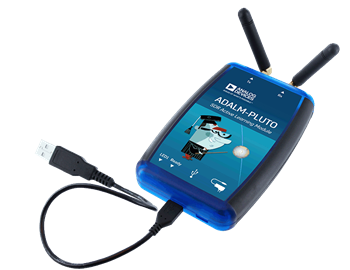
Pluto is a good choice if you:
Are learning SDR, RF, or communications concepts
Need a low‑cost, portable SDR
Want a simple USB‑powered setup
Are developing or teaching basic waveforms and protocols
Do not require multi‑device synchronization or coherence
Note
For questions or help with the Jupiter SDR, please visit:
EngineerZone