AD-FMCOMMS1-EBZ (Obsolete)
Warning
Analog Devices uses six designations to inform our customers where a semiconductor product is in its life cycle. From emerging innovations to products which have been in production for twenty years, we understand that insight into life cycle status is important. Device life cycles are tracked on their individual product pages on analog.com, and should always be consulted before making any design decisions.
This particular article/document/design has been retired or deprecated, which means it is no longer maintained or actively updated, even though the devices themselves may be Recommended for New Designs or in Production. This page is here for historical/reference purposes only.
Warning
Last stable version for Vivado 2015.4: hdl_2016_r1
Overview
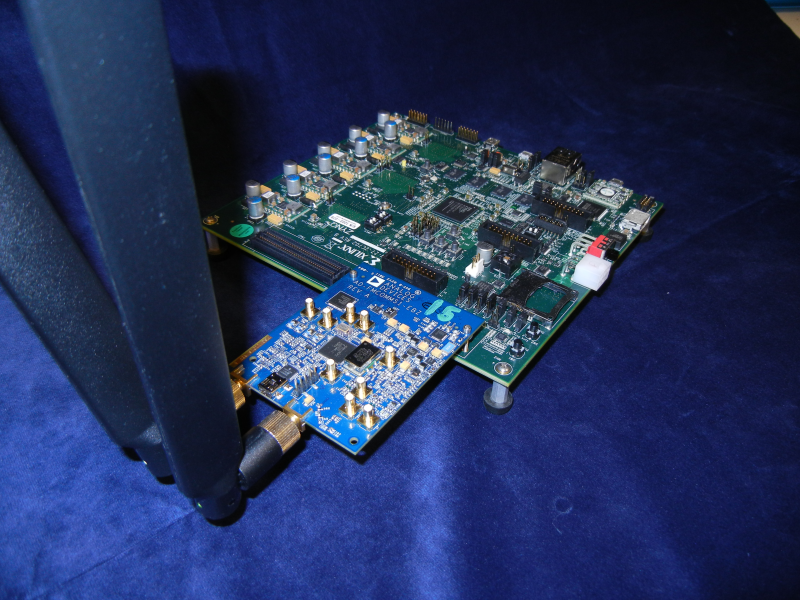
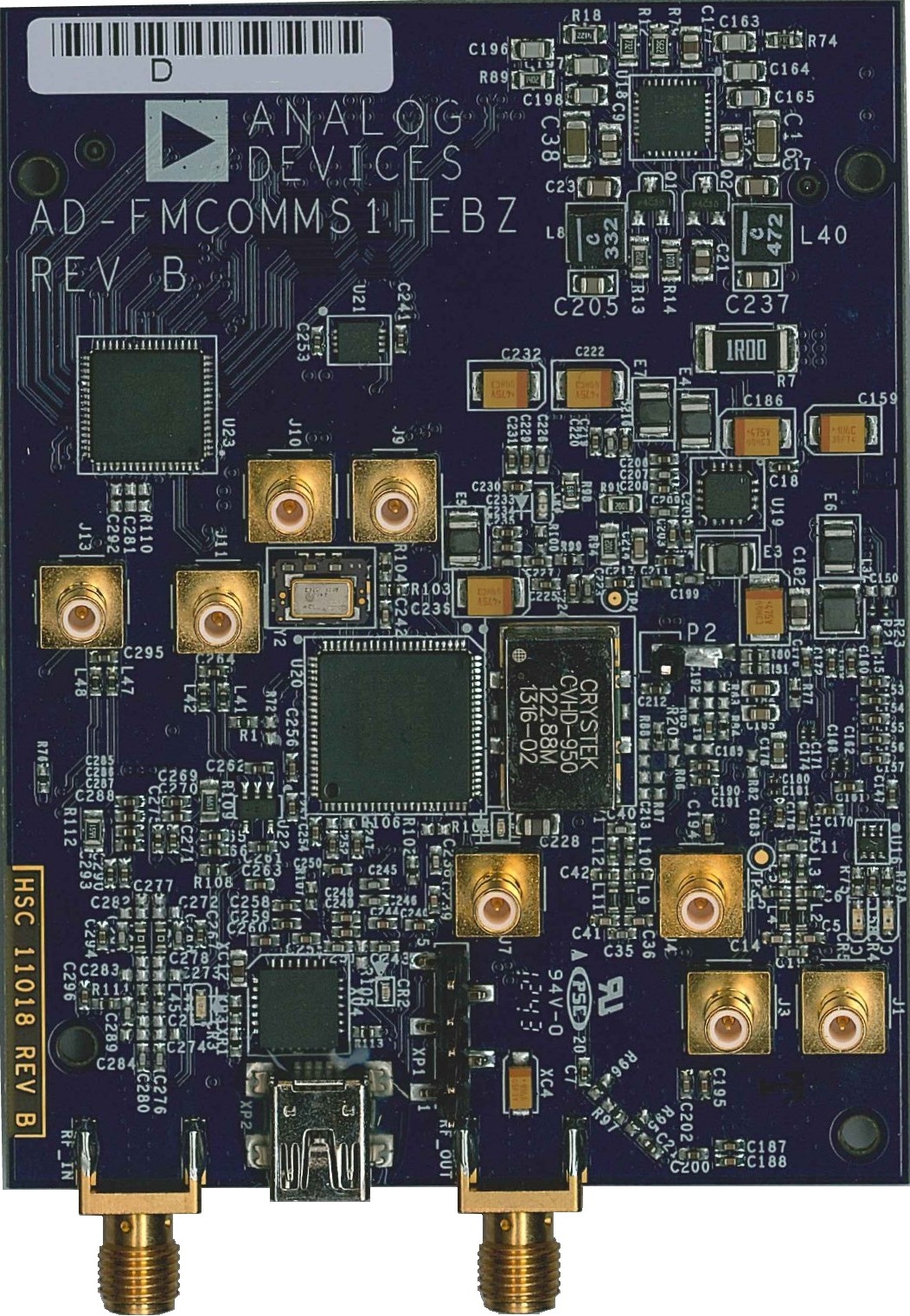
The AD-FMCOMMS1-EBZ high-speed analog module is designed to showcase the latest generation high-speed data converters. It provides the analog front-end for a wide range of compute-intensive FPGA-based radio applications.
The AD-FMCOMMS1-EBZ is an analog front end hardware platform that addresses a broad range of research, academic, industrial and defense applications. It enables RF applications from 400 MHz to 4 GHz. The module is customizable to a wide range of frequencies by software without any hardware changes, providing options for GPS or IEEE 1588 Synchronization, and MIMO configurations.
When combined with the Xilinx ZYNQ® Software-Defined Radio Kit, AD-FMCOMMS1-EBZ enables a variety of wireless communications functions at the physical layer, from baseband to RF. With up to 4 GB of flash storage space, 512 MB of RAM, Gigabit Ethernet interface (depending on the base platform) and a Linux image built specifically for the AD-FMCOMMS1-EBZ, you can get everything you need for a easy out of the box experience. The platform offers enough flexibility for many applications, and supports streaming data, and standard web interfaces to analyze transmitted RF data.
Warning
The AD-FMCOMMS1-EBZ FMC Card is not fully ANSI/VITA 57.1 compatible:
does not meet the mechanical form factor (too tall, too long),
It was designed, and meets the needs of prototyping platforms, and will work with FPGA Development systems which include an FMC connector. It may not mechanically fit on other ANSI/VITA 57.1 carrier cards.
Features:
General purpose design suitable for any application
Software tunable across wide frequency range (400 MHz to 4 GHz) with 125 MHz channel bandwidth (250 MSPS ADC, 1 GSPS DAC)
RF section bypass for baseband sampling
Phase and frequency synchronization on both transmit and receive paths
Allows high channel density
LPC FMC compatible, meets VITA specifications except card length
Powered from single FMC connector
Supports MIMO radio, with less than 1 sample sync on both ADC and DAC
Includes schematics, layout, BOM, HDL, Linux drivers and application software
Common I2C access for all device registers
Applications:
Wireless communications demonstration and learning tool
Remote radio head
Software-defined radio
Satellite modems
Test and measurement equipment
Radar and advanced imaging
General purpose data acquisition
Recommendations
People who follow the flow that is outlined, have a much better experience with things. However, like many things, documentation is never as complete as it should be. If you have any questions, check the Help and Support page.
To better understand the AD-FMCOMMS1-EBZ, we recommend reading the Functional Overview.
Table of contents
Introduction
Hardware (including schematics)
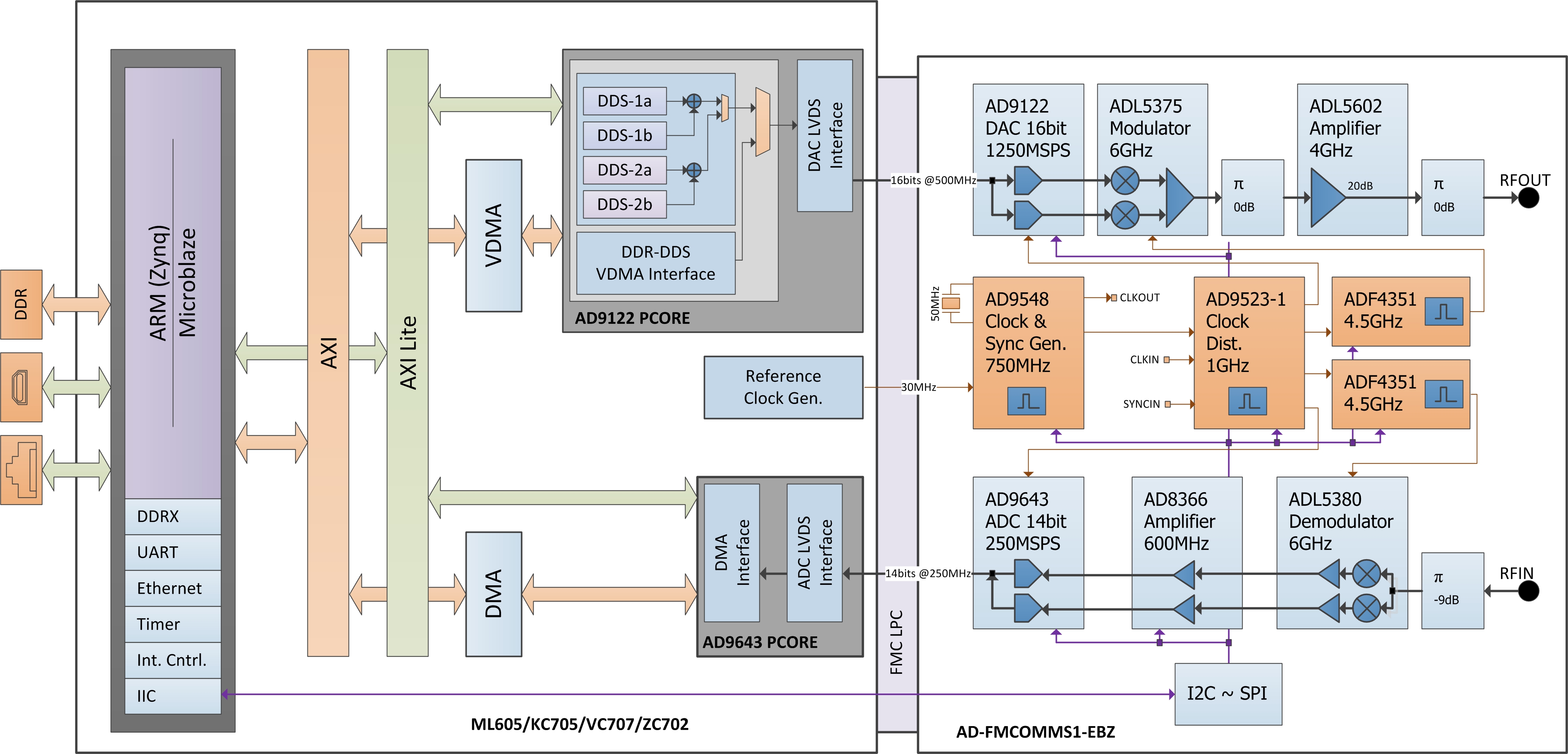
Block diagram
ADI Documentation on SDR Signal Chains
Warning
All the products described on this page include ESD (electrostatic discharge) sensitive devices. Electrostatic charges as high as 4000V readily accumulate on the human body or test equipment and can discharge without detection. Although the boards feature ESD protection circuitry, permanent damage may occur on devices subjected to high-energy electrostatic discharges. Therefore, proper ESD precautions are recommended to avoid performance degradation or loss of functionality. This includes removing static charge on external equipment, cables, or antennas before connecting to the device.
Help and support
Please go to Help and Support page.