AD-FMCOMMS5-EBZ
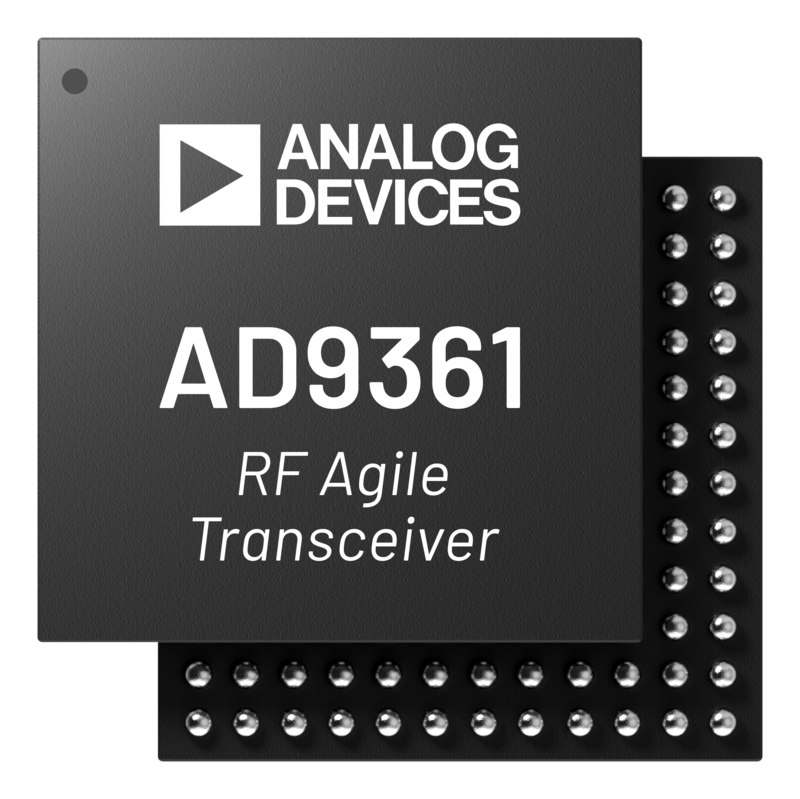
For many Broadband Wireless Access (BWA) systems, Multi Input – Multi Output (SIMO / MISO / SU-MIMO / MU-MIMO) operation and RF beamforming are proven techniques for maximizing throughput and efficient spectrum utilization. Modern integrated devices with multi-channel RX and multi-channel TX capability such as the AD9361 make developing MIMO systems with high performance and linearity utilizing integrated receivers, transmitters, and synthesizers a simpler task.
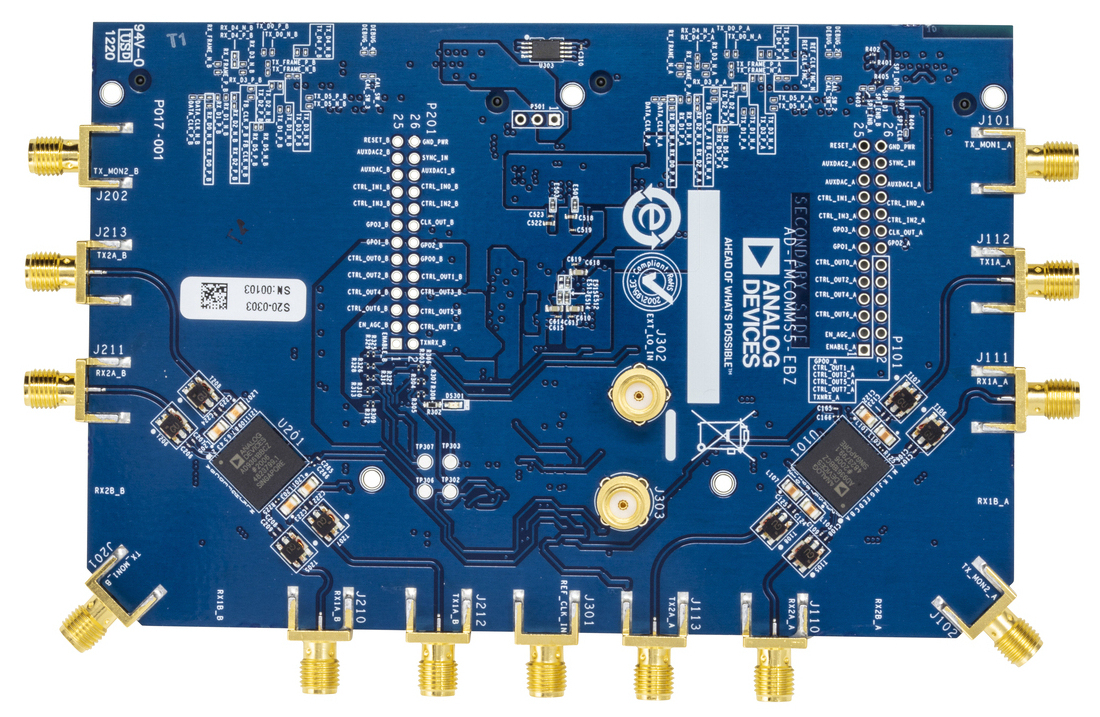
Some systems may require more complex configurations that combine multiple devices. Operating multiple devices while trying to coordinate data for each channel of each device is not practical for devices that operate independently without any mechanism for aligning data timing. Data synchronization into and out of multiple devices is required to implement such configurations. The AD-FMComms5-EBZ is a FMC board for the AD9361, a highly integrated RF Agile Transceiver™, which demonstrates how to design a platform based on multiple devices.
For MIMO systems requiring more than two input or two output channels, multiple AD9361 devices and a common reference oscillator are required. The AD9361 provides the capability to accept an external reference clock and synchronize operation with other devices using simple control logic. Each AD9361 includes its own baseband PLL that generates sampling and data clocks from the reference clock input, so an additional control mechanism is required to synchronize multiple devices.
The complete chip level design package can be found on the the ADI web site. Information on the card, and how to use it, the design package that surrounds it, and the software which can make it work, can be found below in the Table of Contents.
The purpose of the AD-FMCOMMS5-EBZ is to provide a platform to which shows how to connect and synchronize (at the RF side) multiple AD9361s for SIMO / MISO / SU-MIMO / MU-MIMO applications. To help with algorithm array processing development, there are a variety of things that can be done, from purchasing complete solutions:
To creating your own with something like Phased Array System Toolbox.
If you are just starting a design, or investigating the AD9361 for the first time, it’s suggested to get familiar with the single AD9361 based platforms (AD-FMCOMMS2-EBZ or AD-FMCOMMS3-EBZ) first.
Note that the AD-FMCOMMS5-EBZ uses a dual FMC connector. This means the base board requires two adjacent FMC connectors. Suitable base boards for example are ZC702, ZC706, and ZCU102.
User Guide
Table of Contents
Hardware
Use the AD-FMCOMMS5-EBZ Board to better understand the AD9361
Linux Applications
Push custom data into/out of the AD-FMCOMMS5-EBZ
Design with the AD9361
Simulation
Hardware in the Loop / How to design your own custom BaseBand
MATLAB/Simulink Examples
FM Radio/Tuner (listen to FM signals on the HDMI monitor)
Design a custom AD9361 based platform
HDL Reference Design which you must use in your FPGA.
Additional Documentation about SDR Signal Chains
Presentations
Developing Multiple-Input Multiple-Output (MIMO) Systems with the AD9361 As Software Defined Radio (SDR) and Multiple-Input Multiple-Output (MIMO) become more prevalent there is a need for more channel diversity. This webcast will detail how to use multiple AD9361 devices to create an NxN MIMO system, as well as explore the available tradeoffs in the design. The AD9361 is a fully integrated 2x2 MIMO transceiver. Its programmability and wideband capability make it ideal for a broad range of transceiver applications.
Warning
All the products described on this page include ESD (electrostatic discharge) sensitive devices. Electrostatic charges as high as 4000V readily accumulate on the human body or test equipment and can discharge without detection. Although the boards feature ESD protection circuitry, permanent damage may occur on devices subjected to high-energy electrostatic discharges. Therefore, proper ESD precautions are recommended to avoid performance degradation or loss of functionality. This includes removing static charge on external equipment, cables, or antennas before connecting to the device.