AD-FMCADC2-EBZ (Obsolete)
12-Bit, 2500 MSPS, JESD204B, RF Data Acquisition FMC Board.
Warning
The AD-FMCADC2-EBZ is a legacy product and is no longer actively supported. This documentation is provided for reference only.
Note
Support was discontinued starting with the 2022_R2 Kuiper Linux release. The last release with pre-built files is 2021_r2 - see all releases at ADI kuiper repository (releases). HDL source code is available on the hdl_2021_r2 branch.
Overview
The AD-FMCADC2-EBZ is a high speed single channel data acquisition board featuring the AD9625 12-bit ADC at 2500 MSPS, in an FMC form factor which supports the JESD204B high speed serial interface.
Although this board does meet most of the FMC specifications, it is not meant as a commercial off the shelf (COTS) board. If a commercial, ready-to-integrate product is required, please refer to one of the many FMC manufacturers.
ADI provides reference designs (HDL and software) for this board to work with commonly available Xilinx development boards.
The card contains:
AD9625 12-bit single channel ADC with sampling speeds of up to 2500 MSPS, with a JESD204B digital interface.
ADP7104 - 20V, 500mA, low noise, CMOS LDO
ADP1753 - low dropout linear regulator, 1.6V to 3.6V, up to 800mA
ADP2119 - 2A, 1.2MHz, synchronous step-down DC-to-DC regulator
ADP1741 - 2A, low Vin, low dropout, CMOS linear regulator
ADR280 - ultralow power, high PSRR voltage reference
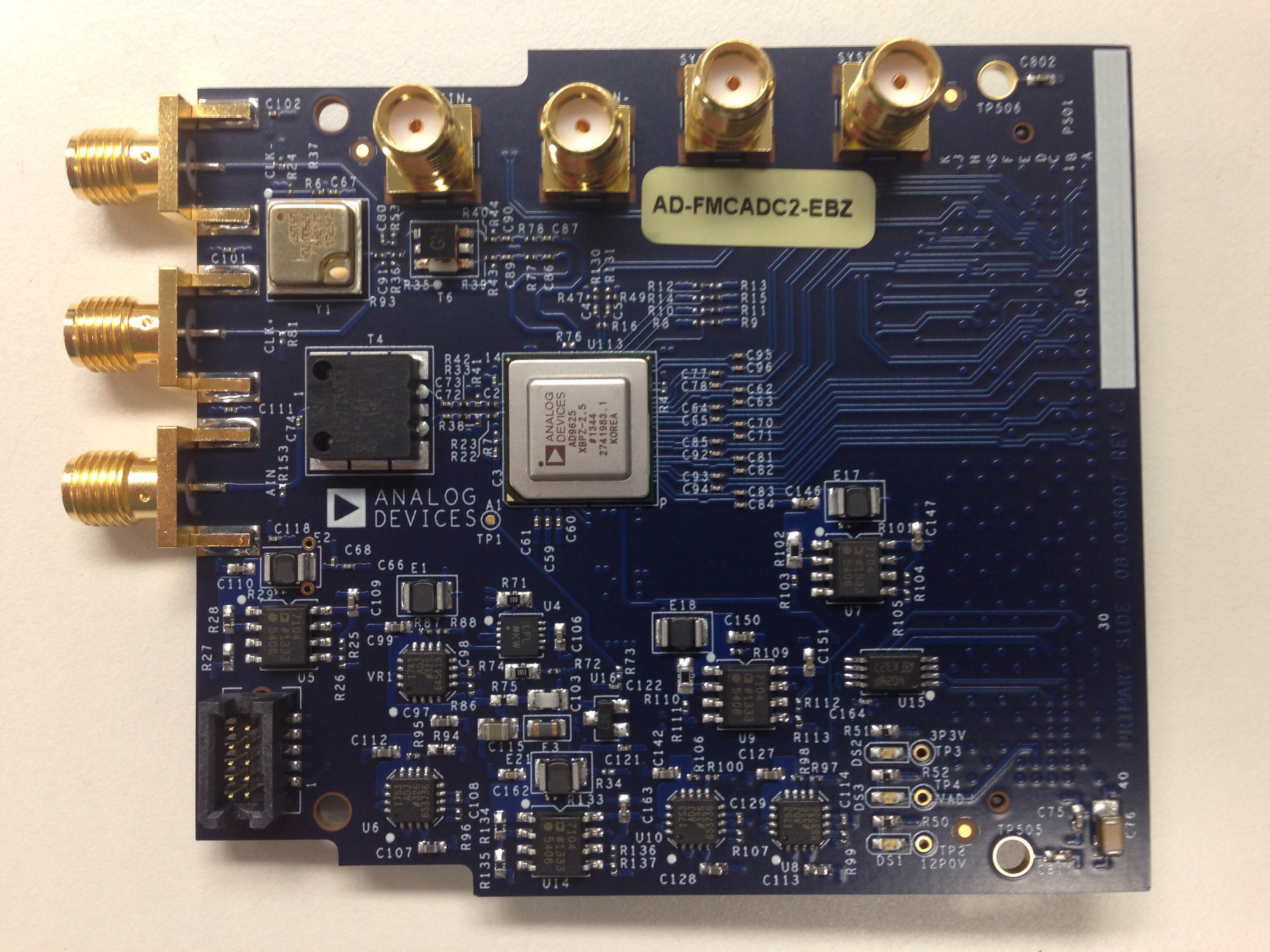
Features:
2500 MSPS sampling rate using the AD9625 with JESD204B high speed serial interface
Self-powered and self-clocked when connected to an FMC carrier
Multiple clocking options: on-board 2.5 GHz oscillator, external single-ended, or external differential clock
Passive wideband front end (500 kHz to 6 GHz balun)
SYSREF IN/OUT connectors for multi-board synchronization
Applications:
Instrumentation and measurement
Radar
Healthcare
Energy
Industrial automation
Recommendations
People who follow the flow that is outlined, have a much better experience with things. However, like many things, documentation is never as complete as it should be. If you have any questions, feel free to ask on our EngineerZone, but before that, please make sure you read our documentation thoroughly.
Table of contents
Using the evaluation board/full stack reference design that we offer:
Design with the AD9625
AD9625 product page
Resources for designing a custom AD9625-based platform:
For Linux software:
Warning
All the products described on this page include ESD (electrostatic discharge) sensitive devices. Electrostatic charges as high as 4000V readily accumulate on the human body or test equipment and can discharge without detection. Although the boards feature ESD protection circuitry, permanent damage may occur on devices subjected to high-energy electrostatic discharges. Therefore, proper ESD precautions are recommended to avoid performance degradation or loss of functionality. This includes removing static charge on external equipment, cables, or antennas before connecting to the device.