FMComms5 Plugin Description
The FMCOMMS5 plugin works with the IIO Oscilloscope. You always use the latest version if possible. Changing any field will immediately write changes which have been made to the FMComms5 settings to the hardware, and then read it back to make sure the setting is valid. If you want to set something that the GUI changes to a different number, that either means that GUI is rounding (sorry), or the hardware (either the AD9361 or the FPGA fabric) does not support that mode/precision.
Note
For the main OSC plot window: The allowed channel sections are based on following rules:
Channels need to enabled pairwise I & Q. (example voltage0 & voltage1 or voltage2 & voltage3, etc. )
The number of enabled pairwise channels need to be equal between the two devices.
Devices are split as following: voltage0..3 Device A, voltage4..7 Device B
If you want to go play with /sys/bus/iio/devices/.... and manipulate the
devices behind the back of the GUI, it’s still possible to see the settings by
clicking the “refresh” button at the bottom of the GUI.
If you think the device has a setting that isn’t managed by this tab, check out the fmcomms5 Advanced Plugin for the IIO Oscilloscope.
The FMComms5 view is divided in four sections:
Device Global Settings
Receive Chain
Transmit Chain
FPGA Settings
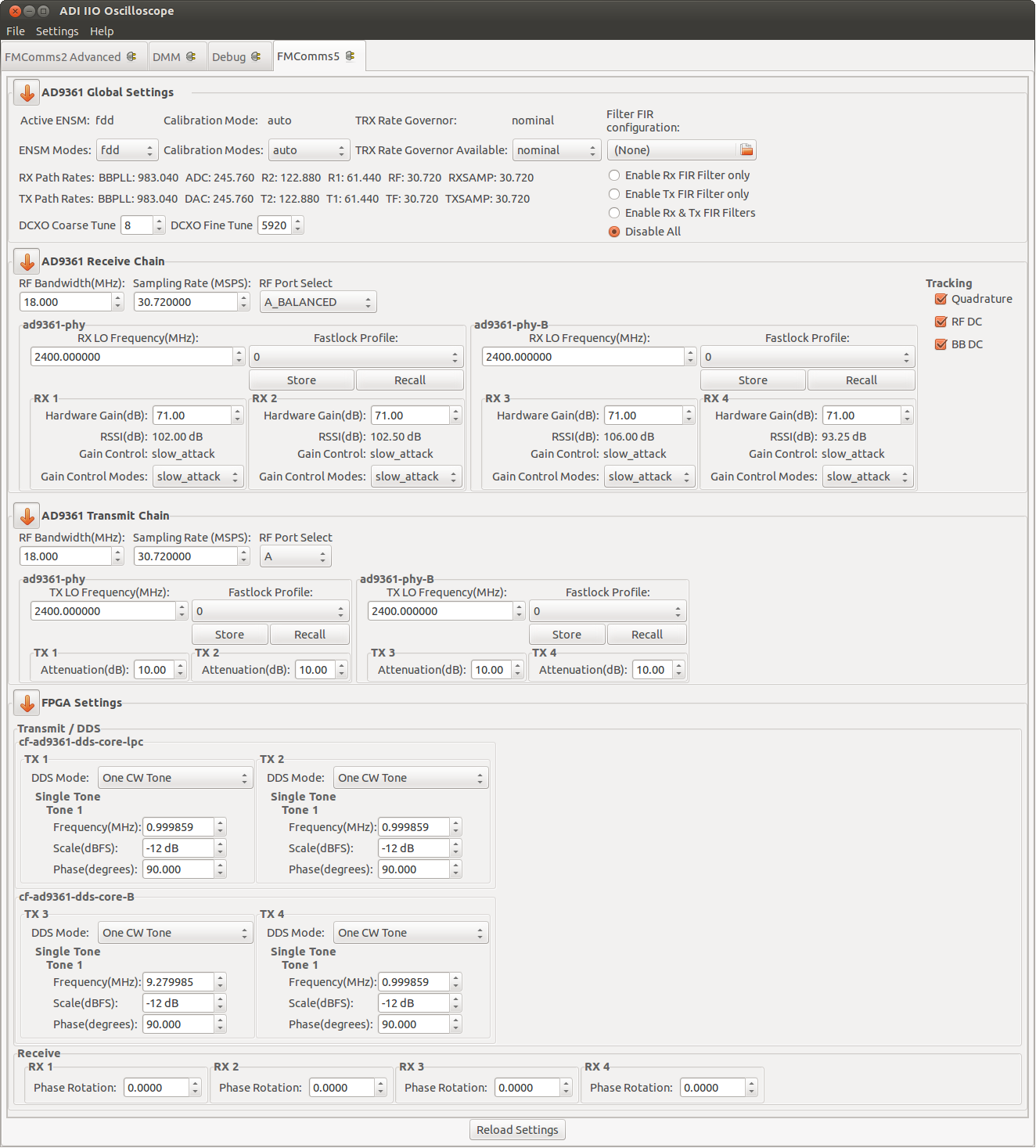
Device Global Settings
Active ENSM: Displays the active mode of the Enable State Machine. (see AD9361 linux driver documentation)
ENSM Modes: Selects one of the available modes: FDD and TDD. (see AD9361 linux driver documentation)
Calibration Mode: Displays the active calibration mode. (see AD9361 linux driver documentation)
Calibration Modes: Selects one of the available modes: auto, manual, rf_dc_offs and tx_quad. (see AD9361 linux driver documentation)
TRX Rate Governor: Displays the active option of the Rate Governors. (see AD9361 linux driver documentation)
TRX Rate Governor Available: Selects one of the available options: nominal and highest_osr. (see AD9361 linux driver documentation)
Filter FIR configuration
FIR parameters file chooser Allows a FIR filter configuration to be loaded from a file. (see AD9361 linux driver documentation)
Enable RX FIR Filter Only: Enables/Disables the FIR filter on RX path. (see AD9361 linux driver documentation)
Enable TX FIR Filter Only: Enables/Disables the FIR filter on TX path. (see AD9361 linux driver documentation)
Enable RX & TX FIR filters: Enables the FIR filter on both RX and TX paths.
Disable All: Disables the FIR filter on both RX and TX paths.
RX Path Rates: Lists the rates of: BBPLL, ADC, R2, R1, RF, RXSAMP. (see AD9361 linux driver documentation)
TX Path Rates: Lists the rates of: TXSAMP, TF, T1, T2, DAC, BBPLL. (see AD9361 linux driver documentation)
DCXO Coarse Tune: Selects the attribute for a coarse tune. (see AD9361 linux driver documentation)
DCXO Fine Tune: Selects the attribute for a fine tune. (see AD9361 linux driver documentation)
Note that all settings above apply to both ad9361 devices.
Receive Chain
RF Bandwidth(MHz): Configures RX analog filters: RX TIA LPF and RX BB LPF. (see AD9361 linux driver documentation)
Sampling Rate(MSPS): Selects the sample rate of the ADC. (see AD9361 linux driver documentation)
RF Port Select: Selects the RF Port of the receive channels. (see AD9361 linux driver documentation)
RX LO Frequency(MHz): Selects the RX local oscillator frequency. Range 70MHz to 6GHz with 1Hz tuning granularity. (see AD9361 linux driver documentation)
Fastlock Mode (see AD9361 linux driver documentation)
Fastlock Profile: Selects a profile to be stored or recalled.
Store: Stores the selected profile.
Recall: Recalls the selected profile.
Tracking (see AD9361 linux driver documentation)
Quadrature
RF DC
BB DC
RX
Hardware Gain(dB): Controls the RX gain only in Manual Gain Control Mode (MGC). (see AD9361 linux driver documentation)
RSSI(dB): Displays the received strength signal level. (see AD9361 linux driver documentation)
Gain Control: Displays the active gain mode. (see AD9361 linux driver documentation)
Gain Control Modes: Selects one of the available modes: manual, slow_attack, hybrid and fast_attack. (see AD9361 linux driver documentation)
Note that only RF Bandwidth, Sampling Rate, RF Port Select and Tracking settings apply to both ad9361 devices.
Transmit Chain
RF Bandwidth(MHz): Configures TX analog filters: TX BB LPF and TX Secondary LPF. (see AD9361 linux driver documentation)
Sampling Rate(MSPS): Selects the sample rate of the DAC. (see AD9361 linux driver documentation)
RF Port Select: Selects the RF Port of the transmit channels. (see AD9361 linux driver documentation)
TX LO Frequency(MHz): Selects the TX local oscillator frequency. Range 70MHz to 6GHz with 1Hz tuning granularity. (see AD9361 linux driver documentation)
Fastlock Mode (see AD9361 linux driver documentation)
Fastlock Profile: Selects a profile to be stored or recalled.
Store: Stores the selected profile.
Recall: Recalls the selected profile.
TX
Attenuation(dB): Individually controlls attenuation for TX1 and TX2. The range is from 0 to -89.75 dB in 0.25dB steps. (see AD9361 linux driver documentation)
Note that only RF Bandwidth, Sampling Rate and RF Port Select settings apply to both ad9361 devices.
FPGA Settings
Transmit/DDS
DDS Mode: Selects on the the available modes:
One CW Tone
Two CW Tones
Independent I/Q Control
DAC Buffer Output (Output a data file)
Disabled.
Tone
Frequency(MHz): Selects the frequency of the tone.
Scale: Selects the scale of the tone.
Phase(degrees): Selects the phase of the tone.
Receive
Phase Rotation : Selects the rotation phase of a RX