ADS-B Example Using libiio
Note
This page was migrated from the ADI Wiki.
Overview
This page documents an airplane tracking system using Automatic Dependent Surveillance – Broadcast (ADS-B) signals. The technology allows aircraft to broadcast their positions via satellite navigation at 1090 MHz, using the AD-FMCOMMS3-EBZ RF transceiver board with MATLAB and Simulink.
Signal Characteristics
Transmit Frequency: 1090 MHz
Modulation: Pulse Position Modulation (PPM)
Data Rate: 1 Mbit/s
Message Length: 56 μsec or 112 μsec
Error Detection: 24-bit CRC checksum
Requirements
Software
MATLAB 2014b or later with:
For the Simulink version, additionally:
Hardware
AD-FMCOMMS3-EBZ RF transceiver board
Xilinx development system (ZC706, ZC702, or Zedboard)
1090 MHz capable antenna (e.g., ADS-B Double 1/2 Wave Mobile Antenna)
Recent Zynq Linux image for the board
MATLAB Implementation
The ad9361_ModeS.m script performs three main operations:
Prepare the Mode S signal
Calculate the earth zone according to user input
Receive data via libiio and decode the ADS-B signals
The script supports two operating modes depending on how TX_LO_FREQ and RX_LO_FREQ are configured.
Pre-captured Data
In this mode, the transmitter and receiver use matching local oscillator frequencies for controlled testing. Any LO frequency supported by the board is acceptable.
[rssi1,rssi2]=ad9361_ModeS('ip','pre-captured',channel);
For example, to receive pre-captured data on Channel 2:
[rssi1,rssi2]=ad9361_ModeS('192.168.10.2','pre-captured',2);
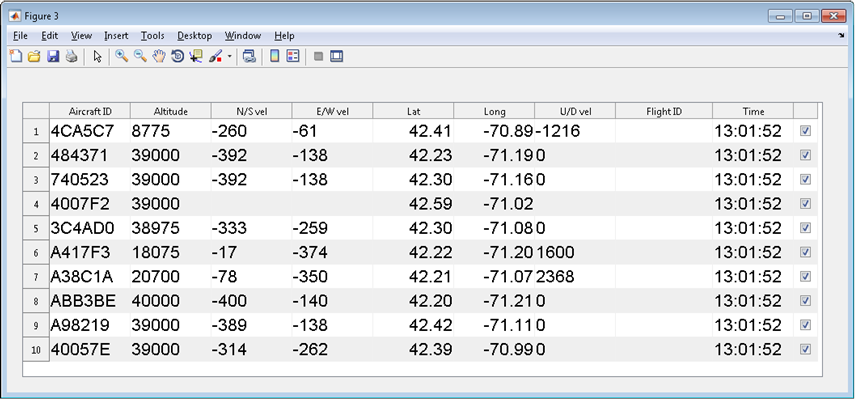
At the end of the simulation, RSSI values for both channels are shown in the command window along with a result table listing decoded aircraft information:
Live Data
In this mode, the receiver operates at 1090 MHz to capture real aircraft signals. TX_LO_FREQ must be set far from 1090 MHz to avoid interference. With a proper antenna, the system can decode signals from aircraft within approximately 80 miles.
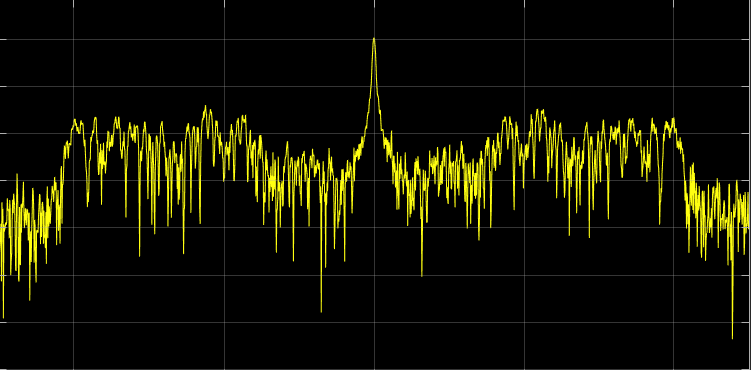
[rssi1,rssi2]=ad9361_ModeS('ip','live',channel);
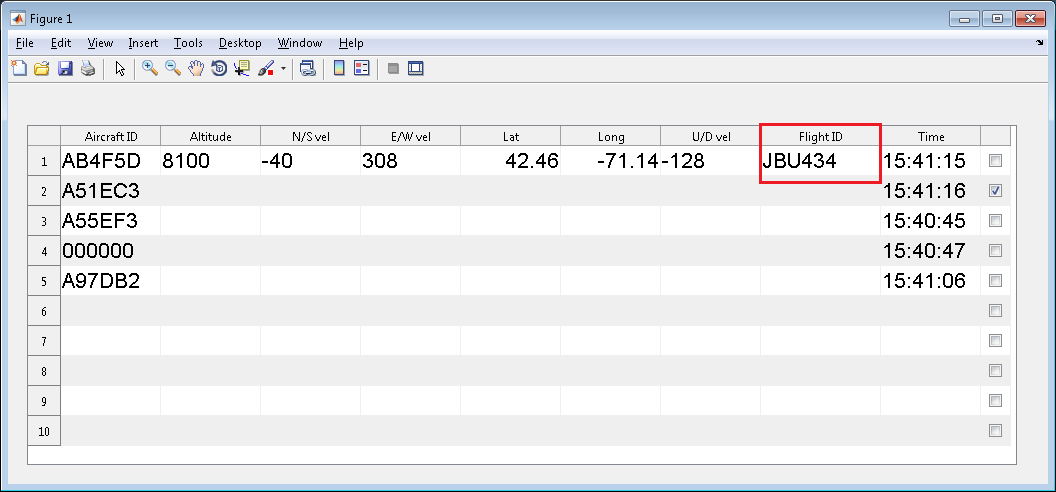
The result table below shows decoded real-world aircraft information. With a proper antenna, this model is able to capture and decode aircraft signals in an 80 miles range with FMCOMMS3. Since there are two types of Mode S messages (56 usec or 112 usec), some messages contain more information than others.
Simulink Implementation
The Simulink model ModeS_Simulink_libiio.slx extends the original
MathWorks ADS-B example by adding an IIO System object block
(iio_sys_obj) for hardware-in-the-loop signal reception. The signal
detection and decoding subsystem is adapted directly from the MathWorks
reference implementation.
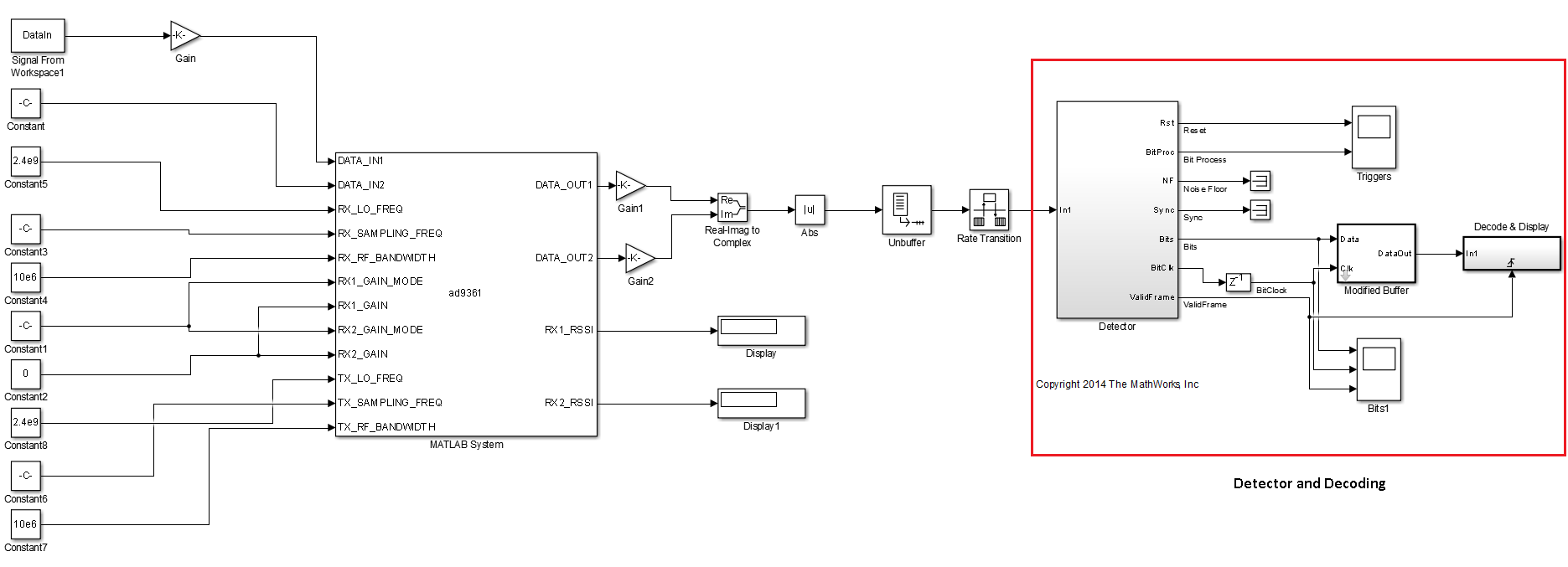
To make the original model compatible with the IIO System object (which operates in buffer mode), two additional blocks are inserted:
unbuffer — converts the buffer output to frame size = 1
rate transition — adjusts sample time to 1
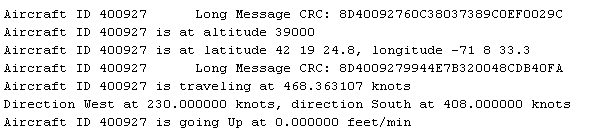
The model supports the same pre-captured and live data modes as the MATLAB version. Output is displayed in text format in the command window (versus the table format used in the MATLAB version):
Support
For questions about FMCOMMS3, AD9361, or libiio, please ask on the EngineerZone. ADI Support
For questions about the ADS-B algorithm, please contact MathWorks. MathWorks Support